
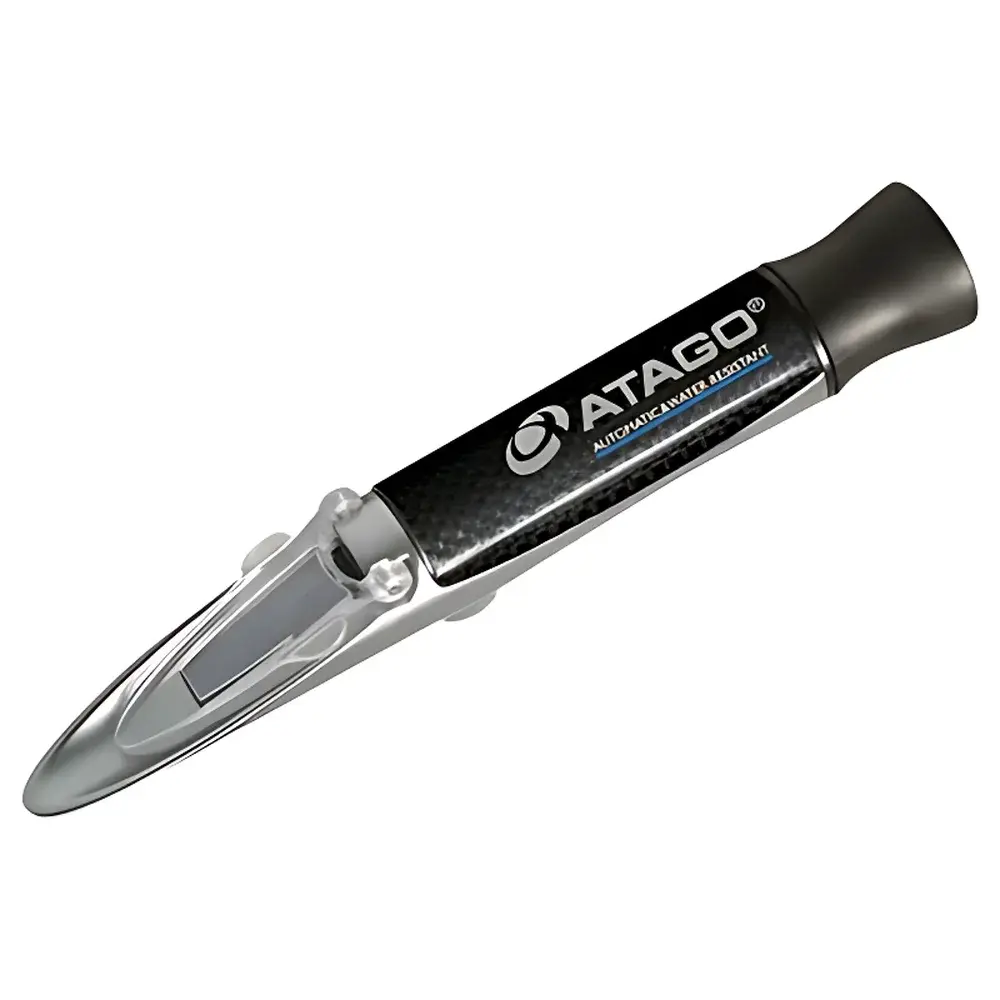
ATAGO MASTER Series Handheld Refractometer
| Brand | ATAGO |
|---|---|
| Origin | Japan |
| Model Series | MASTER |
| IP Rating | IP65 (α, H, T series) |
| Temperature Compensation | Automatic (α, T, H series) |
| Sample Volume | 2–3 drops |
| Prism Cleaning | Rinseable with flowing water |
| Ergonomic Design | Antimicrobial textured grip |
| Compliance | Conforms to JIS Z 8807 (Refractometry), ISO 21748 (Reference materials for refractometer calibration) |
| Measurement Principle | Critical angle of total internal reflection through high-precision optical prism |
Overview
The ATAGO MASTER Series Handheld Refractometer is a precision optical instrument engineered for rapid, field-deployable measurement of refractive index (nD) and derived concentration units—including Brix (% w/w sucrose), sodium chloride (% NaCl), battery electrolyte specific gravity (SG), coolant glycol concentration, seawater salinity (ppt), and specialized scales for honey, ethanol, and industrial fluids. Based on the fundamental optical principle of total internal reflection at the prism-sample interface, the MASTER Series determines refractive index by precisely locating the critical angle boundary between light transmission and cutoff—converted in real time to user-selectable concentration scales via calibrated optical path geometry and temperature-compensated algorithms. Designed for reliability in demanding environments—from food processing lines and beverage QC labs to marine maintenance docks and automotive service bays—the MASTER Series delivers consistent, operator-independent results without external power or software dependency.
Key Features
- Optical precision: High-stability borosilicate glass prism with anti-scratch AR coating ensures long-term calibration stability and resistance to chemical etching from acidic, alkaline, or solvent-based samples.
- IP65-rated enclosure (α, T, H models): Dust-tight and protected against low-pressure water jets—enabling safe rinsing of the sample stage under running water and operation in humid or splash-prone settings.
- Automatic Temperature Compensation (ATC): Integrated bi-metallic thermal sensor dynamically adjusts scale readout across 10–40 °C (50–104 °F), eliminating manual correction tables and reducing measurement uncertainty caused by ambient thermal drift.
- Auto-Sample Dispersion (ASD) design: Patented spoon-shaped sample well guides 2–3 drops of liquid to uniformly coat the entire prism surface without requiring a cover plate—minimizing air bubbles, improving repeatability, and accelerating workflow.
- Ergonomic antimicrobial grip: Textured, non-slip housing with silver-ion infused polymer inhibits microbial colonization during frequent handling in hygiene-critical environments such as dairy farms, breweries, and clinical labs.
- Zero-maintenance optics: No batteries, no firmware updates, no moving parts—operational readiness is guaranteed upon unpacking, with calibration verification possible using distilled water (nD = 1.3330 at 20 °C) or certified ATAGO reference standards.
Sample Compatibility & Compliance
The MASTER Series accommodates aqueous solutions, viscous liquids (e.g., honey, syrup), and moderately aggressive media (e.g., coolants, battery acid, brines) without prism degradation when cleaned per ATAGO protocol. All α-, T-, and H-series models comply with JIS Z 8807:2015 for refractometer performance evaluation and support traceable calibration per ISO/IEC 17025-accredited laboratories. While not intended for regulated GxP environments requiring electronic audit trails, MASTER instruments are routinely deployed in GLP-aligned food safety programs (e.g., Codex Alimentarius Annexes), ISO 22000-certified production facilities, and ASTM D115-22 (coolant analysis) workflows. For pharmaceutical excipient testing, the MASTER-RI model provides direct nD readout compliant with USP refractive index specifications.
Software & Data Management
As an analog optical instrument, the MASTER Series does not incorporate digital connectivity, firmware, or onboard data storage. Readings are interpreted visually via high-contrast reticle eyepiece with parallax-free focusing. For documentation purposes, users may record values manually or integrate with external digital systems via ATAGO’s optional digital adapters (e.g., PAL series interfaces). Calibration records—including date, standard used (e.g., ATAGO RS-1001), and technician ID—should be maintained per internal QA procedures. No FDA 21 CFR Part 11 compliance is applicable due to absence of electronic records or signatures.
Applications
- Food & Beverage: Brix verification in fruit juices, jams, and soft drinks; salt concentration in pickling brines and soy sauce; honey purity screening (HHR-2N scale).
- Automotive & Industrial: Glycol concentration in engine coolants (MASTER-BR); specific gravity of lead-acid battery electrolyte (MASTER-BC); antifreeze freeze point estimation.
- Aquaculture & Marine: Seawater salinity (MASTER-S/Millα) and brackish water management; aquarium system monitoring.
- Chemical & Manufacturing: Ethanol content in sanitizers (AL-21α); concentration control of cleaning agents, plating baths, and cutting fluids.
- Education & Field Service: Portable teaching tool for optical physics principles; on-site verification in HVAC, refrigeration, and agricultural extension services.
FAQ
Does the MASTER Series require periodic recalibration?
Yes—calibration should be verified before each use session using distilled water or a certified ATAGO reference standard. Recalibration is performed manually via the adjustment screw located beneath the eyepiece cap.
Can the MASTER measure hot samples?
The H-series models (e.g., MASTER-50H, MASTER-100H) feature heat-resistant prisms rated up to 100 °C and are specifically designed for direct measurement of steam-condensate, pasteurized milk, or hot syrup without cooling delay.
Is the prism surface scratch-resistant?
The optical prism uses hardened borosilicate glass with anti-reflective coating; however, abrasive particles (e.g., undissolved sugar crystals, sand) can cause micro-scratches—always filter or centrifuge turbid samples prior to analysis.
What is the minimum sample volume required?
Only 0.3 mL (2–3 drops) is needed due to the ASD geometry; excess liquid drains cleanly from the sample stage without cross-contamination.
How do I clean the prism after measuring sticky or oily samples?
Rinse immediately with distilled water, then gently wipe with lens tissue moistened with isopropyl alcohol—never use acetone or strong alkalis, which may degrade prism coatings.



