
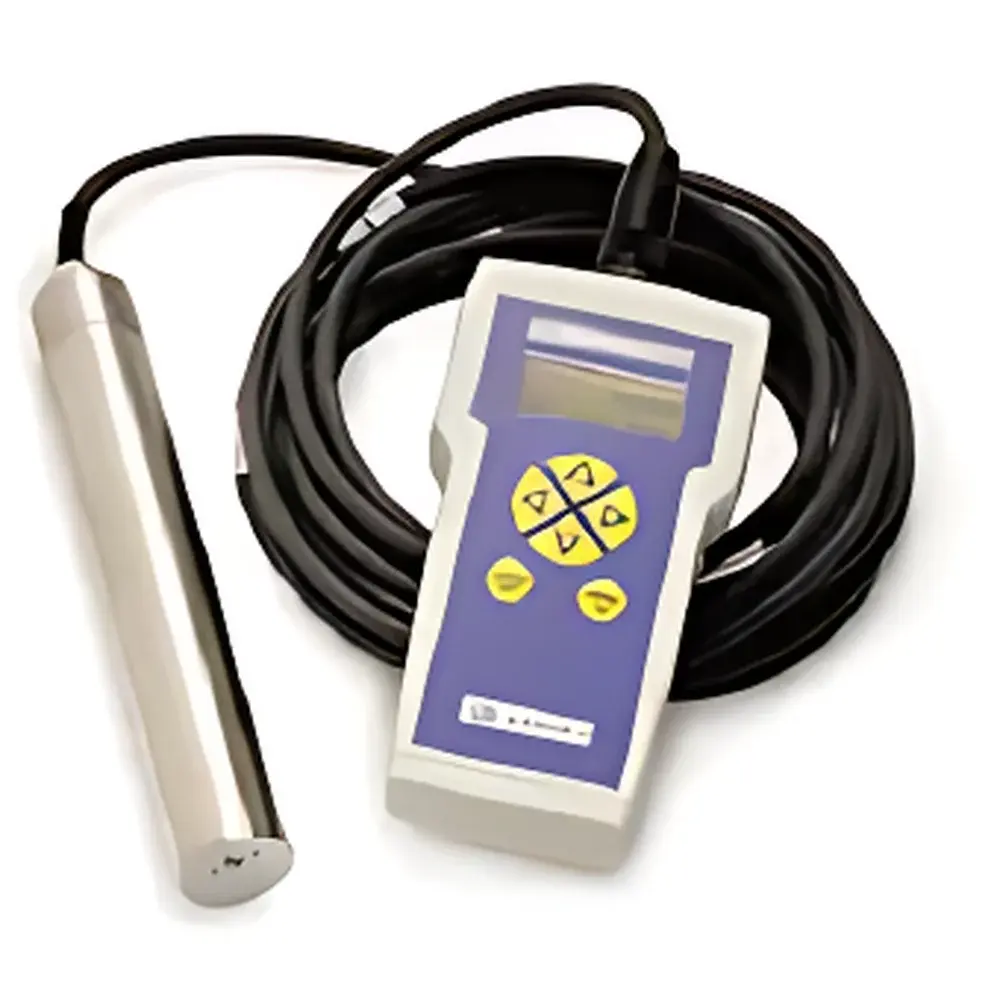
Hach TSS Portable Tri-Parameter Turbidity, Suspended Solids & Sludge Interface Analyzer
| Brand | Hach |
|---|---|
| Origin | USA |
| Model | TSS Portable |
| Instrument Type | Portable |
| Measurement Principle | Multi-beam alternating infrared photometry with dual-channel 90° scattering (turbidity) and six-channel multi-angle absorbance-corrected detection (suspended solids) |
| Turbidity Range | 0.001–4000 NTU |
| Suspended Solids Range | 0.001–400 g/L (1–400,000 mg/L, upper limit sample-dependent) |
| Turbidity Accuracy | ±3% or ±0.02 NTU (whichever is greater) |
| SS Accuracy | ±4% or ±0.001 g/L (whichever is greater) |
| Turbidity Resolution | 0.001 NTU (0–0.999), 0.01 NTU (1–9.99), 0.1 NTU (10–99.9), 1 NTU (>100) |
| SS Resolution | 0.001 g/L (0–0.999), 0.01 g/L (1–9.99), 0.1 g/L (10–99.9), 1 g/L (>100) |
| Units | NTU, FNU, EBC (turbidity) |
| Calibration | 4 pre-stored SS calibration curves + 1 turbidity curve |
| Bubble Compensation | Real-time software-based bubble interference correction |
| Sensor Material | Electropolished 316 stainless steel housing with scratch-resistant sapphire window |
| Data Storage | 290 measurement records (timestamp, location, value, homogeneity flag) |
| Operating Modes | Single-point, Interval, Continuous |
| Battery | Rechargeable Li-ion |
| Display | Backlit graphical LCD with intuitive menu navigation |
| Compliance | Meets DIN EN ISO 7027 (turbidity), supports ASTM D3852, ISO 13319, and USP <730> for suspended solids quantification in water matrices |
Overview
The Hach TSS Portable Tri-Parameter Turbidity, Suspended Solids & Sludge Interface Analyzer is an engineered field instrument designed for high-fidelity, on-site characterization of aqueous suspensions across municipal wastewater treatment plants, industrial effluent streams, drinking water distribution systems, and natural surface waters. It operates on a validated multi-beam alternating infrared photometric principle—combining dual-channel 90° scattered light detection (per DIN EN ISO 7027) for turbidity and six-channel multi-angle transmission/absorbance-corrected photometry for suspended solids (SS) quantification. This dual-optical architecture enables simultaneous, independent parameter derivation without cross-sensitivity artifacts commonly observed in single-wavelength or fixed-angle systems. The instrument’s sludge interface detection capability is not based on arbitrary thresholding but on real-time gradient analysis of SS concentration profiles during controlled vertical probe descent—enabling precise depth-resolved settling layer identification in clarifiers and thickeners. Its optical design inherently mitigates air bubble interference through dynamic baseline referencing and embedded compensation algorithms, ensuring robustness in aerated or turbulent sampling environments.
Key Features
- Tri-parameter functionality: Simultaneous, traceable measurement of turbidity (NTU/FNU/EBC), suspended solids (mg/L/g/L/%), and sludge interface depth—eliminating the need for multiple handheld devices or manual correlation workflows.
- Multi-curve calibration architecture: Four application-specific SS calibration curves (e.g., activated sludge, primary settle solids, chemical precipitates, and digested biosolids) plus one turbidity curve are factory-loaded; each SS curve supports up to three-point slope/zero adjustment to align with lab reference methods (e.g., gravimetric filtration per ISO 11923).
- Sludge interface localization protocol: Integrated depth-sensing workflow—calibrate, lower probe at controlled rate, detect inflection point in SS profile, read calibrated cable markings—provides direct, operator-independent interface depth reporting compliant with EPA Method 1622 and ISO 10523.
- Bubble-resilient photometry: Real-time optical signal processing compensates for transient air entrainment effects by dynamically referencing dark-current baselines and applying scatter-correction coefficients derived from concurrent multi-angle measurements.
- Ruggedized field sensor: Electropolished 316 stainless steel body minimizes biofilm adhesion and particulate fouling; sapphire optical window (Mohs hardness 9) withstands abrasion from grit-laden wastewater and repeated cleaning cycles.
- Configurable data acquisition: Three operational modes—single-point (instant snapshot), interval (programmable time-based logging), and continuous (real-time analog output)—with automatic power-down between intervals to extend battery life.
Sample Compatibility & Compliance
The TSS Portable is validated for use with heterogeneous aqueous matrices exhibiting particle size distributions ranging from colloidal clays (200 µm). Its multi-angle detection geometry ensures linearity across broad SS concentration ranges (0.001–400 g/L), while maintaining compliance with international turbidity standards: DIN EN ISO 7027 (formazin-based calibration traceability), ASTM D3852 (for suspended solids in wastewater), and ISO 13319 (light-scattering particle sizing principles). For regulated environments, the instrument supports GLP-compliant data integrity through timestamped, location-tagged storage (290 records), non-volatile memory retention, and audit-ready export via USB. While not FDA 21 CFR Part 11 certified out-of-the-box, its data structure and user-accessible calibration logs facilitate validation for GMP-aligned water system monitoring per USP and EU Annex 1.
Software & Data Management
Data capture is managed through an embedded firmware platform with hierarchical menu navigation and context-sensitive prompts. All measurements include mandatory metadata fields: date/time stamp (RTC-backed), operator ID (user-defined), GPS-derived location (when paired with external GNSS module), and homogeneity flag (auto-assessed via signal stability over 5-second integration). Export occurs via micro-USB to CSV format—structured with column headers compatible with LIMS ingestion (e.g., “Turbidity_NTU”, “SS_gL”, “Interface_Depth_m”, “Battery_V”). No proprietary software is required; raw files open natively in Excel or import directly into statistical analysis platforms (R, Python pandas). Firmware updates are delivered as signed .bin files via Hach’s secure support portal, preserving cryptographic integrity and rollback capability.
Applications
- Municipal Wastewater Optimization: Rapid verification of online turbidimeter accuracy at final effluent points; real-time assessment of clarifier performance via sludge blanket depth profiling.
- Drinking Water Quality Assurance: Field validation of membrane filtration integrity using sub-0.01 NTU resolution; correlation of turbidity spikes with upstream coagulation anomalies.
- Industrial Effluent Compliance: On-site SS quantification for NPDES permit reporting—particularly for high-solids streams where gravimetric lab analysis introduces significant delay.
- Environmental Monitoring: Longitudinal river sediment transport studies using consistent SS units (g/L) across seasonal flow regimes; turbidity-turbidity correlation modeling for remote sensing ground-truthing.
- Process Troubleshooting: Diagnosing hydraulic overloading in secondary clarifiers by comparing measured interface depth against historical baselines; detecting filamentous bulking via abnormal SS/turbidity ratio deviations.
FAQ
Does the TSS Portable require annual recalibration?
No—its optical system is drift-compensated via internal reference diodes and factory-traceable calibration curves. However, periodic verification against formazin standards (turbidity) or gravimetric SS references is recommended every 6 months in high-usage environments.
Can it measure in seawater or high-salinity brines?
Yes—the infrared photometry is insensitive to ionic strength variations, though users must select appropriate SS calibration curves validated for saline matrices (e.g., marine sediments). Salinity-induced refractive index shifts are inherently corrected by multi-angle signal normalization.
Is the sludge interface measurement affected by temperature gradients?
No—interface detection relies solely on spatial SS concentration gradients, not thermal refraction. The probe’s thermal mass and slow deployment rate minimize convective interference during descent.
How is data security handled during USB export?
Files contain no embedded credentials or device identifiers. All metadata is user-editable prior to export; no cloud connectivity or remote access functionality is implemented—ensuring full data sovereignty.
What maintenance is required beyond routine cleaning?
Annual inspection of O-ring integrity and sapphire window clarity is advised. No optical alignment or lamp replacement is needed—the IR diodes have >50,000-hour lifetimes and are thermally stabilized within the housing.
Related Products







