Hach GLI 5500 Polarographic Dissolved Oxygen Analyzer
| Brand | Hach |
|---|---|
| Origin | USA |
| Technology | Clark-type polarographic sensor (3-electrode system: gold cathode, silver anode, Ag/AgCl reference electrode) |
| Measurement Principle | Amperometric oxygen reduction at polarized cathode |
| Output Options | 4–20 mA analog (1–2 channels), RS-232/RS-485, Profibus DPV1 (optional) |
| DO Range | 0–99.99 mg/L (ppm), 0–999.9% saturation |
| Temp Range | 0.0–100.0 °C |
| Accuracy | ±0.05% of full scale |
| Stability | ±0.05% of full scale over 30 days |
| Enclosure Rating | NEMA 4X (IP66/IP65) |
| Hazardous Area Certification | Class I, Division 2, Groups A, B, C, D, T5 (PRO-D3 model only) |
| Membrane Assembly | Integrated replaceable cartridge (pre-filled membrane & electrolyte) |
| Auto-cleaning | Optional air-pulse cleaning system |
| Compliance | CE-marked |
Overview
The Hach GLI 5500 Polarographic Dissolved Oxygen Analyzer is a field-deployable, process-grade online instrument engineered for continuous, high-stability measurement of dissolved oxygen (DO) in municipal and industrial water and wastewater streams. It operates on the Clark-type polarographic principle: molecular oxygen diffuses through a gas-permeable membrane into an electrolyte-filled chamber, where it undergoes electrochemical reduction at a polarized gold cathode (−0.7 V vs. Ag/AgCl). The resulting diffusion-limited current is linearly proportional to the partial pressure of dissolved O₂, enabling precise quantification in mg/L, ppm, or % saturation. Unlike conventional two-electrode systems, the GLI 5500 employs a three-electrode configuration—gold working electrode, silver counter electrode, and a potentiostatically stabilized Ag/AgCl reference electrode—which eliminates drift caused by reference potential instability and minimizes interference from redox-active species (e.g., sulfides, chlorine residuals). This architecture delivers long-term baseline stability and reproducibility essential for closed-loop aeration control in activated sludge basins, anoxic/anaerobic digesters, and final effluent monitoring.
Key Features
- Three-electrode Clark cell design with potentiostatic polarization of the Ag/AgCl reference electrode ensures measurement robustness in variable redox environments.
- Pre-assembled, field-replaceable membrane cartridge integrates Teflon-based gas-permeable membrane, KCl-based electrolyte, and calibrated electrode geometry—eliminating manual filling, alignment, and conditioning steps.
- Optional integrated air-pulse cleaning system mitigates biofilm accumulation and particulate fouling on the membrane surface without chemical agents or mechanical wipers.
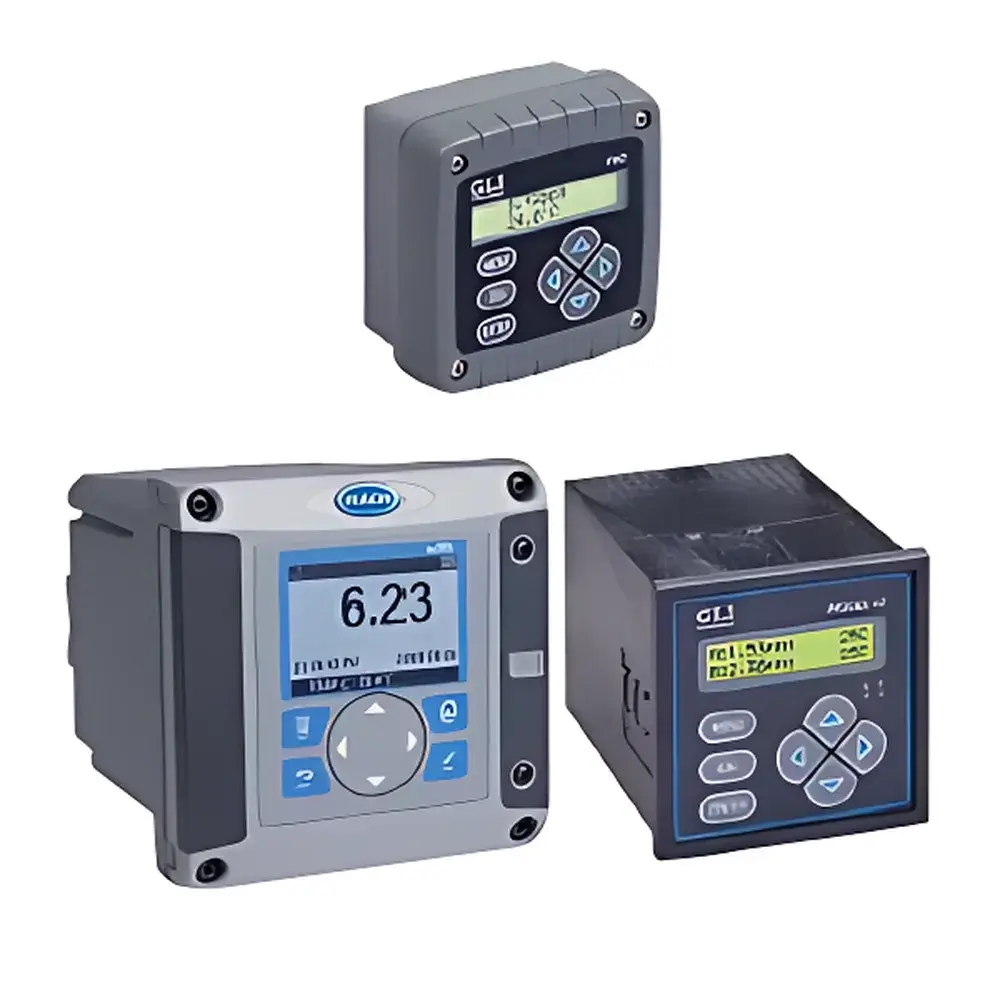
- Multi-platform controller compatibility: sc200 (dual-channel, NEMA 4X, 4 relays, dual 4–20 mA outputs), D33 (compact single-channel, IP65), and PRO-D3 (intrinsically safe for Class I Div 2 hazardous locations, T5 temperature class).
- Full temperature compensation (0.0–100.0 °C) using integrated Pt1000 RTD; automatic compensation algorithms conform to ISO 5814 and ASTM D888 temperature correction protocols.
- Real-time self-diagnostic routines monitor membrane integrity, electrolyte level, electrode polarization status, and signal-to-noise ratio—logging fault codes with timestamps for predictive maintenance planning.
Sample Compatibility & Compliance
The GLI 5500 is validated for use across diverse aqueous matrices including raw sewage, secondary clarifier effluent, nitrification/denitrification basin liquor, seawater-influenced outfalls, and surface water intakes. Its membrane selectivity excludes interference from CO₂, H₂S, Cl₂, and common oxidants when operated within specified pH (4–12) and conductivity (≥50 µS/cm) ranges. All controller variants are CE-marked and comply with EMC Directive 2014/30/EU and Low Voltage Directive 2014/35/EU. The sc200 and D33 support configurable audit trails, electronic signatures, and user-access levels—meeting FDA 21 CFR Part 11 requirements for regulated wastewater utilities operating under NPDES permits or ISO 14001 environmental management systems. Calibration traceability aligns with NIST-traceable standards via saturated air (100% O₂ at local barometric pressure) and zero-oxygen (sodium sulfite) verification procedures.
Software & Data Management
Controllers integrate native firmware supporting Modbus RTU/TCP, Profibus DPV1 (optional module), and ASCII-based RS-232/485 serial protocols for seamless integration into DCS, SCADA, and PLC architectures. The sc200 platform provides embedded data logging (up to 10,000 records) with timestamped events (calibrations, alarms, maintenance alerts) stored in non-volatile memory. Hach’s System Manager software enables remote configuration, firmware updates, historical trend analysis, and export of CSV/Excel-compatible datasets compliant with EPA Method 365.3 reporting formats. All controllers maintain a secure, time-stamped calibration log—including operator ID, ambient pressure input, temperature reading, and deviation from reference standard—required for GLP audits and regulatory submissions.
Applications
- Real-time DO feedback control in aerobic bioreactors to optimize blower energy consumption while maintaining nitrification efficiency (target: 2–4 mg/L).
- Monitoring dissolved oxygen gradients across oxidation ditches, sequencing batch reactors (SBRs), and membrane bioreactors (MBRs) to detect early-stage process upsets.
- Compliance-driven monitoring at NPDES discharge points, ensuring effluent DO remains ≥5.0 mg/L per Clean Water Act requirements.
- Salinity-compensated DO profiling in estuarine outfalls and coastal treatment plants where chloride concentrations exceed 10,000 mg/L.
- Long-duration deployment in grit chambers and primary clarifiers where suspended solids loading exceeds 500 mg/L—enabled by optional air-pulse cleaning.
FAQ
What distinguishes the GLI 5500’s three-electrode design from conventional two-electrode DO sensors?
The dedicated Ag/AgCl reference electrode is maintained at constant potential via potentiostatic control, decoupling reference stability from solution chemistry changes—reducing drift by >70% compared to passive reference configurations.
Can the GLI 5500 be used in high-salinity or low-temperature applications?
Yes. The sensor is rated for 0.0–100.0 °C and performs reliably in seawater (up to 40,000 mg/L Cl⁻); salinity compensation is applied automatically when conductivity input is enabled.
Is air-pulse cleaning compatible with all controller models?
Air-pulse actuation is supported only on sc200 and PRO-D3 controllers via programmable relay output; D33 requires external solenoid valve integration.
How frequently must the membrane cartridge be replaced?
Typical service interval is 3–6 months in municipal wastewater; extended to 12+ months in low-fouling surface water applications—monitored via diagnostic voltage decay rate.
Does the PRO-D3 transmitter support HART communication?
No. PRO-D3 uses 4–20 mA analog output with discrete alarm contacts; HART capability is not implemented due to intrinsic safety constraints in Class I Div 2 certification.
Related Products