
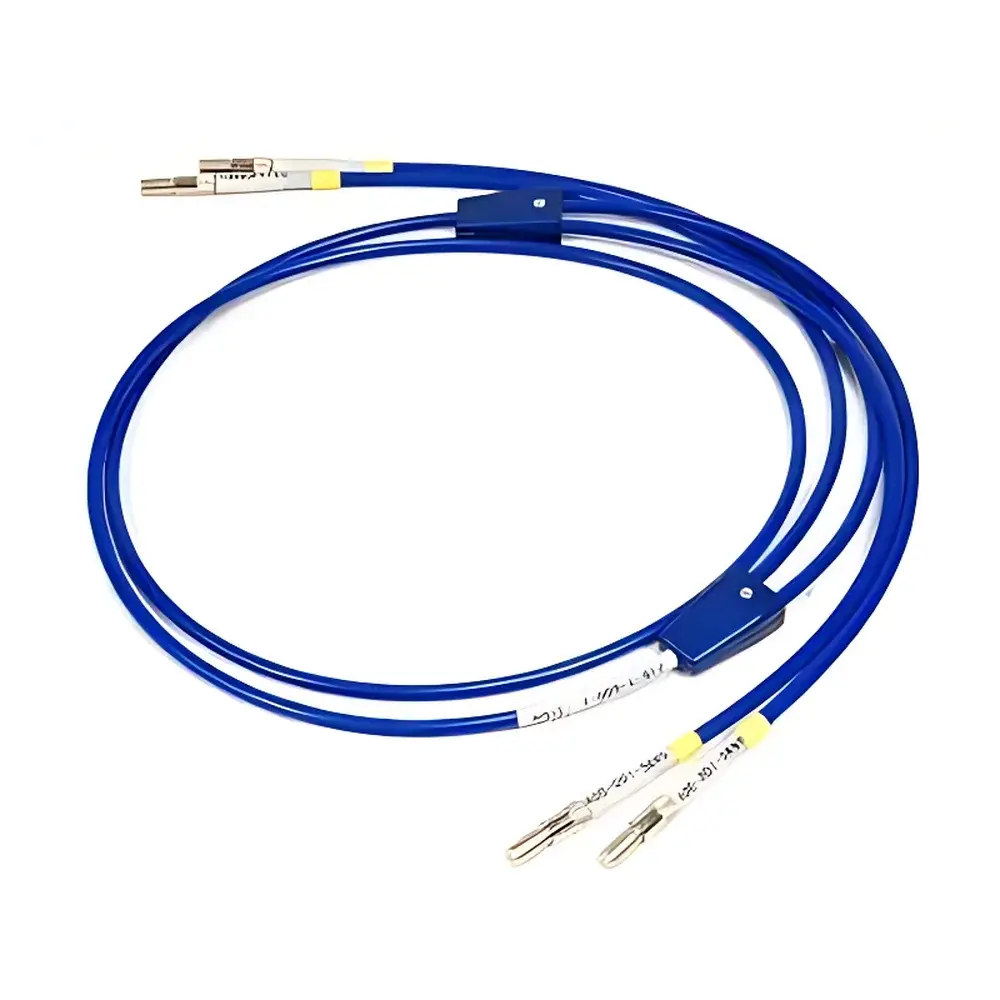
IdeaOptics FIB Series High-Performance Quartz Optical Fiber Bundle
| Brand | IdeaOptics |
|---|---|
| Model | FIB |
| Type | Optical Fiber Bundle (Spectroscopy-Optimized) |
| Core Material | Synthetic Fused Silica |
| Wavelength Range | 190–2500 nm |
| Numerical Aperture | 0.22 (typ.) |
| Standard Bundle Diameter | 400 µm–1000 µm |
| Connector Options | SMA 905, FC/PC, Custom Terminations |
| Compliance | ISO 10110-3 (Surface Quality), ASTM E131 (Terminology for Molecular Spectroscopy) |
Overview
The IdeaOptics FIB Series is a family of high-purity, spectroscopy-grade fused silica optical fiber bundles engineered for reliable light transmission across demanding analytical applications. Designed specifically for integration into UV-Vis-NIR spectral systems, these fibers operate on the principle of total internal reflection (TIR) within a precisely controlled core-cladding refractive index profile. Each FIB bundle consists of multiple individually coated, low-OH synthetic quartz fibers arranged in coherent or non-coherent configurations to optimize coupling efficiency, spatial uniformity, and radiometric stability. Unlike general-purpose telecommunications fibers, the FIB series features enhanced solarization resistance in the deep-UV (down to 190 nm), minimized hydroxyl absorption bands (< 0.1 ppm OH⁻), and tightly controlled attenuation coefficients (< 10 dB/km at 250 nm; < 2 dB/km at 600 nm). This enables quantitative spectral collection with high signal-to-noise ratio (SNR) and long-term photometric repeatability—critical for benchtop spectrometers, process monitoring probes, and remote sensing configurations.
Key Features
- Deep-UV to NIR broadband transmission: validated spectral response from 190 nm to 2500 nm, covering key analytical regions including DUV protein absorbance (200–220 nm), visible colorimetry (400–700 nm), and NIR overtone bands (1000–2500 nm)
- Low solarization design: proprietary dopant-free fused silica preform fabrication reduces radiation-induced defect formation under prolonged UV exposure
- High numerical aperture (NA = 0.22 typ.): maximizes light-gathering capability for low-intensity sources or small sample volumes
- Customizable bundle architecture: selectable core diameters (100 µm to 1000 µm), strand counts (7 to 1000+), and termination types (SMA 905, FC/PC, bare fiber, or custom ferrules)
- Robust mechanical construction: polyimide or metal-jacketed variants available for high-temperature (up to 300 °C) or vacuum-compatible operation
- Batch-certified spectral transmission data: each production lot includes measured attenuation curves and end-face inspection reports per ISO 10110-3 Class 5 surface quality standards
Sample Compatibility & Compliance
FIB fibers are compatible with standard optical interfaces used in laboratory spectrometers (e.g., Ocean Insight, Avantes, Hamamatsu modular platforms), as well as OEM instrumentation requiring fiber-coupled excitation or detection. The fused silica composition ensures chemical inertness toward common solvents (acetonitrile, methanol, dilute acids/bases) and thermal stability across −60 °C to +250 °C (polyimide jacket) or up to +300 °C (metal-sheathed versions). All FIB products comply with ISO 10110-3 for surface imperfections and ASTM E131 definitions for optical component terminology. For regulated environments, traceable calibration certificates and material declarations (RoHS, REACH) are provided upon request. While not inherently FDA-regulated, FIB bundles deployed in USP or ICH Q2(R2)-aligned analytical methods meet GLP/GMP documentation requirements when paired with audit-trail-capable spectrometer software.
Software & Data Management
FIB fibers do not incorporate embedded electronics or firmware; however, they are fully interoperable with industry-standard spectroscopic data acquisition platforms—including IdeaOptics’ own OmniDriver SDK, OceanView, AvaSoft, and MATLAB-based spectral processing toolboxes. When integrated into a full system (e.g., FIB bundle + IdeaOptics FX2000 spectrometer + LS1 light source), users gain access to wavelength calibration traceability (NIST-traceable Hg/Ar lamp references), dark current subtraction routines, and intensity normalization protocols compliant with ASTM E308 and ISO/CIE 11664-3. Raw spectral datasets retain native metadata (fiber NA, length, connector type) for automated correction factor application during post-processing.
Applications
- In-line UV-Vis process monitoring of pharmaceutical dissolution or bioreactor turbidity
- Remote fluorescence excitation and emission collection in hazardous or confined environments
- FTIR and dispersive NIR spectroscopy of powders, films, and liquids using reflectance or transmittance probe geometries
- Plasma emission analysis in semiconductor etch chambers via vacuum-compatible fiber feedthroughs
- Calibration transfer between reference and field-deployable spectrometers using matched FIB pathlengths and terminations
- Microspectroscopy coupling to confocal or Raman microscope platforms with sub-50 µm core options
FAQ
What is the minimum bend radius for FIB bundles without inducing significant loss or damage?
For standard polyimide-jacketed FIB bundles (500 µm core), the recommended static bend radius is ≥ 30 mm; dynamic bending requires ≥ 50 mm. Metal-sheathed variants support tighter routing down to 15 mm radius.
Can FIB fibers be used for laser delivery applications?
Yes—FIB bundles are rated for continuous-wave (CW) power densities up to 1 MW/cm² at 532 nm and 0.5 MW/cm² at 266 nm (with appropriate beam homogenization and end-face polishing). Pulsed laser use requires consultation for peak fluence limits.
Is there batch-to-batch spectral transmission variation?
Transmission variance across production lots is maintained within ±1.5% RMS deviation in the 200–800 nm range, verified by factory spectral mapping on every shipment.
Do you offer custom numerical aperture or core/clad ratios?
Yes—custom NA values from 0.12 to 0.37 and specialized core/clad designs (e.g., step-index vs. graded-index) are available under NRE-supported development agreements.
How should FIB fibers be cleaned and maintained?
Use reagent-grade isopropanol and lens-tissue wipes; avoid acetone on polyimide jackets. Inspect end-faces regularly with 100× microscope; recoating or repolishing services are offered through IdeaOptics’ certified repair center.






