
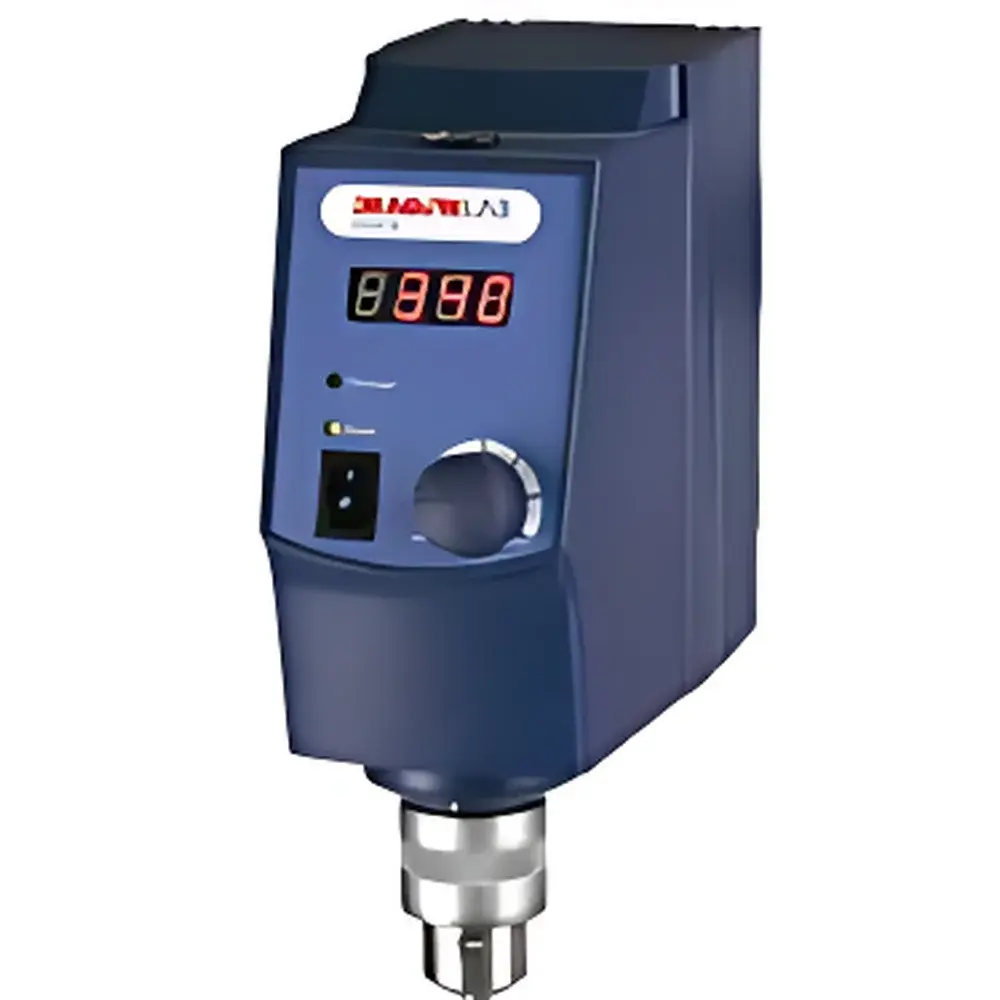
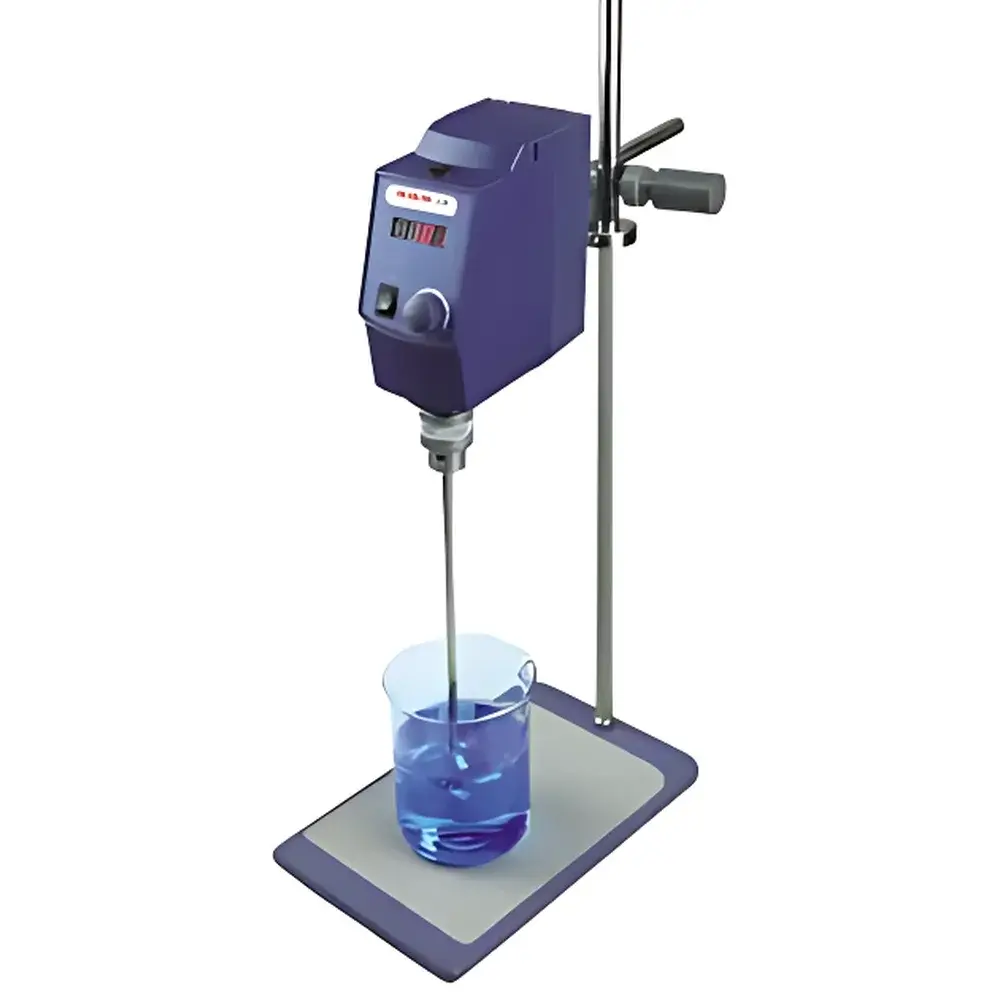
DLAB OS40-S / OS20-S LED-Display Overhead Electronic Stirrer
| Brand | DLAB |
|---|---|
| Model | OS40-S / OS20-S |
| Origin | Beijing, China |
| Input Power | 120 W / 60 W |
| Output Power | 100 W / 50 W |
| Max. Stirring Volume (H₂O) | 40 L / 20 L |
| Speed Range | 0–2200 rpm |
| Speed Display Resolution | ±1 rpm |
| Max. Torque | 60 N·cm / 40 N·cm |
| Max. Viscosity | 50,000 mPa·s / 10,000 mPa·s |
| Chuck Capacity | 0.5–10 mm |
| Dimensions (W×H×D) | 83 × 220 × 186 mm |
| Weight | 2.8 kg / 2.6 kg |
| Protection Class | IP42 |
| Operating Temp. | 5–40 °C |
| Relative Humidity | ≤80 % |
| Safety Certifications | CE, cTUVus, FCC |
| Motor Type | Brushless DC Explosion-Proof Motor |
| Safety Features | Overload protection, short-circuit cutoff, speed anomaly detection, soft-start function |
Overview
The DLAB OS40-S and OS20-S LED-Display Overhead Electronic Stirrers are precision-engineered laboratory instruments designed for reliable, continuous mixing of medium-to-high viscosity liquids and heterogeneous solid–liquid suspensions. Based on controlled rotational torque transmission via a brushless DC motor and mechanical gear reduction, these overhead stirrers operate on the principle of direct-drive impeller rotation—ensuring minimal energy loss, high torque delivery at low speeds, and exceptional stability under load. Unlike magnetic stirrers limited by heat generation and viscosity constraints, overhead models eliminate coupling limitations and enable scalable agitation across volumes up to 40 L (OS40-S) or 20 L (OS20-S) of water-equivalent media. Their robust architecture supports applications demanding prolonged operation under variable rheological conditions—particularly where thermal sensitivity, explosion risk, or sample integrity preclude use of hotplate-integrated systems.
Key Features
- Brushless DC explosion-proof motor: Eliminates carbon brush wear, arcing, and ignition risk—critical for solvent-based chemistry, pharmaceutical synthesis, and flammable environment compliance.
- Soft-start functionality: Gradual acceleration prevents splashing and vortex-induced overflow during initial mixing—enhancing operator safety and sample containment.
- IP42-rated sealed enclosure: Conforms to DIN EN 60529; protects internal electronics from liquid ingress and particulate contamination during routine lab use.
- LED digital display: Real-time readout of rotational speed with ±1 rpm resolution—enabling precise protocol replication and audit-ready parameter logging.
- Dual-stage electronic protection: Integrated circuitry monitors current draw, thermal rise, and rotational feedback; triggers automatic shutdown and visual alarm (LED indicator) upon overload, short circuit, or speed deviation.
- Universal voltage input (100–240 VAC, 50/60 Hz): Ensures operational compatibility across global laboratory power infrastructures without external transformers.
- Ergonomic compact housing (83 × 220 × 186 mm): Optimized footprint for fume hood integration and benchtop space efficiency.
Sample Compatibility & Compliance
These stirrers accommodate standard laboratory impellers—including propeller, paddle, anchor, and helical types—via a 0.5–10 mm keyless chuck with repeatable clamping force. They support Newtonian and non-Newtonian fluids up to 50,000 mPa·s (OS40-S) and 10,000 mPa·s (OS20-S), making them suitable for polymer solutions, colloidal dispersions, cell culture media, ointment bases, and suspension formulations. All units comply with EU Machinery Directive 2006/42/EC and Electromagnetic Compatibility Directive 2014/30/EU. Certified to CE, cTUVus (UL 61010-1), and FCC Part 15 Subpart B standards, they meet essential safety requirements for Class I, Division 2 hazardous locations per NEC Article 500 when operated within specified environmental limits (5–40 °C, ≤80% RH). No RS232 interface is provided; manual operation aligns with GLP-aligned workflows where electronic data capture is not mandated.
Software & Data Management
The OS40-S and OS20-S operate as standalone, firmware-controlled instruments without embedded software or connectivity options. Speed setting and status monitoring occur exclusively via front-panel controls and LED display—eliminating cybersecurity exposure, driver dependencies, or validation overhead associated with PC-linked devices. This design supports laboratories operating under strict IT governance policies or those maintaining legacy infrastructure. While no audit trail or electronic record is generated, the ±1 rpm display resolution and deterministic soft-start behavior ensure procedural consistency across shifts and operators—facilitating manual logbook entries compliant with ISO/IEC 17025 clause 7.7 (result reporting) and FDA 21 CFR Part 11 predicate rules for paper-based records.
Applications
- Chemical synthesis: Homogenization of viscous reaction mixtures (e.g., polycondensation, esterification) under inert atmosphere or reflux conditions.
- Pharmaceutical development: Preparation of suspensions, emulsions, and semi-solids (creams, gels) per USP & Ph. Eur. monographs requiring defined agitation profiles.
- Food & cosmetics R&D: Dispersing thickeners (xanthan, carbomer), stabilizing emulsions, and hydrating hydrocolloids without shear degradation.
- Biotechnology: Gentle agitation of mammalian cell cultures in serum-free media or high-density microbial fermentations where oxygen transfer must be balanced against shear stress.
- Petrochemical QA/QC: Blending of lubricants, asphalt modifiers, and drilling fluid components prior to rheological or compositional analysis.
FAQ
What safety certifications do the OS40-S and OS20-S hold?
Both models carry CE, cTUVus (UL 61010-1), and FCC marks—validating compliance with electrical safety, electromagnetic immunity, and radiated emissions requirements for laboratory equipment.
Can these stirrers be used in explosion-hazardous areas?
Yes—the brushless DC motor eliminates sparking risk, and the IP42 enclosure provides basic protection against dust and dripping water; however, formal ATEX or IECEx certification is not claimed. Use in Zone 2/Class I Div 2 requires site-specific risk assessment.
Is speed calibration traceable to national standards?
The LED display resolution is ±1 rpm, but factory calibration is performed using NIST-traceable tachometry. End-user recalibration is not supported; periodic verification with an external optical tachometer is recommended per ISO/IEC 17025.
Does the unit include data export capability?
No. These are analog-control instruments with no serial, USB, or network interface. Data recording must be performed manually.
What impeller types are compatible?
Any standard shaft-mounted impeller with shank diameters between 0.5 mm and 10 mm—including PTFE-coated, stainless steel, and glass-bladed variants—can be secured using the integrated keyless chuck.



