
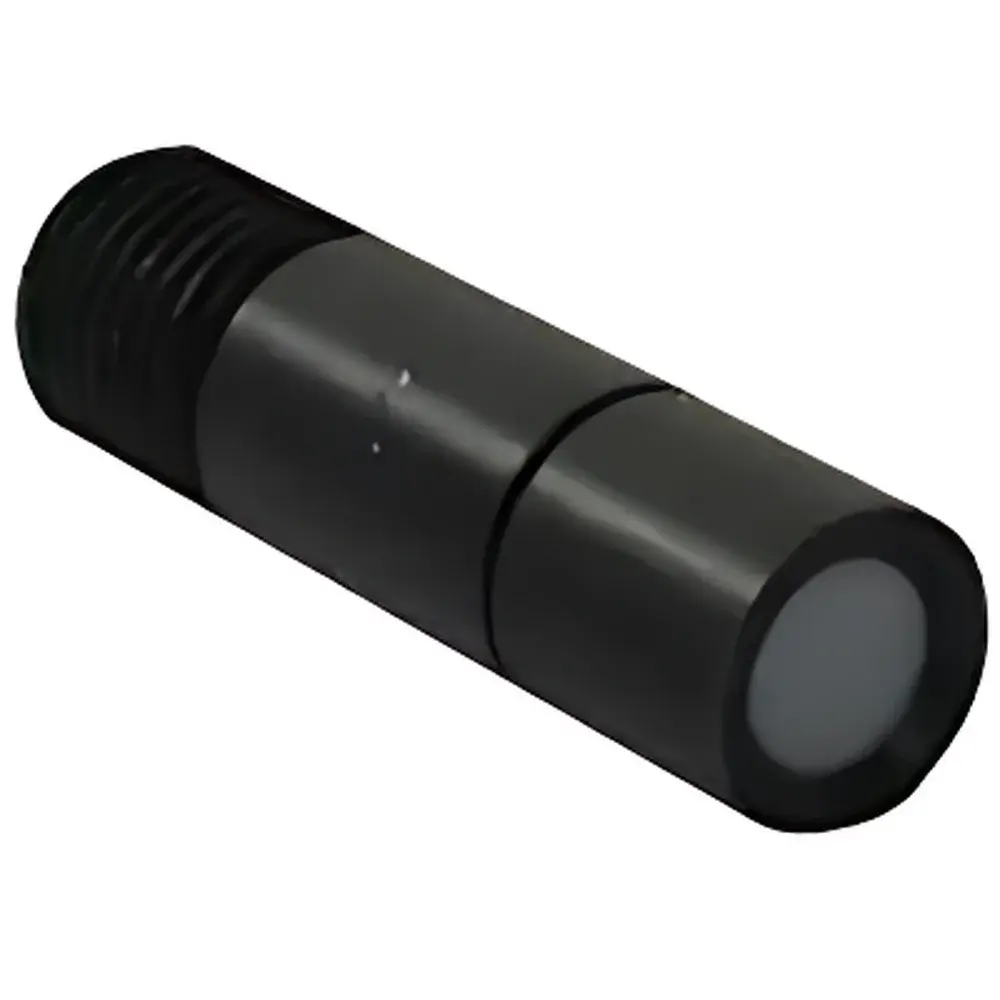
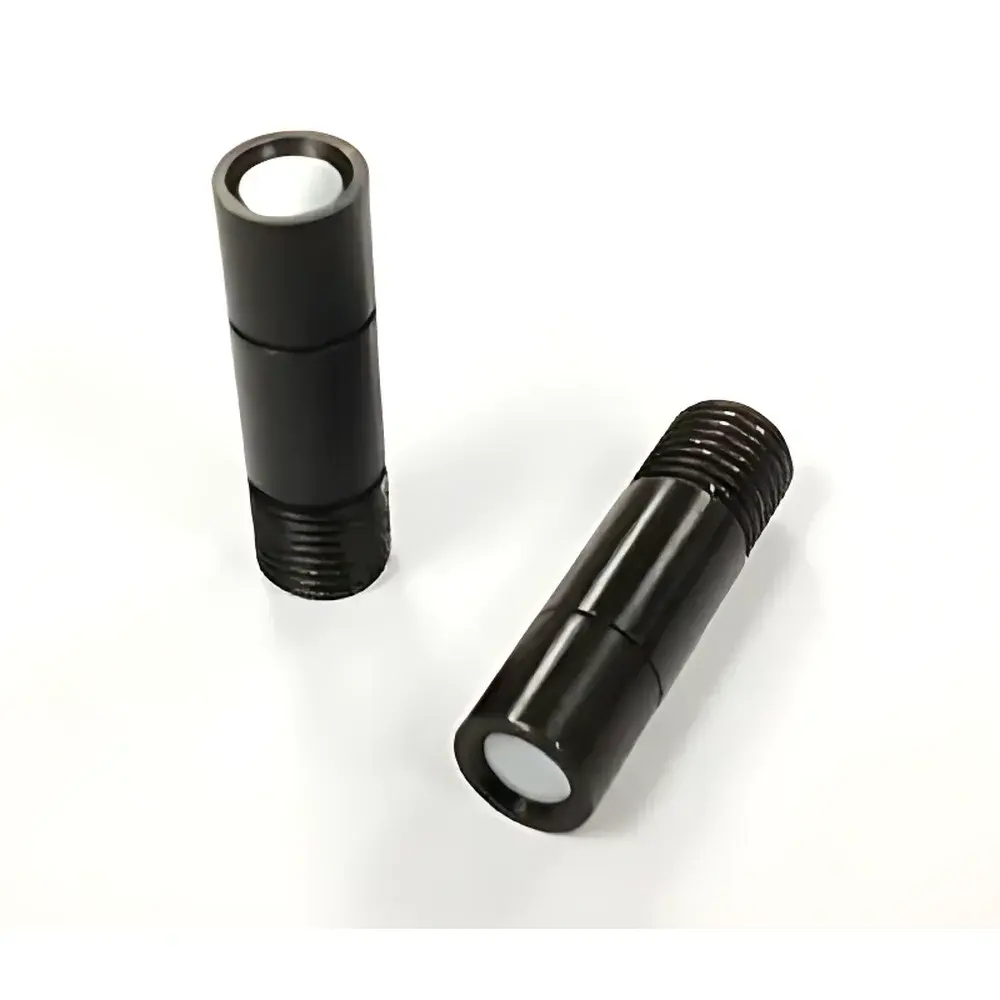
IdeaOptics STD-CC Cosine Corrector
| Brand | IdeaOptics |
|---|---|
| Origin | Shanghai, China |
| Manufacturer Type | OEM Manufacturer |
| Regional Category | Domestic (China) |
| Model | STD-CC |
| Component Category | Optical Element |
| Interface | SMA905 |
Overview
The IdeaOptics STD-CC Cosine Corrector is a precision optical component engineered for accurate angular response correction in spectral radiometry and photometry applications. It operates on the principle of Lambertian cosine projection—ensuring that incident light from any angle within the ±80° field of view contributes to the detected signal in strict proportion to the cosine of the incidence angle. This physical compliance enables traceable measurement of spectral irradiance (W·m⁻²·nm⁻¹), spectral radiant intensity (W·sr⁻¹·nm⁻¹), and relative spectral power distribution (SPD) under non-collimated or diffuse illumination conditions. Designed for integration into fiber-coupled spectroscopic systems, the STD-CC serves as a critical front-end optic for spectrometers equipped with SMA905-compatible input ports, eliminating angular bias inherent in bare fiber acceptance and enabling ISO/CIE-compliant characterization of LEDs, OLEDs, laser diodes, and general lighting sources.
Key Features
- True cosine angular response across ±80° field of view, validated per CIE S 023/E:2013 and ISO 13406-2 Annex B requirements
- High-transmission diffuser surface fabricated from sintered PTFE (polytetrafluoroethylene), offering >95% Lambertian reflectance from 250 nm to 2500 nm
- Integrated SMA905 male connector for direct mechanical and optical coupling to standard spectroscopy fibers (e.g., Ocean Insight, Avantes, Hamamatsu)
- Compact, black-anodized aluminum housing with threaded M6 mounting interface for stable benchtop or fixture-integrated deployment
- No internal optics or coatings—purely passive design ensures minimal spectral distortion and zero polarization dependence
- Calibration-ready geometry: defined active aperture diameter (6.35 mm) and fixed working distance (0 mm standoff) support NIST-traceable irradiance calibration protocols
Sample Compatibility & Compliance
The STD-CC is compatible with broadband and narrowband emitters operating across UV-VIS-NIR spectral ranges. It supports measurements of spatially extended sources (e.g., LED arrays, backlit panels), quasi-point sources (e.g., packaged LEDs at ≥10 cm distance), and collimated beams when used with appropriate beam-expanding optics. The device conforms to key international standards governing optical radiation measurement: CIE Publication 127 (LED measurement guidelines), IEC 62471 (photobiological safety), and ASTM E308 (computing colorimetric quantities from spectral data). Its geometric and spectral characteristics are fully documented in accordance with ISO/IEC 17025 requirements for accredited calibration laboratories performing spectral irradiance intercomparisons.
Software & Data Management
While the STD-CC itself is a passive hardware component, its use directly impacts data integrity in spectral analysis workflows. When paired with compliant spectrometers (e.g., those supporting irradiance mode with factory-applied cosine correction factors), the STD-CC enables full implementation of ASTM E2758-compliant spectral irradiance reporting—including uncertainty budgets incorporating angular response error (<±1.2% deviation from ideal cos(θ) over ±75°). Software platforms such as OceanView, AvaSoft, or custom Python-based acquisition tools (using PySpectra or seabreeze libraries) can apply standardized correction matrices derived from NIST SRM 2030-based calibration reports. All calibration certificates include full spectral responsivity curves (350–1050 nm), angular response maps, and GLP-compliant metadata (operator ID, environmental conditions, traceability chain to NIM).
Applications
- LED and solid-state lighting (SSL) characterization per LM-79 and EN 13032-4 standards
- Display backlight uniformity and chromaticity mapping in LCD/OLED manufacturing QA
- Solar simulator spectral match evaluation (Class AAA per IEC 60904-9)
- UV curing lamp spectral output verification in semiconductor and coating processes
- Biomedical light source validation for phototherapy and circadian rhythm studies
- Field-deployable irradiance monitoring in environmental photometry and agrilight research
FAQ
Is the STD-CC calibrated before shipment?
Yes—each unit undergoes factory angular response verification and includes a certificate of conformance referencing CIE S 023/E:2013 test methodology.
Can it be used with integrating spheres?
No—the STD-CC is designed for direct irradiance measurement; it must be positioned normal to the source plane without intervening optics.
What is the maximum irradiance level it supports?
The PTFE diffuser has no intrinsic damage threshold below 10 W·cm⁻² continuous exposure; thermal lensing is negligible up to 50°C ambient.
Does it require periodic recalibration?
Per ISO/IEC 17025, recalibration is recommended every 24 months or after mechanical impact, though long-term stability data shows <0.3% responsivity drift over 36 months.
Is it compatible with UV-enhanced spectrometers?
Yes—the sintered PTFE surface maintains >92% reflectance down to 250 nm, making it suitable for deuterium-lamp-based UV-VIS systems.




