
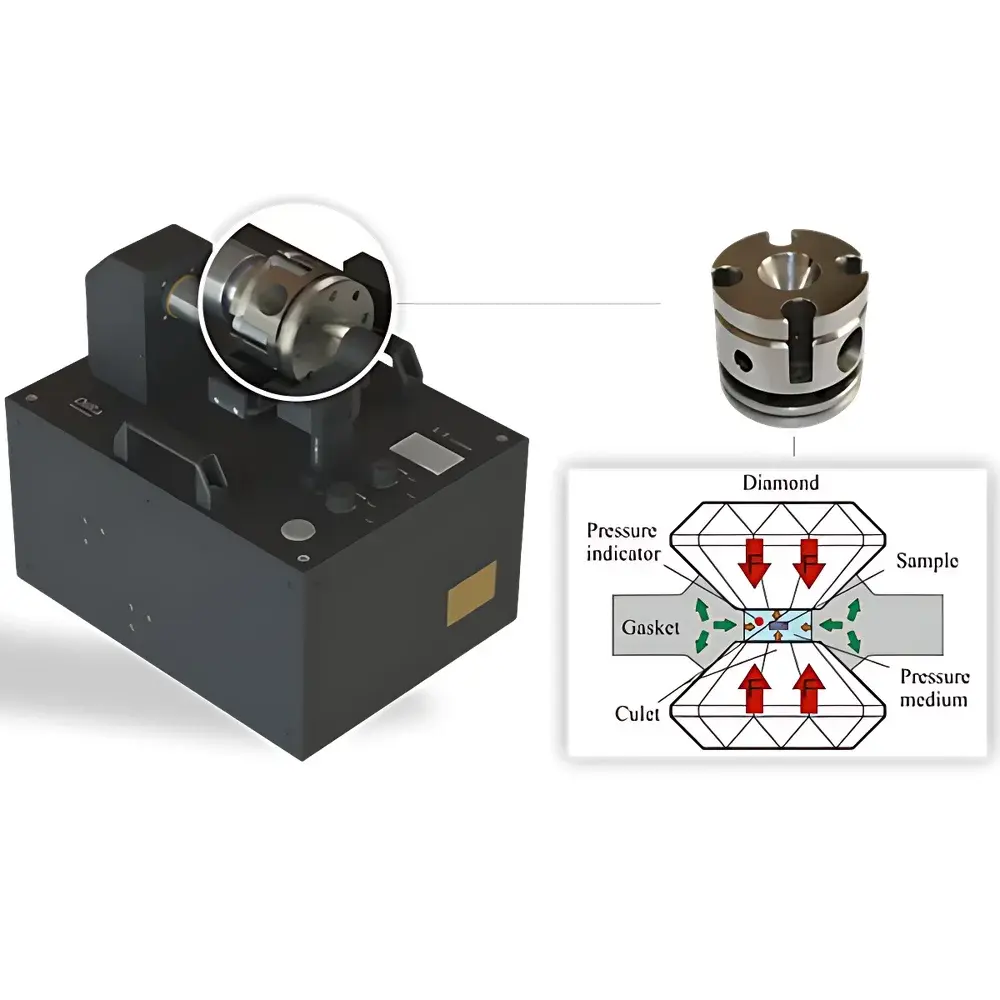
IdeaOptics DiRa High-Pressure Raman Spectrometer
| Brand | IdeaOptics |
|---|---|
| Origin | Shanghai, China |
| Manufacturer Type | Original Equipment Manufacturer (OEM) |
| Country of Origin | China |
| Model | DiRa |
| Pricing | Upon Request |
Overview
The IdeaOptics DiRa High-Pressure Raman Spectrometer is an integrated, purpose-built optical instrumentation system engineered for in situ Raman spectroscopic analysis within diamond anvil cell (DAC) environments. It operates on the fundamental principle of inelastic light scattering—where monochromatic laser excitation induces vibrational mode shifts in crystalline or molecular samples under extreme hydrostatic or quasi-hydrostatic pressure conditions. Unlike conventional benchtop Raman systems requiring extensive optical realignment and external coupling to DACs, the DiRa integrates the excitation source, spectral dispersion optics, high-quantum-efficiency detector, and DAC-compatible sample stage into a single mechanically stable platform. This architecture minimizes alignment drift, suppresses ambient light leakage, and ensures consistent optical throughput across pressure cycles—critical for reproducible quantification of phonon frequency shifts, linewidth broadening, and mode splitting associated with structural phase transitions.
Key Features
- Monolithic optomechanical design optimized for DAC integration, eliminating beam path realignment between pressure runs
- Integrated narrow-linewidth diode-pumped solid-state (DPSS) laser source with wavelength stabilization (typically 532 nm or optional 473/638 nm variants)
- High-throughput Czerny–Turner spectrometer with thermoelectrically cooled back-illuminated CCD sensor, delivering spectral resolution better than 5 cm⁻¹ (FWHM) across the 100–4000 cm⁻¹ range
- DAC-specific motorized XYZ translation stage with sub-5 µm positional repeatability and angular alignment stability <5°, enabling precise spatial registration of laser focus onto the gasketed sample chamber
- One-click acquisition workflow: automated laser shutter control, exposure time optimization, background subtraction, and spectral calibration applied in sequence without user intervention
- Plug-and-play deployment: factory-aligned and pre-calibrated; no post-installation optical collimation or wavelength calibration required
Sample Compatibility & Compliance
The DiRa system supports standard symmetric and asymmetric DAC configurations with culet sizes ranging from 100 µm to 500 µm. It accommodates common pressure-transmitting media—including neon, helium, methanol–ethanol mixtures, and silicon oil—enabling quasi-hydrostatic compression up to 400 GPa. Pressure determination is traceable via the well-established Raman shift of the diamond first-order phonon mode (1332.5 cm⁻¹ at ambient), calibrated per ISO 21365:2021 (“Determination of pressure in diamond anvil cells using Raman spectroscopy”). The system’s mechanical rigidity and thermal management meet ASTM E2937-22 requirements for long-term stability during multi-hour static compression experiments. While not certified to GLP or FDA 21 CFR Part 11 by default, audit-ready data logs—including timestamped spectra, pressure metadata, laser power records, and stage coordinates—are natively generated in HDF5 format for laboratory compliance workflows.
Software & Data Management
Control and analysis are performed via DiRaControl v3.x—a native Windows application built on Qt and Python-based scientific libraries (NumPy, SciPy, h5py). The software implements real-time spectral preview, automatic cosmic ray removal, polynomial baseline correction, peak fitting using Voigt profiles, and pressure-dependent peak tracking. All raw and processed data are stored in self-describing HDF5 files compliant with NeXus conventions, ensuring interoperability with third-party tools such as PyMca, OriginPro, and MATLAB. Export options include CSV, TXT, and JCAMP-DX formats for archival and publication use. Version-controlled firmware updates are delivered through secure HTTPS channels, with SHA-256 checksum verification.
Applications
- In situ characterization of pressure-induced structural phase transitions in transition metal oxides, hydrogen-rich compounds, and 2D materials
- Quantitative phonon softening analysis for superconductivity onset prediction in hydride systems above 150 GPa
- Calibration of pressure scales using diamond edge fluorescence, ruby fluorescence (R₁ line), and secondary standards (e.g., MgO, Au)
- Time-resolved Raman studies of metastable phases formed during dynamic compression or laser-heating protocols
- Correlative analysis combining Raman mapping with simultaneous DAC-integrated micro-IR or XRD where space permits
FAQ
What laser wavelengths are supported by the DiRa system?
Standard configuration uses a 532 nm DPSS laser; optional 473 nm (blue) and 638 nm (red) modules are available for resonance enhancement or fluorescence suppression.
Can the DiRa be retrofitted to existing DAC setups?
Yes—the optical interface is designed to mate with standard DAC viewports (⌀25 mm, N-BK7 or sapphire windows); custom flange adapters are provided upon request.
Is spectral calibration traceable to NIST standards?
Wavelength calibration is performed using a mercury–argon hollow cathode lamp; full calibration certificate with uncertainty budget (k=2) is supplied with each unit.
Does the system support low-temperature DAC measurements?
The DiRa platform is compatible with cryogenic DAC stages down to 4 K; optional vibration-isolation mounts and cold-finger–compatible lens tubes are available.
How is pressure calculated from diamond Raman shift?
The DiRa software implements the Mao–Bell–Shen equation (J. Geophys. Res., 1986) and the updated Dewaele–Loubeyre model (Phys. Rev. B, 2008) for pressure derivation from the observed 1332 cm⁻¹ peak shift.



