
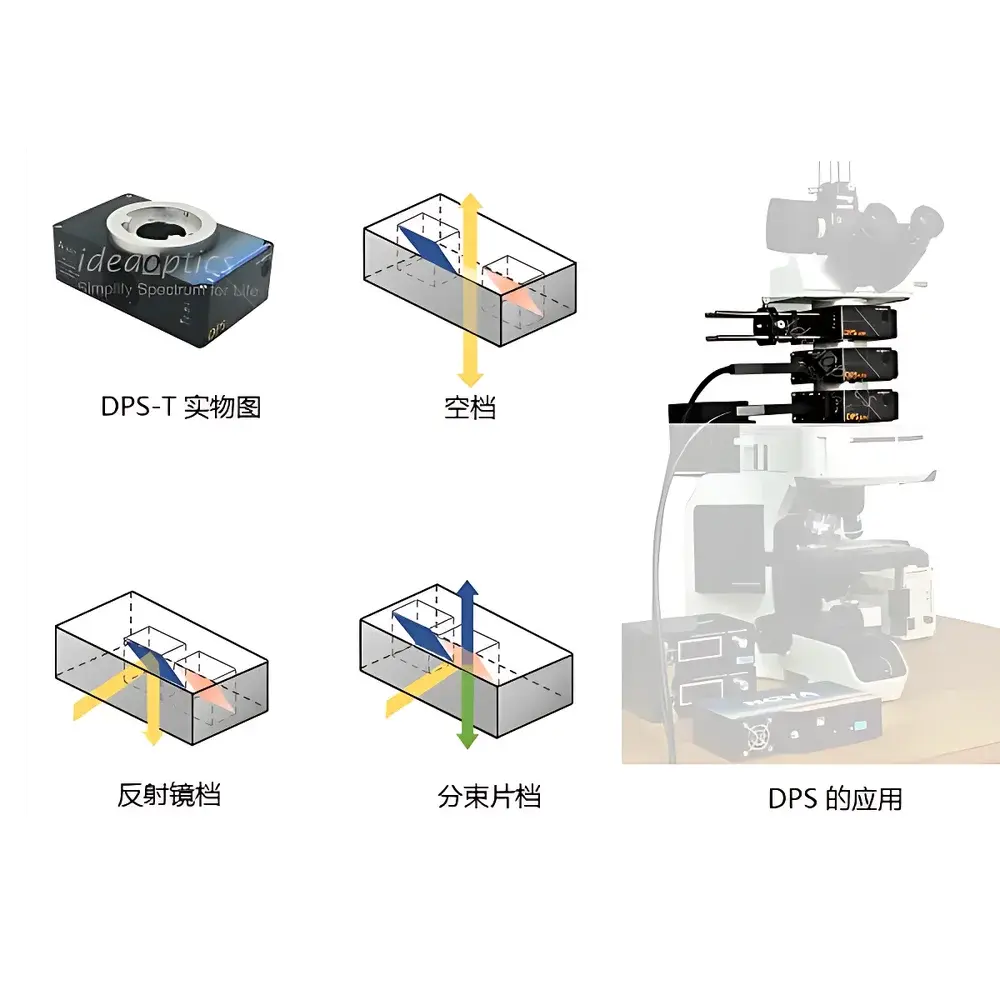
IdeaOptics DPS Microscopic Parallel-Beam Dual-Port Switcher
| Brand | IdeaOptics |
|---|---|
| Model | DPS |
| Origin | Shanghai, China |
| Manufacturer Type | Direct Manufacturer |
| Product Category | Optical Component |
| Mounting Compatibility | Standard Microscope Trinocular Port (C-Mount & RMS Adaptable) |
| Switching Precision | ±1 µm (repeatability at objective focal plane) |
| Port Configuration | Two independent parallel-beam output ports with in-situ mechanical indexing |
| Structural Framework | Stainless steel chassis with precision linear slide rails and kinematic mirror mounts |
| Customization Options | Interchangeable filter holders (25 mm, 32 mm), dichroic mount adapters, fiber-coupling interfaces (SMA905, FC/PC), cage system compatibility (30 mm rods) |
Overview
The IdeaOptics DPS Microscopic Parallel-Beam Dual-Port Switcher is an engineered optical component designed for high-fidelity beam routing in integrated microspectroscopy platforms. It operates on the principle of mechanically indexed, collimated-beam redirection—enabling deterministic switching between two parallel optical paths without realignment of downstream spectrometers, detectors, or excitation sources. Unlike conventional flip mirrors or manual turret systems, the DPS maintains beam collimation and spatial stability across switching cycles, ensuring consistent magnification scaling, minimal wavefront distortion, and preserved étendue at the microscope’s intermediate image plane. Its architecture is optimized for integration into confocal, epifluorescence, and micro-Raman configurations where spectral fidelity, path-to-path reproducibility, and multi-modal compatibility are critical—particularly in research involving sub-micron emitters, low-photon-yield quantum dot ensembles, or spatially resolved photoluminescence mapping.
Key Features
- Precision dual-port indexing: Two independently accessible, collimated output ports with ≤1 µm positional repeatability at the objective back focal plane—validated via interferometric alignment tracking over >10,000 actuation cycles.
- Modular optical carrier platform: Integrated kinematic mirror mounts (±2° tip/tilt adjustability) support user-installed dichroic beamsplitters, bandpass filters (25 mm or 32 mm diameter), metallic mirrors, or custom optics—without requiring recalibration of the primary imaging axis.
- Collimation-preserving mechanics: Utilizes hardened stainless steel linear translation stages with preloaded recirculating ball bearings and thermal-compensated housing to eliminate hysteresis and drift under ambient lab conditions (20–25 °C, <60% RH).
- Universal microscope interface: Ships with standardized C-mount and RMS-thread adapters; optional custom flanges available for Zeiss Axio, Nikon Eclipse, Olympus BX series, and Thorlabs KPS101/KPS201 microscope bodies.
- Hybrid coupling flexibility: Supports free-space beam delivery to spectrographs or CCD/EMCCD cameras, as well as direct SMA905 or FC/PC fiber coupling for portable Raman probes or OEM spectrometer modules.
Sample Compatibility & Compliance
The DPS switcher is routinely deployed in GLP-compliant microanalysis workflows for semiconductor metrology, nanomaterial characterization, and life science imaging. Its mechanical design conforms to ISO 10110-7 (optical component surface quality) and meets RoHS Directive 2011/65/EU material restrictions. When integrated into a full CMS-based microspectroscopy system (e.g., CMS-200 + DPS + Shamrock 303i), the configuration supports ASTM E2821–22 (standard practice for micro-Raman spectral acquisition) and ISO/IEC 17025:2017 traceability requirements when paired with NIST-traceable calibration standards. No electrical certification (e.g., CE, UL) applies, as the DPS is a passive, non-powered optical component.
Software & Data Management
As a hardware-level optical router, the DPS requires no embedded firmware or driver software. Switching is executed manually via tactile knurled knob or optionally automated via third-party stepper motor controller (e.g., Thorlabs KDC101, Zaber T-NA08B) using TTL-triggered open-loop sequencing. All positional states are mechanically encoded—eliminating dependency on encoder feedback or software-defined “home” positions. In automated platforms, DPS state synchronization is managed externally through LabVIEW, Python (PyVISA), or MATLAB instrument control toolboxes, enabling script-driven acquisition sequences across fluorescence, Raman, and reflectance modalities within a single experimental session.
Applications
- Micro-LED spectral uniformity mapping: Enables rapid port-switching between broadband white-light reflectance and 405 nm laser-excited photoluminescence channels—preserving pixel registration across modalities at <5 µm spatial resolution.
- Quantum dot multichannel fluorescence profiling: Facilitates sequential insertion of narrowband emission filters (e.g., 525/30 nm, 580/30 nm, 620/30 nm) into the detection path while maintaining diffraction-limited focus and signal-to-noise ratio across repeated acquisitions.
- Correlative micro-Raman / micro-PL analysis: Allows concurrent alignment of 532 nm Raman excitation and 785 nm PL excitation paths onto the same sample region—minimizing stage drift-induced misregistration during cross-modal correlation.
- Weak-signal fluorescence lifetime validation: Used in conjunction with time-correlated single-photon counting (TCSPC) systems to isolate background-free detection windows via synchronized spectral filtering and port selection.
FAQ
Is the DPS compatible with inverted microscopes?
Yes—the DPS supports inverted configurations via optional extended arm adapters and upright/inverted optical path reversal kits. Mechanical footprint remains identical; only mounting orientation and beam height adjustment differ.
Can I install custom dichroic mirrors with non-standard angles of incidence?
Yes—kinematic mounts accommodate AOI from 0° to 45°, with angular repeatability better than ±0.02°. Mirror thickness tolerance: 1–6 mm.
Does switching affect the microscope’s Köhler illumination alignment?
No—because the DPS operates downstream of the microscope’s intermediate image plane and preserves collimation, Köhler alignment remains unaffected after port selection.
What is the maximum beam diameter supported?
32 mm clear aperture per port; effective usable diameter limited by installed optic size and field stop placement—typically 28 mm for optimal vignetting control.
Is vacuum or cleanroom compatibility available?
Standard DPS units are not vacuum-rated, but ultra-high-vacuum (UHV)-compatible variants with CF-flanged housings and outgassing-certified materials (per ASTM E595) can be supplied upon request.



