
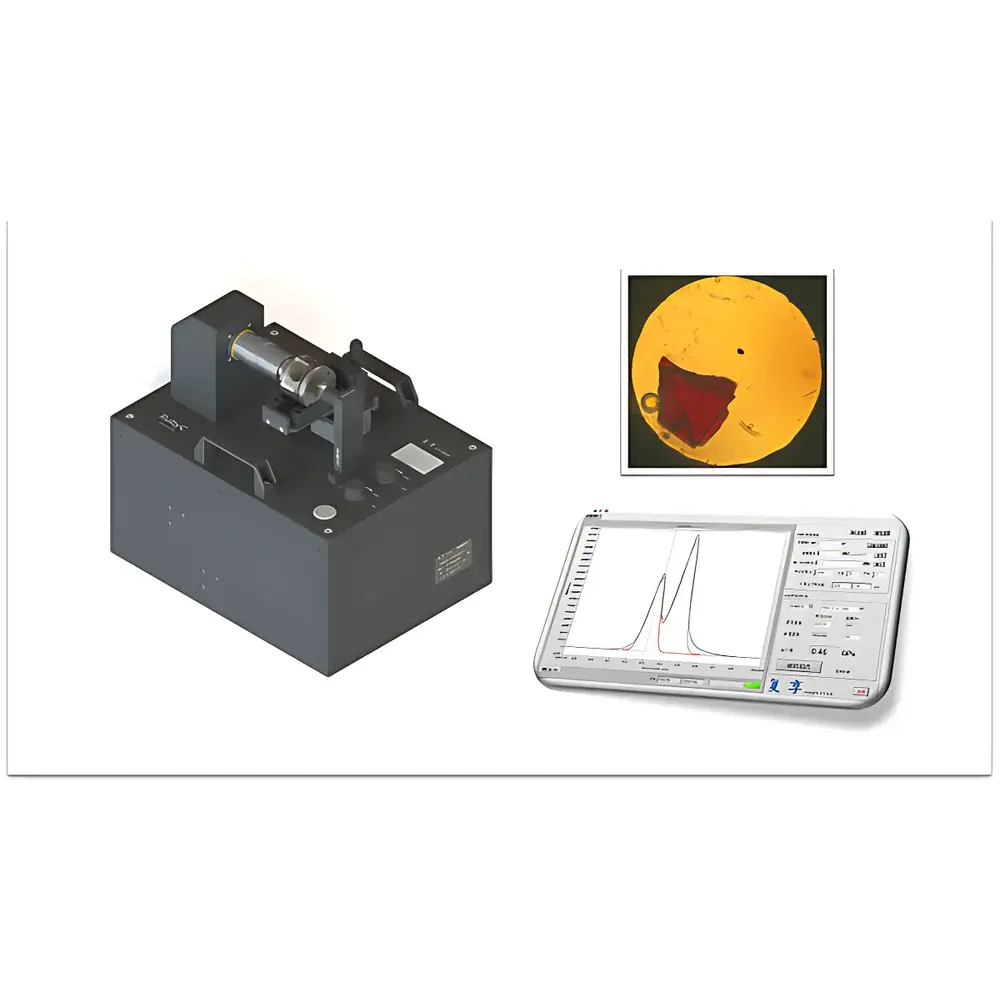
IdeaOptics RubyC Ruby Fluorescence Pressure Calibration System
| Brand | IdeaOptics |
|---|---|
| Origin | Shanghai, China |
| Manufacturer Type | Manufacturer |
| Product Origin | Domestic (China) |
| Model | RubyC |
| Pricing | Upon Request |
Overview
The IdeaOptics RubyC Ruby Fluorescence Pressure Calibration System is a compact, field-deployable optical instrument engineered for high-precision in situ pressure determination in diamond anvil cell (DAC) experiments. It operates on the well-established principle of ruby R₁ fluorescence peak shift under hydrostatic pressure—where the zero-pressure R₁ emission wavelength (694.2 nm at 300 K) redshifts linearly with increasing pressure, following calibrated empirical relations (e.g., Mao et al., J. Geophys. Res., 1986; Dorogokupets & Oganov, Phys. Rev. B, 2007). Designed specifically for synchrotron beamlines, high-pressure laboratories, and mobile research platforms, the RubyC system delivers traceable pressure calibration across a validated range exceeding 50 GPa, with measurement uncertainty better than ±0.05 GPa under standard ambient temperature conditions (295–300 K). Its integrated optomechanical architecture ensures thermal and mechanical stability during long-duration acquisitions, while maintaining compatibility with cryogenic stages, magnetic fields, and laser heating setups.
Key Features
- Low-Power, Diffraction-Limited Excitation: Utilizes a confocal optical path with <5 µm spatial resolution at the sample plane, minimizing photothermal stress and preventing irreversible fluorescence quenching or lattice damage in ruby microcrystals or adjacent high-pressure samples.
- High-Sensitivity Spectral Detection: Equipped with a back-illuminated, deep-depletion CCD sensor (64 × 2048 pixels), delivering quantum efficiency >85% in the 670–720 nm spectral window—more than double that of conventional front-illuminated detectors—enabling robust R₁/R₂ peak discrimination even under weak fluorescence yield.
- Large Field-of-View Imaging: Integrated 600 × 400 µm² high-resolution visible-light imaging channel facilitates rapid sample navigation, precise ruby grain localization, and real-time alignment verification without requiring stage repositioning.
- Fully Automated Spectral Analysis: Onboard algorithms perform real-time peak search, Gaussian/Lorentzian fitting, baseline correction, and pressure calculation using NIST-traceable calibration polynomials (e.g., Datchi et al., Rev. Sci. Instrum., 2007), supporting both single-point and multi-point mapping modes.
- Transport-Optimized Mechanical Design: Monolithic aluminum chassis with vibration-damping mounts, shock-absorbing packaging, and IP52-rated enclosure enable safe air freight and repeated field deployment without recalibration.
Sample Compatibility & Compliance
The RubyC system is compatible with standard DAC geometries (e.g., symmetric, wedge-shaped, membrane-driven cells) and accommodates ruby chips (typically 5–20 µm size) embedded in various pressure-transmitting media (e.g., neon, helium, methanol-ethanol mixtures). It supports operation under cryogenic conditions (down to 4 K with optional cryo-adaptation) and in magnetic fields up to 15 T when used with non-magnetic optical components. All optical paths comply with ISO 10110-7 surface quality standards, and spectral calibration is traceable to NIST SRM 2035a (ruby fluorescence reference). The system meets general laboratory safety requirements per IEC 61010-1 and is designed for use in GLP-compliant environments where audit-ready data provenance is required.
Software & Data Management
The proprietary RubyControl software (Windows 10/11, 64-bit) provides a modular GUI for instrument control, spectral acquisition, and pressure reporting. It features full metadata logging—including timestamp, excitation power, integration time, ambient temperature, and user-defined experimental notes—and exports ASCII-compatible .csv and HDF5 files for third-party analysis (e.g., Python, Igor Pro, OriginLab). Audit trail functionality records all parameter changes and processing steps, satisfying FDA 21 CFR Part 11 requirements for electronic records in regulated research settings. Remote operation via TCP/IP is supported for integration into automated high-pressure workflows.
Applications
- In situ pressure calibration during synchrotron X-ray diffraction and spectroscopy experiments
- Multi-anvil press (MAP) and large-volume press (LVP) pressure monitoring with fiber-coupled probe adaptation
- Coupled high-pressure–low-temperature studies using closed-cycle refrigerators
- Pressure–magnetic field correlation measurements in superconductivity and quantum material research
- Calibration transfer between primary and secondary high-pressure facilities
- Educational demonstrations of solid-state phase transitions and equation-of-state modeling
FAQ
What is the maximum pressure range validated for the RubyC system?
The system has been experimentally verified for reliable R₁ peak tracking up to 53 GPa using neon as a pressure medium, consistent with the extended calibration range defined by Dorogokupets & Oganov (2007).
Can the RubyC be used with non-ruby pressure standards (e.g., Sm:YAG, Si)?
While optimized for ruby fluorescence, the spectrometer’s broad spectral response (650–750 nm) allows adaptation to other visible-emitting standards via custom calibration protocols and firmware updates.
Is remote calibration support available?
Yes—certified calibration reports with uncertainty budgets are issued annually; remote diagnostics and firmware updates are provided via secure customer portal.
Does the system require external water cooling or high-power electrical supply?
No—it operates on a single 24 V DC input (≤60 W), with passive thermal management enabling continuous operation in confined or portable lab environments.
How is data integrity ensured during long-term field deployments?
All acquired spectra include embedded SHA-256 checksums, and software enforces write-once archival mode to prevent post-acquisition modification—critical for publication-grade reproducibility and peer review compliance.





