
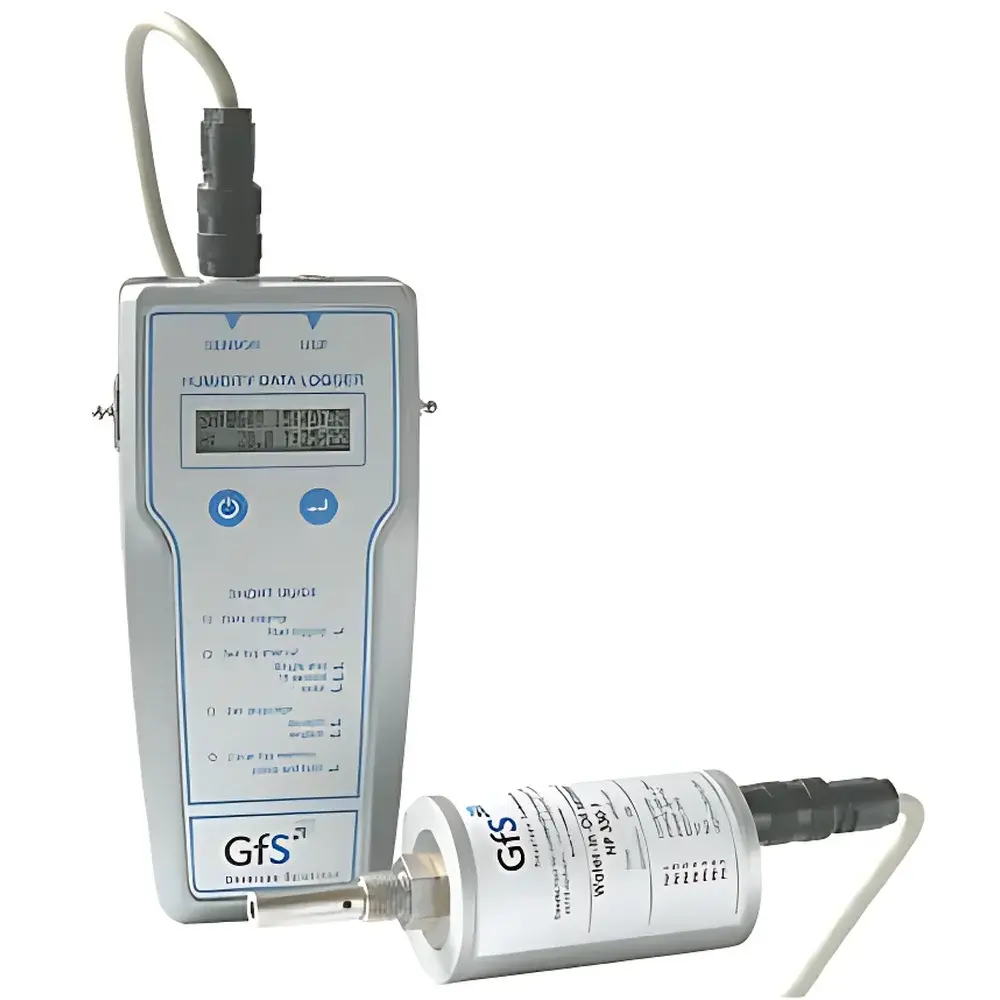
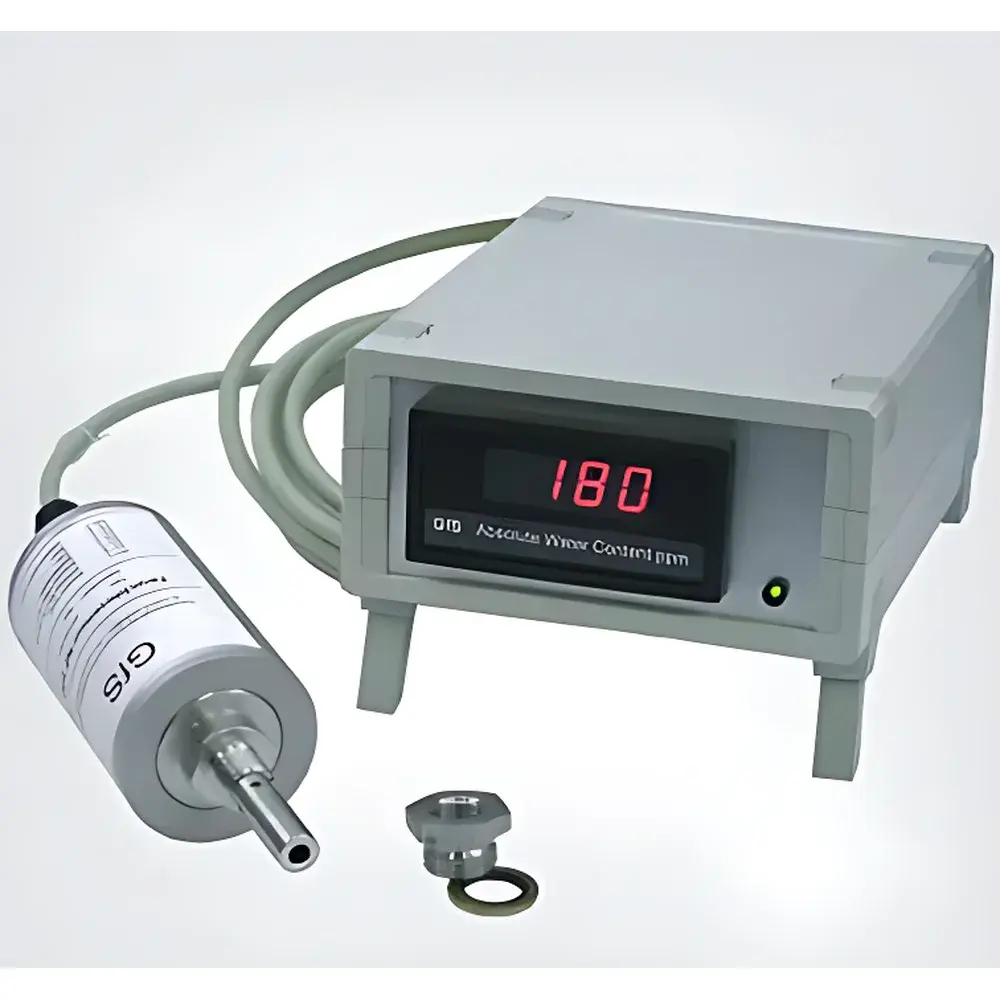
GFS NP330-F Online Oil Moisture Analyzer
| Brand | GFS |
|---|---|
| Origin | Germany |
| Model | NP330-F |
| Measurement Principle | Capacitive Dielectric Sensing (ASTM D1533 Traceable Calibration) |
| Measurement Range (Sensor) | 10–20,000 ppm H₂O in oil |
| Temperature Range (Sensor) | −20 °C to +70 °C |
| Pressure Rating (Sensor) | 0–300 bar |
| Sensor Thread | 1/2″ NPT |
| IP Rating (Sensor) | IP65 |
| Display Range (Desktop Unit) | 0–1999 ppm |
| Desktop Operating Temp. | 0–50 °C |
| Desktop Power | 230 V AC, 50–60 Hz |
| Desktop Enclosure | IP50 |
| Portable Unit Housing | Die-cast aluminum |
| Portable IP Rating | IP54 |
| Portable Power | Rechargeable Ni-Mn battery (4×AA equivalent) |
| Display | 2-line LCD, 16 characters/line |
| Data Storage Capacity | 12,000 records |
| Data Logging Interval | User-adjustable |
| Connector | Binder 723 |
| Interface | USB |
| Portable Operating Temp. | 0–40 °C |
| Dimensions (Desktop) | 150 × 65 × 210 mm (W×H×D) |
| Dimensions (Portable) | 100 × 220 × 42.4 mm (W×H×D) |
| Installation Depth | 50 mm |
Overview
The GFS NP330-F Online Oil Moisture Analyzer is an industrial-grade, in-line capacitive dielectric sensor system engineered for continuous, real-time quantification of water content in liquid hydrocarbon-based lubricants and hydraulic fluids. Unlike conventional Karl Fischer titration—which requires offline sampling, reagent handling, and laboratory infrastructure—the NP330-F operates on a traceable, non-destructive dielectric principle calibrated against ASTM D1533 reference methodology. This ensures metrological consistency across diverse oil chemistries, including mineral oils, synthetic esters, polyalphaolefins (PAOs), silicone-based fluids, and biodegradable vegetable-oil derivatives. The sensor’s robust stainless-steel housing and ceramic dielectric sensing element withstand sustained exposure to high-pressure hydraulic circuits (up to 300 bar) and wide thermal transients (−20 °C to +70 °C), enabling direct insertion into main circulation lines without bypass loops or flow conditioning. Its 50 mm immersion depth and standardized 1/2″ NPT thread facilitate retrofitting into existing OEM manifolds and condition-monitoring ports.
Key Features
- Capacitive dielectric sensing technology with factory calibration traceable to ASTM D1533 for reproducible ppm-level water quantification
- Wide dynamic range: 10–20,000 ppm water-in-oil—covering both early-stage contamination and near-saturation conditions
- High-pressure sensor rated to 300 bar, suitable for turbine lube systems, servo-valve circuits, and high-intensity hydraulic power units
- Dual-host configuration: choice between compact desktop unit (IP50, mains-powered) and rugged portable unit (IP54, battery-operated)
- Portable host features integrated data logger storing up to 12,000 timestamped readings with user-defined logging intervals (1 min to 24 h)
- Binder 723 connector ensures secure, vibration-resistant sensor interface; USB port enables direct data export to PC-based asset management platforms
- Die-cast aluminum enclosure (portable) and corrosion-resistant sensor body ensure long-term reliability in industrial environments subject to dust, moisture, and mechanical shock
Sample Compatibility & Compliance
The NP330-F is validated for use with non-conductive and low-conductivity oils having dielectric constants ranging from εr ≈ 2.0 (e.g., PAO-based synthetics) to εr ≈ 5.5 (e.g., phosphate ester fire-resistant fluids). It excludes conductive fluids such as water-glycol blends or emulsified coolants. Calibration stability is maintained across viscosity ranges from ISO VG 10 to VG 680, provided fluid cleanliness meets NAS 1638 Class 7 or better. The analyzer complies with electromagnetic compatibility requirements per EN 61326-1 (industrial environment), and its electrical safety design conforms to EN 61010-1. While not a standalone GLP/GMP instrument, the portable unit’s audit-ready data log—including operator ID fields, calibration timestamps, and sensor serial traceability—supports adherence to ISO 55001 asset management frameworks and internal QC protocols aligned with ISO 4406 and ASTM D7688 for lubricant condition monitoring.
Software & Data Management
No proprietary software installation is required. Raw measurement files exported via USB are structured as plain-text CSV with columns: Date, Time, ppm Reading, Sensor Temp (°C), Host Battery Level (%), and Event Flag (e.g., “Calibration,” “Alarm”). This format integrates natively with CMMS platforms (e.g., SAP PM, IBM Maximo), SCADA historian databases (e.g., OSIsoft PI, Canary Labs), and statistical process control tools (e.g., Minitab, JMP). The portable unit supports firmware updates via USB and includes configurable alarm thresholds (low/high ppm limits) with visual LED indicators and audible alerts. All stored records retain immutable metadata—no editing or deletion is possible post-acquisition, satisfying basic data integrity requirements under FDA 21 CFR Part 11 Annex 11 for non-GxP industrial documentation.
Applications
- Continuous moisture surveillance in gas turbine lube oil systems to prevent bearing corrosion and varnish formation
- Real-time monitoring of hydraulic fluid in offshore wind pitch/yaw actuators where water ingress accelerates hydrolytic degradation
- Condition-based maintenance of compressor lubricants in petrochemical refineries operating under cyclic thermal stress
- Verification of dehydration efficiency in offline vacuum dehydrators and coalescer filter systems
- Field verification of oil dryness prior to commissioning transformers, gearboxes, and servo-valve assemblies
- Trend analysis of water accumulation kinetics in biodegradable lubricants used in food-grade machinery and forestry equipment
FAQ
Does the NP330-F require periodic recalibration using Karl Fischer standards?
No. The sensor is factory-calibrated against ASTM D1533 reference materials and maintains baseline stability for ≥12 months under typical operating conditions. Field verification with certified standard oils (e.g., GFS MOIST-STD-1000) is recommended annually or after sensor replacement.
Can the sensor be installed in vertical piping without affecting accuracy?
Yes. The capacitive measurement is orientation-independent; however, mounting must ensure full immersion of the 50 mm active sensing zone and avoid air pockets or sediment accumulation at the tip.
Is the portable unit suitable for intrinsically safe (IS) hazardous areas?
No. Neither the sensor nor the portable host carries ATEX, IECEx, or UL HazLoc certification. For Zone 1/2 applications, consult GFS for explosion-proof enclosure options or remote-mount configurations.
What happens if oil temperature exceeds +70 °C at the sensor location?
Prolonged exposure above +70 °C may accelerate dielectric drift and reduce long-term stability. For high-temp applications (e.g., engine oil sumps), use a cooled sample probe or install upstream of heat exchangers.
How is sensor fouling addressed during extended service?
The ceramic sensing surface resists carbonaceous deposits and oxidation films. If fouling occurs (e.g., in severely degraded oils), cleaning with isopropyl alcohol and lint-free swabs restores performance—no disassembly required.
Related Products





