
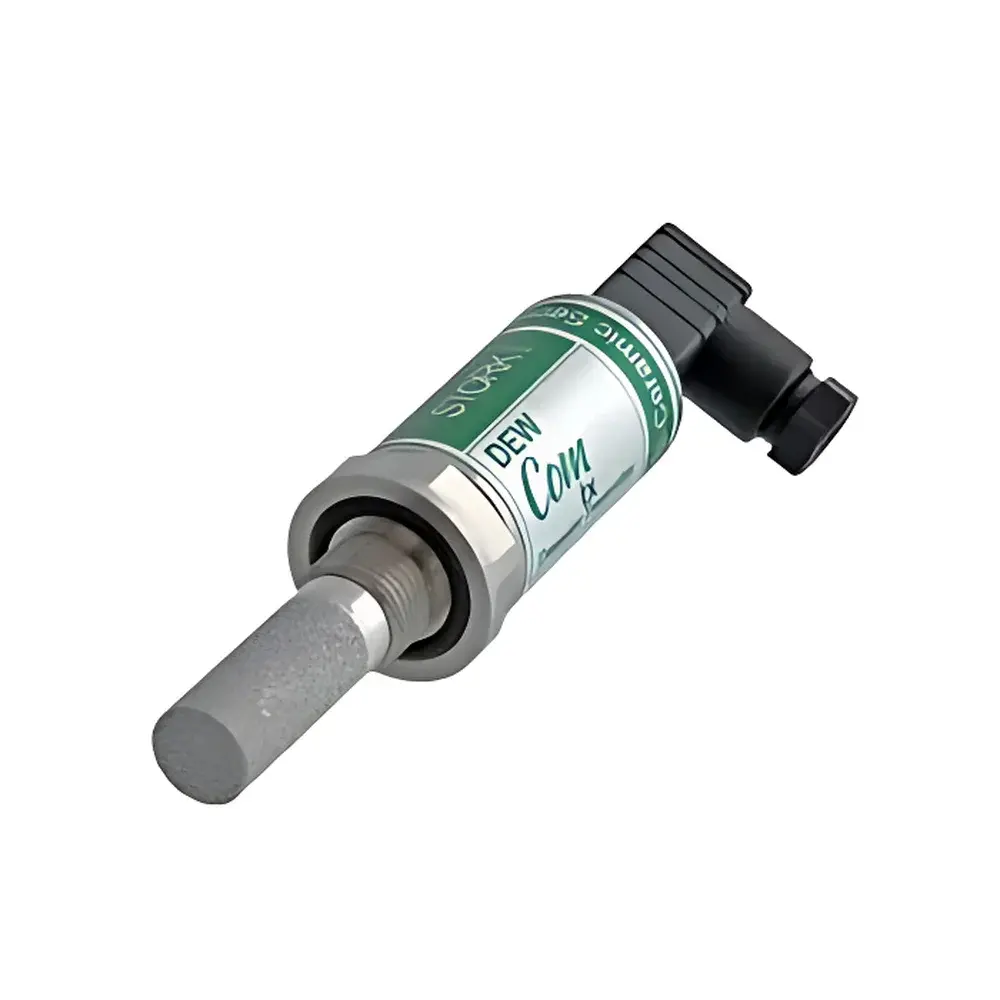
Stork DEWCom Online Dew Point Transmitter
| Brand | Stork |
|---|---|
| Origin | Poland |
| Model | DEWCom |
| Product Type | Online Dew Point Transmitter |
| Measurement Principle | Dual-ceramic nanofilm capacitive sensor |
| Operating Temperature | -40 °C to +60 °C |
| Accuracy | ±2 °C dew point |
| Repeatability | ±0.5 °C dew point |
| Dew Point Range | -100 °C to +20 °C dew point |
| Response Time (T95) | ~1 min (dry-to-wet) |
| Output Signal | 4–20 mA, 2-wire |
| Supply Voltage | 8–36 V DC |
| Load Resistance | ≤660 Ω @ 24 V DC |
| Power Consumption | ≤20 mA |
| Pressure Rating | up to 40 MPa |
| Flow Rate | 0.2–5 L/min (in standard flow cell) |
| Temperature Compensation | Full-range automatic compensation |
| Enclosure Rating | IP65 |
| Housing Material | Stainless steel |
| Filter | 20 µm sintered stainless steel |
| Sensor Interchangeability | Fully plug-and-play, no field recalibration required |
| Fault Signals | 23 mA or 3.5 mA (configurable) |
| <range | 4 mA |
| >range | 20 mA |
| Dimensions | Ø30 mm × 114 mm |
| Weight | 170 g |
Overview
The Stork DEWCom Online Dew Point Transmitter is a high-reliability, two-wire 4–20 mA industrial dew point measurement instrument engineered for continuous, real-time monitoring of moisture content in compressed air and non-corrosive process gases. It employs dual-ceramic nanofilm capacitive sensing technology—a robust, drift-resistant method based on the dielectric constant shift of hydrated ceramic layers under varying water vapor partial pressure. Unlike chilled-mirror or aluminum oxide sensors, this architecture delivers stable performance across wide temperature and pressure ranges without mechanical cooling or frequent zero-point drift correction. The DEWCom is designed for seamless integration into distributed control systems (DCS), programmable logic controllers (PLC), and SCADA architectures—functioning as a drop-in replacement for conventional temperature or pressure transmitters in gas quality assurance loops.
Key Features
- True plug-and-play sensor interchangeability: factory-calibrated ceramic nanofilm elements require no field configuration or zero/span adjustment upon replacement—ensuring uninterrupted process monitoring.
- Full-range automatic temperature compensation: internal thermal modeling corrects dew point output across the full operating ambient range (−40 °C to +60 °C), eliminating manual correction tables or external RTD inputs.
- High-pressure capability: rated for continuous operation up to 40 MPa (5800 psi), validated per EN 13480-3 and ASME B31.4 for integration into natural gas transmission, hydrogen compression, and supercritical CO₂ pipelines.
- IP65-rated stainless steel housing with integrated 20 µm sintered stainless steel filter—designed for harsh industrial environments including offshore platforms, chemical processing zones, and cleanroom utility tunnels.
- Configurable fault signaling: user-selectable 23 mA or 3.5 mA alarm output for sensor failure, with linear 4–20 mA scaling covering the full −100 °C to +20 °C dew point range (4 mA = below range; 20 mA = above range).
- Low-power, loop-powered design: operates within standard HART-compatible 2-wire infrastructure, consuming ≤20 mA at 24 V DC and supporting load resistances up to 660 Ω—compatible with legacy analog I/O modules.
Sample Compatibility & Compliance
The DEWCom is validated for use with dry air, nitrogen, argon, helium, hydrogen, oxygen (non-oxygen-rich service), natural gas, and purified industrial gases—including those meeting ISO 8573-1 Class 0 and ASTM D2029 specifications for instrumental air quality. It is not suitable for corrosive gases (e.g., Cl₂, NH₃, H₂S), solvent vapors, or condensing streams. All units ship with a NIST-traceable 7-point calibration certificate (−70 °C to +20 °C DP), compliant with ISO/IEC 17025 requirements for accredited calibration laboratories. The transmitter meets EMC Directive 2014/30/EU, RoHS 2011/65/EU, and carries CE marking for use in ATEX Zone 2 (II 3G Ex nA IIC T4 Gc) when installed with appropriate barrier systems.
Software & Data Management
While the DEWCom operates as a stand-alone analog transmitter, its output is fully compatible with industry-standard data acquisition platforms—including Siemens Desigo CC, Honeywell Experion PKS, Emerson DeltaV, and Yokogawa CENTUM VP. For commissioning and diagnostics, Stork provides the optional DEWLink USB interface and PC software (Windows 10/11), enabling live parameter readout, calibration history review, and firmware updates. Audit trails generated during configuration comply with FDA 21 CFR Part 11 requirements when used with validated electronic record systems. The device supports HART 7 protocol via optional digital overlay, allowing remote verification of sensor health, diagnostic flags, and last-calibration timestamp without interrupting 4–20 mA signal integrity.
Applications
- Petrochemical & refining: monitoring dew point in fuel gas lines, amine regeneration off-gas, and catalyst purge streams to prevent hydrate formation and corrosion.
- Natural gas transmission: inline verification of dehydration efficiency pre- and post-molecular sieve beds per AGA Report No. 10 and GPA 2172 standards.
- Power generation: compressed air system validation for turbine control air, instrument air, and generator hydrogen-cooling circuits.
- Pharmaceutical manufacturing: environmental monitoring of compressed air used in sterile filling lines (ISO 8573-1 Class 1.1.1), lyophilizer purge gas, and clean steam tracing.
- Aerospace & defense: moisture control in aircraft pneumatic systems, avionics cooling loops, and inerting gas supplies for fuel tanks.
- Nuclear facilities: qualification-grade dew point monitoring in primary coolant purge gas and containment ventilation systems under ASME NQA-1 guidelines.
FAQ
Can the DEWCom be installed directly in high-velocity gas streams?
Yes—when configured with the optional in-situ probe variant, it supports direct insertion at flow velocities up to 10 m/s, provided the probe is oriented perpendicular to flow and upstream turbulence is minimized per ISO 8573-3 Annex B.
Is field recalibration required after sensor replacement?
No. Each ceramic nanofilm sensor is individually calibrated and serialized at the Stork manufacturing facility in Kraków. Replacement is fully interchangeable with no zero/span adjustment needed.
Does the transmitter support digital communication protocols?
The base model is analog-only (4–20 mA), but HART 7 digital overlay is available as a factory-configurable option for enhanced diagnostics and remote configuration.
What is the maximum allowable process pressure for standard flow-cell installation?
The standard flow cell is rated to 40 MPa (5800 psi) at 20 °C. Derating applies above 50 °C per EN 13480-3 Annex C; consult Stork’s pressure-temperature derating chart for specific conditions.
How is traceability maintained across calibration cycles?
Each unit includes a NIST-traceable 7-point certificate with uncertainty budget per ISO/IEC 17025. Calibration intervals are determined by risk assessment per ISO/IEC 17025 Clause 7.7 and typically range from 12–24 months depending on process severity.





