
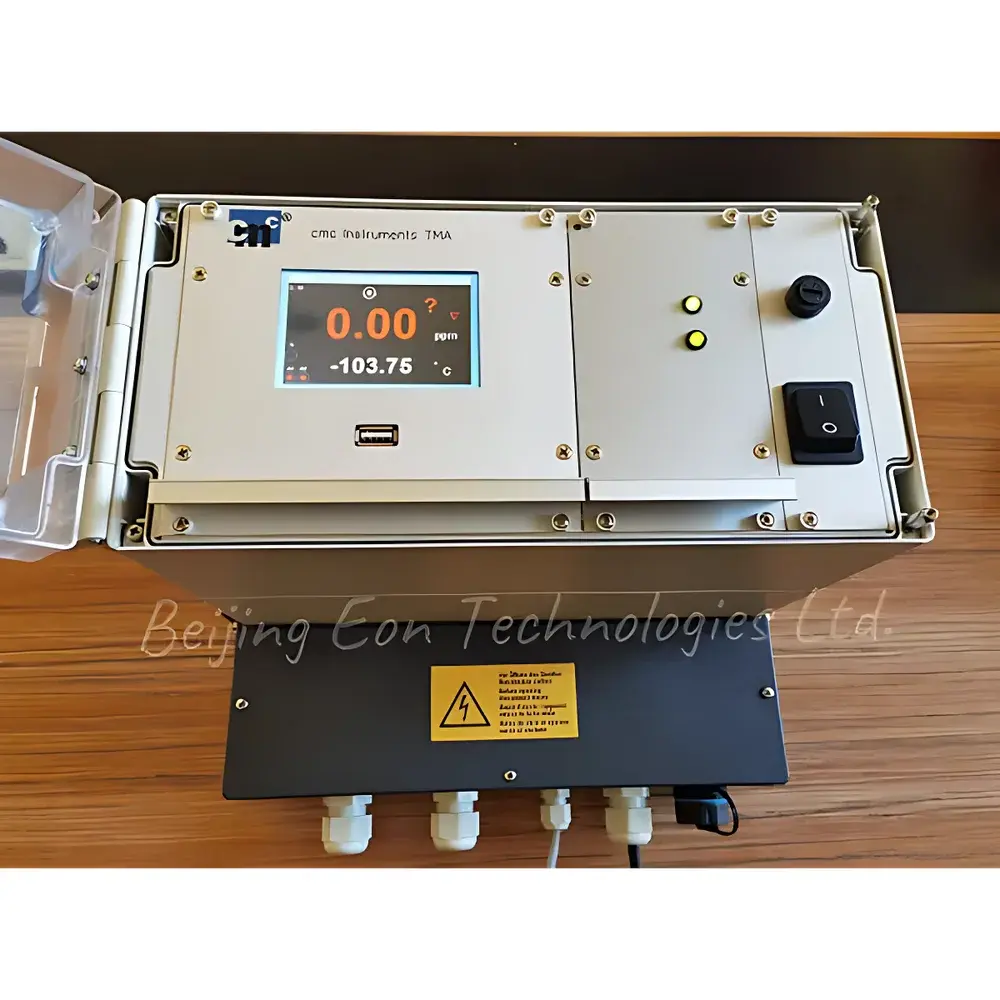
CMC iTMA-204-W-Ex Intrinsically Safe Electrolytic Dew Point Analyzer for Chlorine and Corrosive Gases
| Brand | CMC |
|---|---|
| Origin | Germany |
| Model | iTMA-204-W-Ex |
| Product Type | In-line Dew Point Analyzer |
| Measurement Principle | Phosphorus Pentoxide (P₂O₅) Electrolytic Method |
| Operating Temperature | 5–50 °C |
| Accuracy | ±1% of full scale |
| Repeatability | ±0.1% of full scale |
| Range Options | 0–10 ppm, 0–100 ppm, 0–1000 ppm, 0–2500 ppm (auto/manual switching) |
| Response Time (T₉₀) | <1 s |
| T₅₀ Response | <8 s |
| Sample Flow Rate | 20 NL/h |
| Recommended Sample Pressure | 0.1–0.5 barg |
| Display | Touchscreen with multilingual UI (including Chinese) |
| Analog Output | 0/4–20 mA (configurable) |
| Alarm Outputs | 2 relay outputs |
| Enclosure Rating | ATEX/IECEx certified for Zone 1/21 (Ex d ia IIC T4 Ga / Ex tD A21 IP66 T80°C) |
| Dimensions | 310 × 250 × 285 mm (W × H × D) |
| Cable Length | Standard 3 m (up to 300 m optional) |
Overview
The CMC iTMA-204-W-Ex is an intrinsically safe, in-line electrolytic dew point analyzer engineered for continuous, absolute moisture measurement in aggressive and flammable process gases—particularly chlorine (Cl₂), hydrogen chloride (HCl), sulfur dioxide (SO₂), hydrogen sulfide (H₂S), and other high-purity acid gases. It employs the well-established phosphorus pentoxide (P₂O₅) electrolytic principle: water vapor in the sample gas is quantitatively decomposed via electrochemical reaction across a thin-film P₂O₅-coated sensor cell. The resulting electrolysis current is directly proportional to the water concentration, enabling trace-level detection without reliance on calibration drift or external reference standards. Unlike capacitive or chilled-mirror methods, this technique delivers true absolute measurement—eliminating the need for periodic recalibration under stable operating conditions. The sensor’s glass-body construction, platinum/rhodium electrode configuration, and chemically inert P₂O₅ electrolyte layer ensure long-term stability and resistance to chemical attack in highly corrosive environments. The instrument is certified for hazardous areas per ATEX Directive 2014/34/EU and IECEx standards (Ex d ia IIC T4 Ga / Ex tD A21 IP66 T80°C), making it suitable for installation directly in Cl₂ liquefaction lines, chlor-alkali plant off-gas streams, and semiconductor-grade gas delivery systems.
Key Features
- Intrinsically safe design compliant with ATEX Zone 1 and IECEx Zone 21 for direct installation in explosive atmospheres containing Cl₂, HCl, or H₂S
- True absolute measurement via P₂O₅ electrolytic sensor—no zero drift, no span recalibration required under normal operation
- Ultra-fast response: T₉₀ < 1 second, T₅₀ < 8 seconds—enabling real-time process control and rapid leak detection
- Four auto-switching measurement ranges (0–10 ppm, 0–100 ppm, 0–1000 ppm, 0–2500 ppm) optimized for varying moisture load scenarios
- Full microprocessor-based architecture with self-diagnostic startup sequence, sensor health monitoring, and fault logging
- Robust sensor regeneration capability: electrochemical reconditioning of the P₂O₅ film restores baseline sensitivity without sensor replacement
- Touchscreen HMI with configurable language support (including English, German, and Chinese), intuitive navigation, and embedded data history
Sample Compatibility & Compliance
The iTMA-204-W-Ex is validated for use with non-reactive and moderately reactive gases including N₂, O₂, Ar, Kr, Xe, He, H₂, D₂, CO₂, CH₄, natural gas, SF₆, Freons, and acetylene. Its primary application domain centers on highly corrosive and oxidizing gases where conventional sensors fail—especially chlorine, hydrogen chloride, sulfur dioxide, and hydrogen sulfide. Compatibility is contingent upon absence of species that chemically degrade P₂O₅ or poison the electrode surface (e.g., strong reducing agents or fluoride-containing compounds beyond trace levels). All wetted materials—including sensor housing, flow path, and inlet fittings—are selected for corrosion resistance (e.g., 316L SS, PTFE, borosilicate glass). The analyzer meets NAMUR NE 43 signaling conventions and supports integration into SIL-2-capable safety instrumented systems (SIS) when deployed with appropriate redundancy architecture. It operates within GLP/GMP-aligned environments and supports audit-ready data integrity when paired with CMC’s optional secure logging module (compliant with FDA 21 CFR Part 11 requirements for electronic records).
Software & Data Management
The embedded firmware provides real-time moisture concentration display, trend plotting over 30 days, and event-triggered data capture (e.g., alarm activation, range switch, sensor regeneration). Analog output (4–20 mA) is fully scalable and linearized across any selected range; two programmable relay outputs support high/low alarms or maintenance alerts. Optional Ethernet or RS-485 Modbus RTU interface enables connection to DCS, SCADA, or LIMS platforms. CMC’s PC-based configuration software (iTMA ConfigTool v3.2+) allows remote parameter setup, firmware updates, calibration certificate import/export, and diagnostic report generation. All operational logs—including sensor voltage, electrolysis current, temperature compensation status, and power-on self-test results—are timestamped and stored with SHA-256 hash verification to ensure data provenance and regulatory compliance.
Applications
- Chlor-alkali industry: Continuous monitoring of moisture in liquid chlorine transfer lines, vaporizer outlets, and cylinder filling stations
- Chemical synthesis: Moisture control in SO₂ and HCl feed streams for catalyst protection in alkylation or fluorination reactors
- Semiconductor manufacturing: Verification of ultra-high-purity (UHP) process gases prior to chamber introduction
- Power generation: Monitoring of SF₆ insulation gas dryness in GIS substations to prevent dielectric breakdown
- Pharmaceutical excipient drying: In-line verification of residual moisture in nitrogen purge streams during lyophilization
- Environmental emission monitoring: Quantification of water interference in stack gas analyzers measuring acidic pollutants
FAQ
Is the P₂O₅ sensor affected by chlorine exposure?
No—the sensor’s glass body and platinum/rhodium electrodes are chemically inert to Cl₂ at typical process concentrations and temperatures. Long-term validation data from chlor-alkali installations confirm >24 months of stable operation without measurable degradation.
Can the instrument measure below 1 ppmv in Cl₂?
Yes—when configured in the 0–10 ppm range, the analyzer achieves a practical lower detection limit of 0.1 ppmv with a signal-to-noise ratio ≥10:1 under controlled flow and pressure conditions.
Does the iTMA-204-W-Ex require zero gas or span gas for routine operation?
Not for daily use. The P₂O₅ method is inherently absolute; only initial factory verification and periodic (e.g., annual) performance verification using traceable NIST-traceable moisture standards are recommended.
How is sensor regeneration performed?
Regeneration is initiated automatically during idle periods or manually via HMI. It applies reverse polarity current to restore the P₂O₅ film’s hydration state—typically completed in <90 seconds with no hardware intervention.
What is the maximum allowable sample pressure?
The standard flow cell is rated for continuous operation up to 0.5 barg. For higher-pressure applications (up to 10 barg), CMC offers a pressure-regulated sampling interface kit with integrated back-pressure control and particulate filtration.




