
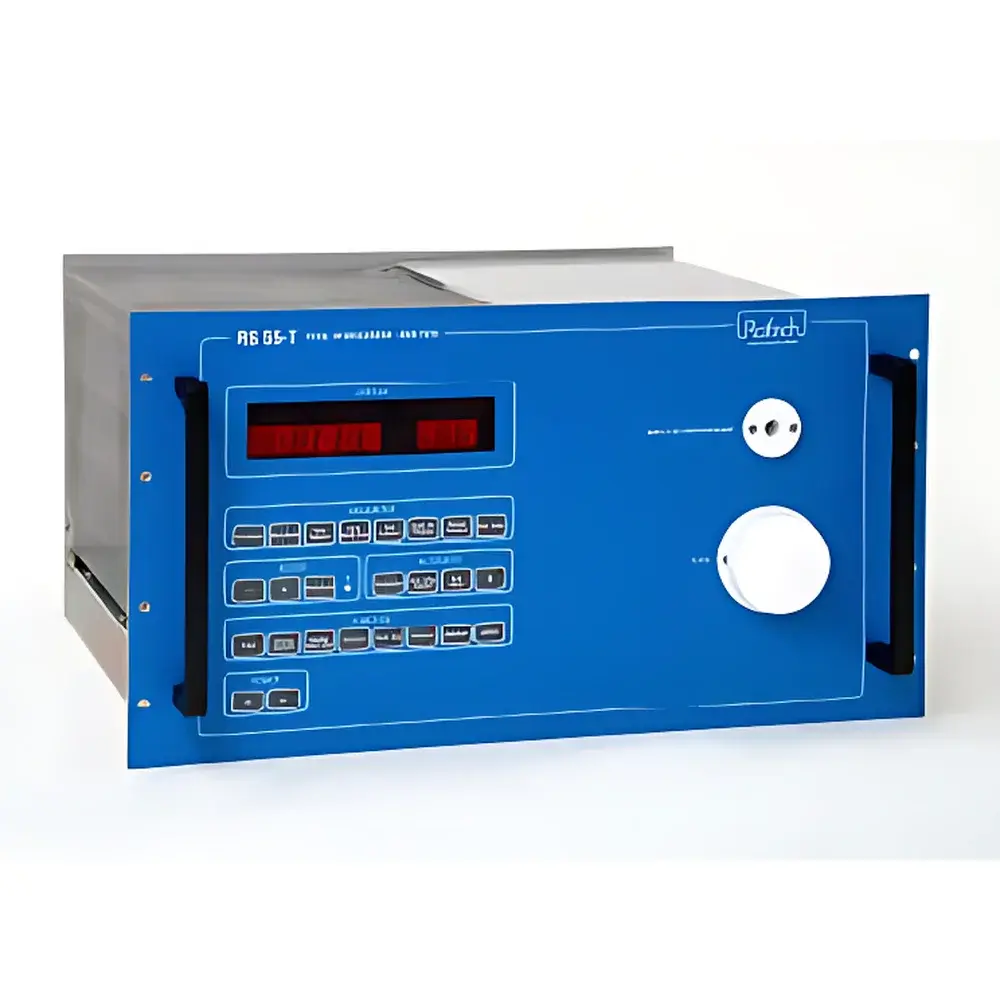
Ratfisch RS55-T Online Total Hydrocarbon Analyzer
| Brand | Ratfisch |
|---|---|
| Origin | Germany |
| Model | RS55-T |
| Measurement Principle | Catalytic Combustion (Flame Ionization Detection alternative configuration available per customization) |
| Range | 0–10 / 100 / 1,000 / 10,000 / 100,000 ppm C₃H₈ (propane-equivalent) |
| Linearity | ±2% of full scale up to 10,000 ppm |
| Cross-sensitivity to O₂ | <±2% of full scale |
| Detection Limit | <2% of lowest full-scale range |
| Zero Drift | <2% FS/week |
| Span Drift | <4% FS/week |
| Response Time (T₉₀) | ~1–2 s (sample line excluded) |
| Sample Flow Rate | ~220 L/h |
| Operating Temperature | +5 °C to +35 °C |
| Power Supply | 230 V / 50 Hz, 800 W |
| Dimensions | 483 mm (W) × 267 mm (H) × 500 mm (D) |
| Weight | ~26.5 kg |
| Certified Compliance | TÜV-certified per German 17. BImSchV |
| EPA Method Compatibility | Compliant with EPA Method 25A and 25B requirements for THC monitoring |
| Output Signals | 0–10 V analog, 0/4–20 mA isolated current loop |
| Status Contacts | Pre-alarm, Alarm, Range Identification, Flame-Out Indication, Calibration Mode (Zero/Gas), System Health (Pressure/Temperature/Flame Monitoring) |
Overview
The Ratfisch RS55-T Online Total Hydrocarbon Analyzer is a robust, continuous-emission monitoring system engineered for real-time quantification of total hydrocarbons (THC) in industrial exhaust streams, combustion flue gases, and process vents. It operates on the principle of catalytic combustion — a thermometric detection method where hydrocarbons are oxidized over a heated noble-metal catalyst, generating a measurable temperature differential proportional to concentration. This architecture ensures high stability, low maintenance, and immunity to non-hydrocarbon interferents such as CO₂, H₂O vapor (when heated), and NOₓ — critical advantages over flame ionization detection (FID) in harsh or humid environments. Designed for regulatory-grade compliance, the RS55-T meets stringent European and U.S. environmental measurement standards, including full alignment with the German 17. BImSchV ordinance and EPA Methods 25A and 25B for stationary source THC monitoring. Its heated measurement chamber (adjustable up to 200 °C) prevents condensation and eliminates adsorption losses of higher-boiling hydrocarbons (e.g., C₆–C₁₂), ensuring representative sampling across complex hydrocarbon matrices.
Key Features
- Heated analysis chamber (up to 200 °C) for dew-point suppression and volatile organic compound (VOC) recovery
- Auto-ranging capability with five programmable full-scale ranges (0–10 ppm to 0–100,000 ppm propane-equivalent)
- Integrated flame supervision system with automatic fuel cutoff upon flame-out detection
- Real-time diagnostics for chamber temperature, sample pressure, and catalytic flame status
- Configurable alarm hierarchy: pre-alarm, main alarm, range identification, and calibration mode signaling
- Modular expansion options: heated sample probe (up to 200 °C), particulate pre-filter (HEPA-rated), internal zero-air generator, compressed air supply module, and multi-channel sampling manifold
- Compliance-ready firmware supporting audit trails, user access levels, and configurable data logging intervals
Sample Compatibility & Compliance
The RS55-T is validated for use with dry or moderately humid gas streams containing saturated and unsaturated aliphatic/aromatic hydrocarbons (C₁–C₁₂). It excludes halogenated, oxygenated, or highly polar VOCs (e.g., methanol, acetone) from quantitative reporting unless individually calibrated. Sample conditioning is supported via optional heated sampling lines (maintained >120 °C) and inert-surface filtration to minimize catalytic poisoning and particle fouling. Regulatory conformance includes TÜV certification per 17. BImSchV Annex 4 (emission limit value verification), compatibility with EN 15267-3 QA/QC protocols, and adherence to EPA Performance Specification 8 (PS-8) for THC analyzers. Data integrity meets GLP and GMP-aligned requirements through time-stamped event logs, password-protected configuration changes, and non-volatile memory retention for calibration history.
Software & Data Management
The RS55-T supports optional PC-based data acquisition software compliant with FDA 21 CFR Part 11 for electronic records and signatures. The software provides real-time trend visualization, automated calibration scheduling, configurable alarm thresholds, and export to CSV or XML formats compatible with SCADA, DCS, and environmental data management systems (EDMS). All operational events — including zero/span validation, flame ignition/failure, range switching, and sensor health diagnostics — are timestamped and stored locally for ≥30 days. Remote diagnostics via Ethernet or RS-485 enable predictive maintenance alerts and firmware updates without on-site intervention.
Applications
- Continuous emission monitoring (CEM) of thermal oxidizers, incinerators, and regenerative thermal oxidizers (RTOs)
- Combustion efficiency optimization in boilers, furnaces, and kilns via THC feedback control loops
- Threshold limit value (TLV) and occupational exposure limit (OEL) monitoring in fenceline and workplace air
- Process safety interlock integration for solvent recovery units and paint spray booths
- Regulatory reporting for ISO 14001 environmental management systems and EU IED (Industrial Emissions Directive) compliance
- Commissioning support for VOC abatement technologies under VDI 3872 and VDI 2066 guidelines
FAQ
What hydrocarbon species does the RS55-T detect?
It measures total hydrocarbons expressed as propane-equivalent (C₃H₈) concentration, based on catalytic oxidation response. Calibration is performed using certified propane standard gas; other hydrocarbons yield relative response factors documented in the instrument’s calibration certificate.
Is the analyzer suitable for wet or corrosive gas streams?
The RS55-T requires conditioned sample gas — free of liquid water, aerosols, and aggressive acids (e.g., HCl, SO₂ above 50 ppm). Optional acid-resistant sampling probes and Nafion™ dryers are recommended for such applications.
Does it support remote calibration and audit trail generation?
Yes — when equipped with the optional data acquisition software, it provides electronic calibration logs, user action timestamps, and digital signature support per 21 CFR Part 11.
Can multiple sample points be monitored sequentially?
Yes — via the optional multi-channel sampling manifold with solenoid-valve sequencing and flow-controlled distribution.
What maintenance intervals are recommended?
Catalyst cartridge replacement every 12–18 months under typical operation; quarterly verification of zero/span accuracy and annual full performance verification per EN 14181 QAL1 protocol.
Related Products







