
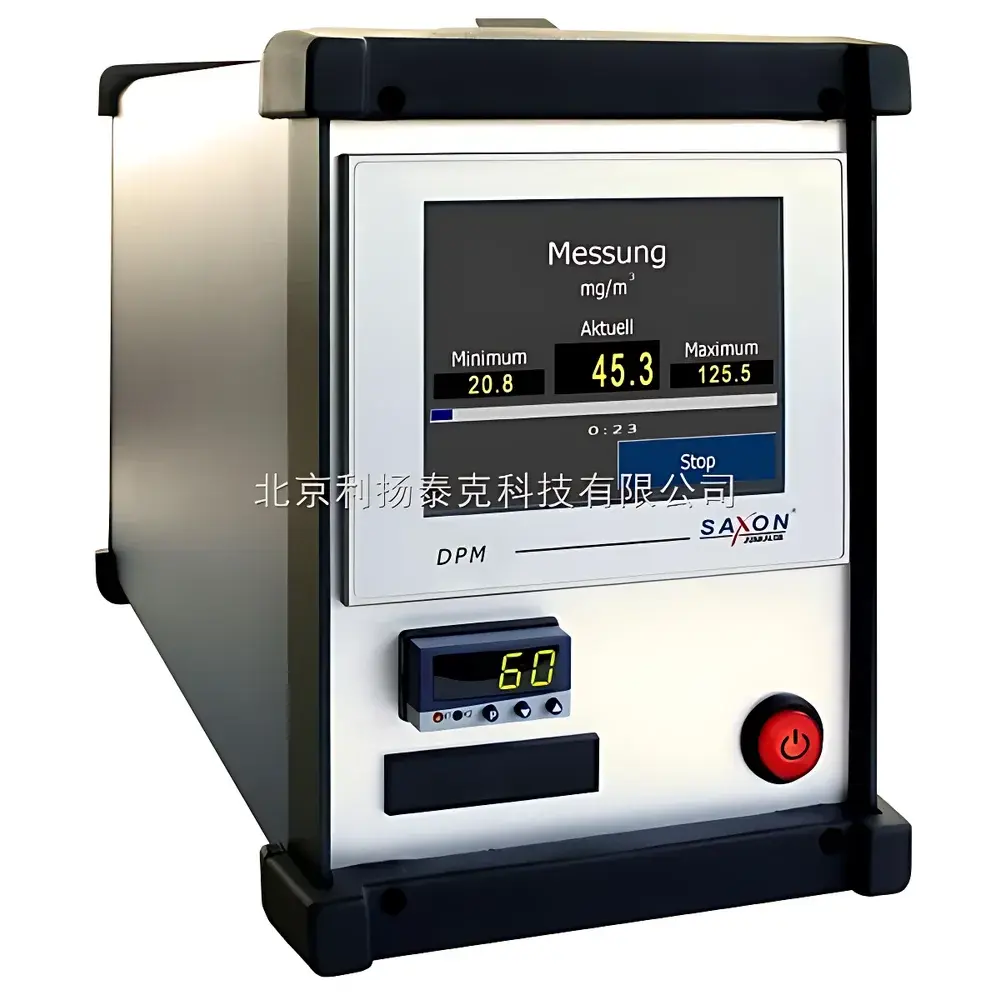
SAXON DPM1.0 Portable Diesel Particulate Matter Analyzer
| Brand | SAXON |
|---|---|
| Origin | Germany |
| Model | DPM1.0 |
| Instrument Type | Aerosol Detector |
| Measurement Principle | Laser Light Scattering |
| Particle Size Range | 40 nm – 10 µm |
| Range | 0–300 mg/m³ |
| Resolution | 0.1 mg/m³ |
| Repeatability | ≤ ±3% |
| Accuracy | ≤ ±5% of full scale up to 150 mg/m³ |
| Exhaust Gas Temperature Limit | < 800 °C |
| Probe Melting Point Limit | < 70 °C |
| Sampling Probe | 400 mm flexible stainless-steel probe with 2 m heated sampling line |
| Response Time (T90) | < 15 s (with 2 m heated line) |
| Heating Time | < 10 min |
| Zero Calibration Time | 20 s |
| Built-in Functions | Automatic zero adjustment, internal data logger |
| Communication Interfaces | RS232, USB, Bluetooth |
| Display | Color touchscreen |
| Language Support | English, German |
| Operating Ambient Temperature | 5–40 °C |
| Relative Humidity | ≤ 95% RH (non-condensing) |
| Power Supply | 230 VAC / 50 Hz, max. 250 VA (including probe) |
| Dimensions (W×H×D) | ~190 × 275 × 330 mm |
| Weight | ~7.5 kg |
Overview
The SAXON DPM1.0 Portable Diesel Particulate Matter Analyzer is a CE-marked, Germany-engineered instrument designed for real-time, in-situ quantification of diesel exhaust particulate mass concentration (mg/m³) under dynamic engine operating conditions. It employs a calibrated laser light scattering principle—traceable to ISO 29463 and aligned with the physical basis of EN 15058 and ISO 8573-1—where incident laser photons interact with suspended soot agglomerates and unburned hydrocarbons, generating scattered intensity proportional to particle surface area and refractive index. This optical signal is processed via embedded microcontroller algorithms incorporating Mie theory approximations for non-spherical carbonaceous aerosols, enabling robust correlation between scattering response and gravimetric-equivalent mass concentration. Unlike filter-based gravimetric methods (e.g., ISO 8573-2), the DPM1.0 delivers continuous, second-by-second output without sampling interruption or post-test laboratory analysis—making it suitable for transient cycle testing (e.g., WHSC, WHTC), on-board diagnostics validation, and regulatory conformity assessment per EU Stage V and U.S. EPA Tier 4 standards.
Key Features
- Integrated heated sampling system: 400 mm flexible stainless-steel probe + 2 m actively heated transfer line (maintained >120 °C), preventing condensation-induced bias and volatile organic compound (VOC) loss during transport.
- Real-time thermal management: Onboard PID-controlled heating ensures stable optical chamber temperature, minimizing drift from ambient fluctuations and enhancing long-term measurement reproducibility (≤±3% RSD over 8 h).
- High-fidelity optical path: Dual-wavelength (650 nm & 850 nm) scatter detection compensates for particle morphology effects and improves sensitivity across the full 40 nm–10 µm size distribution.
- Field-deployable architecture: Compact 7.5 kg chassis with IP54-rated enclosure, ruggedized touchscreen interface, and dual power options (mains or external 24 V DC via optional adapter) for bench, chassis dyno, or roadside enforcement use.
- Regulatory-ready calibration protocol: Factory-traceable zero and span verification using NIST-traceable aerosol generators; supports user-performed field calibration per ISO 17025-compliant procedures.
Sample Compatibility & Compliance
The DPM1.0 is validated for direct sampling of raw and diluted diesel exhaust streams—including those downstream of DOC, DPF, SCR, and GPF aftertreatment systems—without requiring dilution tunnels or conditioning units. It complies with key international test standards including ISO 8178-4 (non-road engines), ISO 20884 (heavy-duty vehicles), and SAE J1667 (light-duty chassis testing). Its measurement uncertainty profile satisfies the data quality objectives outlined in EU Regulation (EU) 2016/427 for in-use compliance monitoring and supports GLP-aligned data integrity when paired with audit-trail-enabled software. The instrument meets EMC Directive 2014/30/EU and Low Voltage Directive 2014/35/EU, and its firmware implements secure boot and write-protected memory to ensure data immutability during regulatory audits.
Software & Data Management
The DPM1.0 operates with SAXON’s proprietary PC-based ControlSuite v3.2 software, which provides synchronized acquisition of particulate mass, exhaust gas temperature, and flow rate (when interfaced with optional mass flow meters). All measurements are timestamped with UTC synchronization and stored in CSV/SQLite formats compliant with ASTM E2500-18 for electronic records. The software includes configurable alarm thresholds, automatic report generation (PDF/Excel), and built-in statistical tools for calculating mean, standard deviation, and coefficient of variation per test phase. Data export supports FDA 21 CFR Part 11 requirements through optional digital signature modules and role-based access control (admin/operator modes), ensuring chain-of-custody integrity for certification labs and OEM validation centers.
Applications
- Engine development laboratories performing transient emission mapping (e.g., ESC, ETC, WHSC cycles) and DPF regeneration efficiency analysis.
- Automotive OEMs conducting production-line consistency checks and type-approval testing per UN ECE R49 and GB 17691–2018.
- Government metrology institutes and third-party test labs supporting national vehicle inspection programs (e.g., China’s I/M system, EU’s roadside PEMS enforcement).
- Academic research groups studying nanoparticle formation mechanisms, fuel formulation impacts, and aftertreatment aging behavior under realistic load profiles.
- Environmental agencies deploying mobile monitoring units for urban black carbon hotspot identification and fleet-level emission inventory refinement.
FAQ
Does the DPM1.0 require periodic recalibration against reference gravimetric filters?
Yes—while factory-calibrated for routine operation, annual traceable recalibration using certified polydisperse aerosol standards (e.g., CAST soot, DEHS) is recommended per ISO/IEC 17025:2017 Clause 7.7. Internal zero checks remain valid between calibrations.
Can the instrument measure particles below 40 nm reliably?
No—the lower detection limit is physically constrained by optical diffraction limits and signal-to-noise ratio at sub-40 nm diameters. For nucleation-mode characterization, complementary SMPS or CPC instrumentation is advised.
Is the heated sampling line compatible with Euro VI-compliant high-temperature exhaust configurations?
Yes—the probe and line withstand peak temperatures up to 800 °C for short durations (<30 s), and the integrated thermocouple feedback loop maintains line wall temperature ≥120 °C even during low-flow transients.
How is data security ensured during Bluetooth transmission?
All wireless communication uses AES-128 encryption with device-pairing authentication; no raw sensor data is stored on the mobile endpoint—only time-stamped summaries are cached locally until secure upload to the host PC.
What maintenance intervals are specified for optical window cleaning?
The quartz measurement cell requires visual inspection every 50 hours of operation; cleaning with spectroscopic-grade isopropanol and lint-free wipes is recommended if contamination is observed—no disassembly required.
Related Products







