
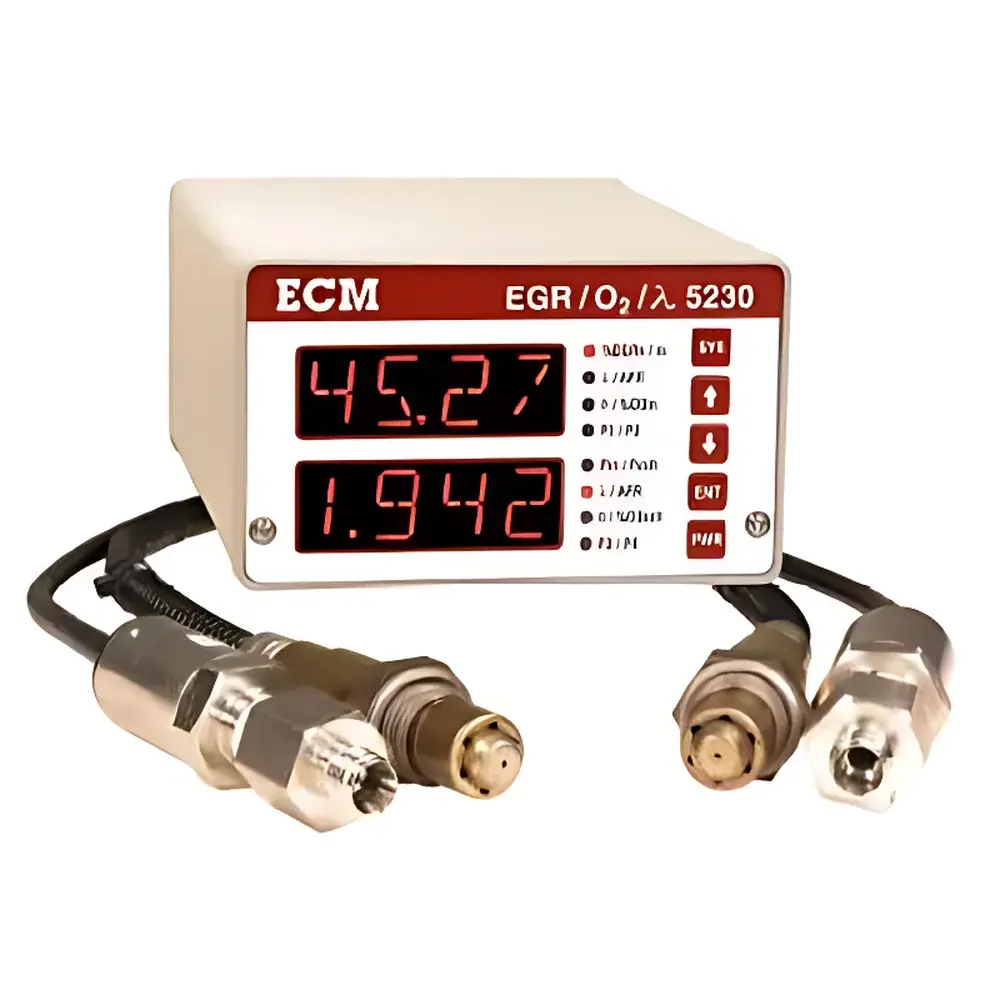
ECM EGR5230 Fast Exhaust Gas Recirculation Analyzer
| Brand | ECM |
|---|---|
| Origin | USA |
| Model | EGR 5230 |
| Instrument Type | Online Analyzer |
| Detection Principle | Electrochemical Sensing |
| Maximum Permissible Error | ±0.5% |
| Repeatability | 0.5% |
| Measurement Range | EGR 0–100% |
| Response Time | <1 s (%EGR) |
| Output | 6-channel linearized 0–5 V analog |
| Power Supply | 11–28 VDC |
| Operating Temperature | −40 °C to +85 °C |
| Sensor Mounting | 18 mm × 1.5 mm threaded O₂ sensors |
| Dimensions | 105 mm (W) × 64 mm (H) × 165 mm (D) |
| Weight | 676 g (main unit), 244 g (sensor module) |
| Cable Length | Standard 4 m, optional up to 100 m |
Overview
The ECM EGR5230 Fast Exhaust Gas Recirculation Analyzer is an online, real-time measurement system engineered for precision quantification of exhaust gas recirculation (EGR) mass and volumetric flow rates in internal combustion engine development and calibration environments. Unlike traditional extractive sampling systems, the EGR5230 employs a non-intrusive, direct-mount electrochemical oxygen sensing architecture—paired with dual absolute pressure transducers—to compute EGR ratio based on stoichiometric mass balance principles. Its core methodology relies on simultaneous, synchronized measurement of intake and exhaust oxygen concentration (%O₂), intake and exhaust absolute pressure, and ambient air reference conditions. This enables robust, physics-based calculation of EGR fraction without reliance on exhaust dilution assumptions or calibration against reference gas mixtures. The analyzer operates under transient engine conditions with sub-second response latency, making it suitable for closed-loop EGR control algorithm validation, hardware-in-the-loop (HIL) testing, and rapid prototyping of variable geometry EGR valves.
Key Features
- Real-time EGR mass and volumetric ratio calculation (0–100%) derived from first-principles oxygen and pressure balance
- Dual-channel electrochemical O₂ sensors (18 mm × 1.5 mm thread mount) with integrated thermal stabilization for stable output across −40 °C to +85 °C ambient
- High-speed dual absolute pressure measurement (0–517 kPa) with ±5.2 kPa accuracy and <50 ms response time
- Simultaneous computation and display of Lambda (0.4–25), air–fuel ratio (AFR: 6–364), equivalence ratio (Φ: 0.04–2.5), and %O₂ (0–25%)
- Six linearized 0–5 V analog outputs configurable per parameter, supporting integration with third-party DAQ systems including National Instruments, dSPACE, and ETAS INCA
- Multi-protocol digital interface: CAN bus (user-configurable baud rate and message ID), USB 2.0, and RS232 (Ford-specific command set supported)
- One-button zero calibration using ambient air as reference—no external gas cylinders or calibration kits required
- Low-maintenance design: no sample pump, no heated line, no condensate trap—minimizing drift and service intervals
Sample Compatibility & Compliance
The EGR5230 is compatible with gasoline, diesel, ethanol (E85), methanol, natural gas (CNG/LNG), hydrogen, and dual-fuel engines. Fuel composition parameters—including H:C, O:C, and N:C atomic ratios—are user-configurable to ensure accurate stoichiometric calculations across diverse fuel chemistries. All sensor electronics comply with ISO 26262 ASIL-B functional safety requirements for diagnostic coverage and fault detection. Pressure and O₂ modules meet EN 61000-6-2 (immunity) and EN 61000-6-4 (emissions) standards. Data logging and configuration settings support audit trails aligned with GLP and GMP documentation practices. While not certified for continuous emissions compliance reporting (e.g., EPA 40 CFR Part 1065), the instrument meets ASTM D6750 and SAE J1930 specifications for engine development-grade instrumentation.
Software & Data Management
The EGR5230 communicates natively via ASCII-based serial protocol over RS232 and CAN, enabling seamless integration into existing test cell infrastructure. ECM provides a Windows-compatible configuration utility for sensor setup, analog output mapping, and CAN message definition. Raw data streams include timestamped values for all six primary parameters at up to 100 Hz. Output formats support CSV export and direct ingestion into MATLAB, Python (via PySerial or CANoe APIs), and LabVIEW. Firmware updates are delivered via USB and include version-controlled change logs. All configuration changes and calibration events are logged internally with UTC timestamps—supporting traceability requirements under FDA 21 CFR Part 11 when used in regulated R&D environments.
Applications
- Engine control unit (ECU) calibration and validation of dynamic EGR actuation strategies
- Transient emissions mapping during WLTC, FTP-75, and RDE cycle simulation
- Development of low-NOₓ combustion modes (e.g., PPC, RCCI) requiring precise EGR feedback
- Aftertreatment system integration studies involving DOC, DPF, and SCR interactions with EGR-derived exhaust composition
- Powertrain bench testing where space-constrained mounting and minimal installation complexity are critical
- Academic research on combustion chemistry, flame propagation, and thermal efficiency optimization
FAQ
What is the fundamental principle behind EGR calculation in the EGR5230?
It uses a mass-balance method based on measured intake and exhaust O₂ concentrations and absolute pressures, assuming known intake air composition and fuel stoichiometry.
Can the EGR5230 be used with turbocharged or supercharged engines?
Yes—the absolute pressure sensors accommodate boosted intake manifolds up to 517 kPa, and the algorithm inherently accounts for compression-induced density changes.
Is field recalibration required after sensor replacement?
No—each O₂ and pressure sensor includes factory-traceable calibration coefficients stored in onboard EEPROM; only ambient-air zeroing is needed post-installation.
Does the device support synchronization with crank-angle-resolved engine data?
Yes—external TTL trigger input allows phase-locking of EGR5230 output to engine position signals for cycle-resolved analysis.
How is long-term stability maintained without periodic span calibration?
Electrochemical O₂ sensors feature built-in temperature compensation and drift-correction algorithms trained on >10,000 hours of accelerated aging data.







