
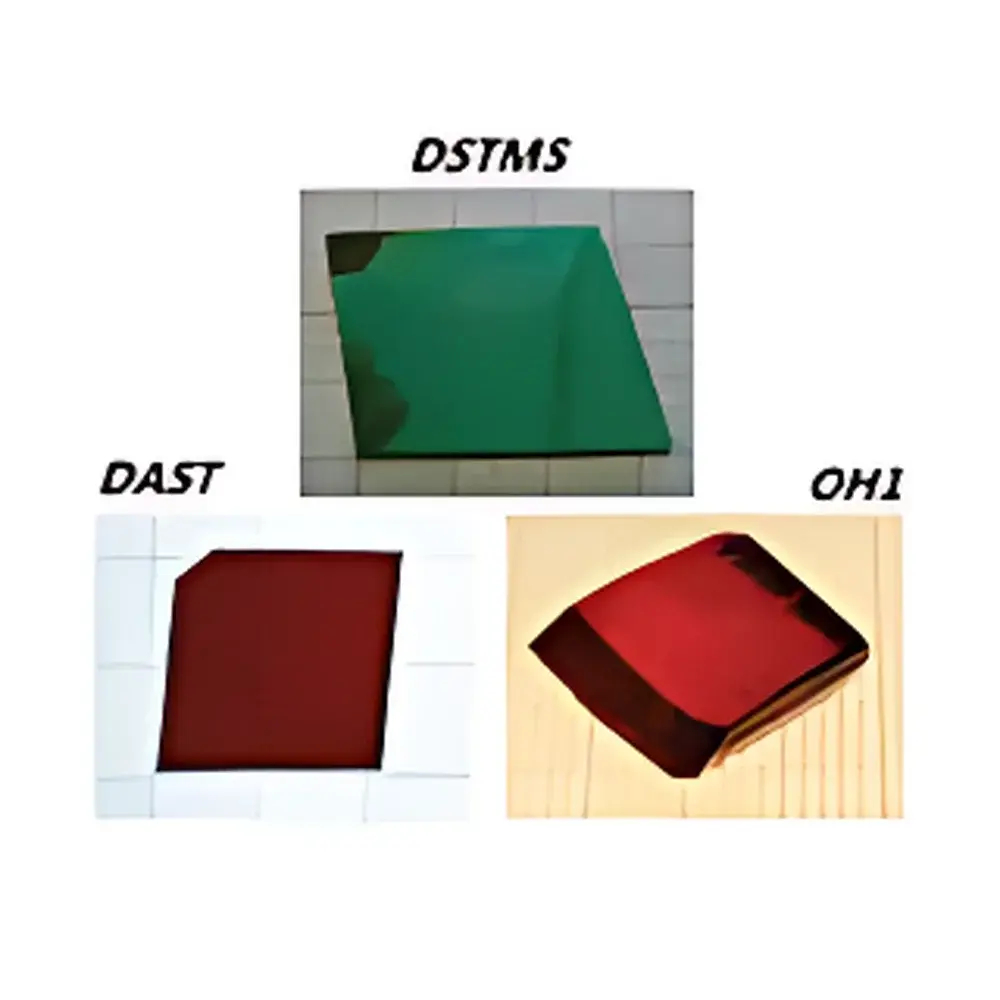
DAST/OH1/DSTMS THz Organic Nonlinear Crystals
| Origin | Zhejiang, China |
|---|---|
| Manufacturer Type | Distributor |
| Origin Category | Domestic |
| Model | DAST, OH1, DSTMS |
| Component Type | Optical Nonlinear Crystal |
| Pump Wavelength Optimization | 1200–1600 nm (standard), 700–800 nm (optional) |
| THz Generation Mechanism | Optical Rectification & Difference-Frequency Generation (DFG) |
| THz Detection Mode | Electro-Optic Sampling (EOS) |
| Typical THz Bandwidth (measured via Rainbow Photonics setup) | Up to ~30 THz (DAST), ~25 THz (OH1), ~20 THz (DSTMS) |
| Compliance Context | Compatible with ISO/IEC 17025-aligned THz-TDS systems |
Overview
DAST, OH1, and DSTMS are high-performance organic nonlinear optical crystals engineered for efficient terahertz (THz) wave generation and coherent detection in time-domain spectroscopy (THz-TDS) and imaging systems. Unlike inorganic counterparts such as ZnTe or GaP, these organic crystals exhibit significantly higher second-order nonlinear susceptibility (deff), enabling superior THz conversion efficiency—particularly under near-infrared femtosecond pump excitation. Their operation relies on two primary physical mechanisms: optical rectification (OR) for broadband THz pulse generation and electro-optic sampling (EOS) for phase-resolved detection. The molecular noncentrosymmetry of DAST (4-N,N-dimethylamino-4′-N′-methyl-stilbazolium tosylate), OH1 (2-(3′-nitrophenyl)-5-(2′-thienyl)-1,3,4-oxadiazole), and DSTMS (4-dimethylamino-N-methyl-4′-stilbazolium tosylate) underpins their strong χ(2) response, making them especially effective in low-energy, high-repetition-rate laser systems operating at 1200–1600 nm—where dispersion management and thermal load mitigation are critical.
Key Features
- High nonlinear coefficient: DAST exhibits deff ≈ 400–600 pm/V (at 1550 nm), substantially exceeding ZnTe (~65 pm/V), enabling lower pump fluence requirements and reduced risk of optical damage.
- Broadband THz emission: Measured spectral bandwidth reaches up to ~30 THz for DAST, ~25 THz for OH1, and ~20 THz for DSTMS—verified using calibrated Rainbow Photonics THz spectrometers under standardized pump pulse conditions (e.g., <100 fs, 80 MHz repetition rate).
- Pump wavelength flexibility: Optimized for 1200–1600 nm Er:fiber or Yb:fiber laser systems; optional compatibility with 700–800 nm Ti:sapphire sources via crystal angle-tuning and phase-matching recalibration.
- Low absorption in THz range: All three materials maintain transmission >70% across 0.1–10 THz (DAST) and extend beyond 20 THz under cryogenic or vacuum conditions.
- Robust architecture for integration: Standard AR-coated (1200–1600 nm / THz dual-band) polished plates (typical dimensions: 5 × 5 × 0.5 mm³); custom thicknesses and facet angles available per application-specific phase-matching requirements.
Sample Compatibility & Compliance
These crystals are designed for use in laboratory-grade THz-TDS platforms compliant with ISO/IEC 17025 calibration frameworks. When installed in controlled environments (temperature-stabilized mounts, dry nitrogen purging), they support reproducible measurements required for material characterization per ASTM E3122 (Standard Guide for Terahertz Spectroscopy of Polymers) and ISO 19727 (Terahertz Time-Domain Spectroscopy—Performance Verification). While the crystals themselves are not certified devices, their performance characteristics align with FDA 21 CFR Part 11 data integrity expectations when used within validated instrument software stacks that enforce audit trails, electronic signatures, and secure data storage.
Software & Data Management
DAST/OH1/DSTMS crystals integrate seamlessly with industry-standard THz control and analysis suites—including TeraView’s TeraPulse software, Menlo Systems’ TeraStudio, and open-source platforms such as THzTools (Python-based). Raw EOS signals are acquired as time-domain waveforms, then Fourier-transformed to yield amplitude/phase spectra. Built-in calibration routines accommodate crystal-specific group velocity dispersion (GVD) compensation and pump-probe delay line corrections. All spectral datasets support export in HDF5 or MAT formats, ensuring compatibility with MATLAB, Python (NumPy/SciPy), and LabVIEW-based QA/QC pipelines.
Applications
- Pharmaceutical solid-state analysis: Identification of polymorphs, hydrates, and amorphous content in active pharmaceutical ingredients (APIs) via characteristic THz phonon modes (0.3–3 THz).
- Security screening: Non-invasive detection of concealed explosives (e.g., RDX, PETN) and illicit substances through spectral fingerprinting in transmission/reflection geometry.
- Non-destructive evaluation (NDE): Thickness mapping of multi-layer polymer films, coating integrity assessment, and delamination detection in composites.
- Fundamental physics research: Ultrafast carrier dynamics in 2D materials (graphene, TMDCs), superconducting gap measurements, and topological insulator surface state probing.
- Gas-phase spectroscopy: High-resolution rotational spectroscopy of polar molecules (e.g., HCl, NH₃) in the 0.1–5 THz range using frequency-comb-pumped DFG sources.
FAQ
What pump laser specifications are recommended for optimal DAST performance?
A femtosecond fiber laser centered at 1560 nm, with pulse duration <100 fs, average power 100–500 mW, and repetition rate 50–100 MHz is ideal. Pulse energy should remain below 1 nJ to avoid two-photon absorption-induced degradation.
Can OH1 be used for both generation and detection?
Yes—OH1 supports bidirectional electro-optic functionality in collinear or reflective EOS geometries, though its lower damage threshold relative to DAST warrants careful fluence management during detection.
Is vacuum or purged operation necessary?
For measurements above 5 THz, dry nitrogen purging or vacuum enclosure is strongly advised to suppress atmospheric water vapor absorption lines (e.g., 0.557, 0.988, 1.199 THz).
How does DSTMS compare to DAST in terms of thermal stability?
DSTMS demonstrates improved thermal degradation onset (~120 °C vs. ~95 °C for DAST), making it preferable for high-average-power pump regimes or extended-duration scanning protocols.
Are custom coatings or substrate configurations available?
Yes—anti-reflection coatings optimized for dual-band (pump + THz) transmission, wedged substrates to eliminate etalon effects, and bonded configurations for enhanced thermal dissipation can be supplied upon technical specification submission.




