
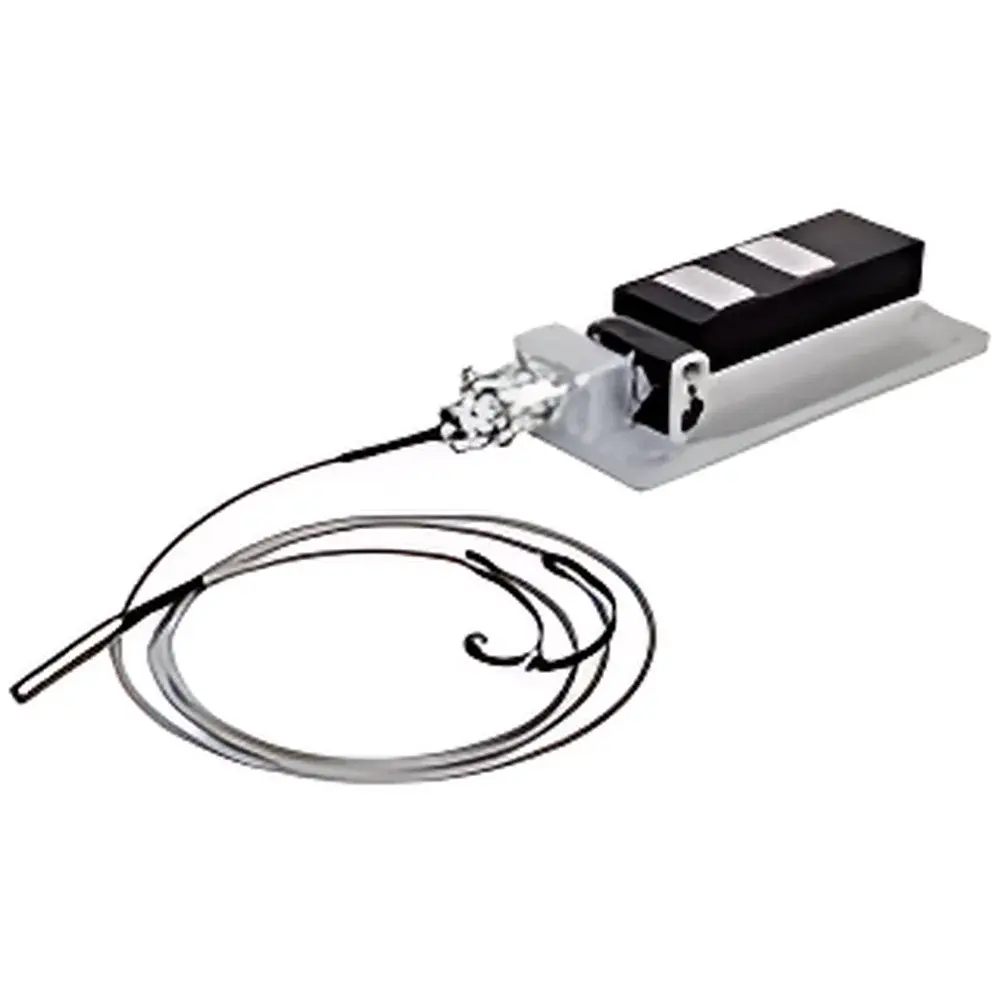
Cobolt 04-01 Series Dual-Wavelength Modulated Laser System
| Brand | Cobolt |
|---|---|
| Origin | Sweden |
| Model | newopto |
| Wavelength Options | Any two of 457, 473, 491, 515, 532, 561, or 594 nm |
| Spectral Linewidth | <1 MHz (<0.01 pm) |
| Spatial Mode | TEM₀₀, M² < 1.1 |
| Beam Diameter (at aperture) | 700 µm |
| Full-Angle Beam Divergence | <1.2 mrad |
| Beam Overlap | <250 µrad |
| Long-Term Power Stability (8 h, ±3 °C) | <3% |
| Beam Pointing Stability (10–40 °C) | <25 µrad/°C |
| Polarization Ratio (linear) | >100:1 |
| Total Power Consumption | <70 W (typ. <30 W) |
| Operating Temperature | 10–40 °C |
| Heat Sink Thermal Resistance | 0.5 K/W |
| Dual Combiner Dimensions | 190 × 65 × 46 mm |
| Controller Dimensions | 190 × 72 × 28 mm |
| Communication Interface | RS-232 or USB |
| Shutter Modulation Frequency | 125 Hz |
| Shutter Rise Time | <350 µs |
| Warranty | 24 months |
Overview
The Cobolt 04-01 Series Dual-Wavelength Modulated Laser System is an engineered solution for precision optical integration requiring simultaneous, independently modulated output at two discrete visible wavelengths. Built upon Cobolt’s industry-proven 04-01 single longitudinal mode (SLM) diode-pumped solid-state (DPSS) laser platform, this system combines two user-selected lasers—spanning 457 nm to 594 nm—within a mechanically and thermally stabilized dual-combiner module. Each laser operates in fundamental transverse mode (TEM₀₀) with sub-MHz spectral linewidth (<0.01 pm), enabling high-coherence applications such as multi-color confocal microscopy, pump-probe spectroscopy, fluorescence lifetime imaging (FLIM), and quantum optics experiments where temporal synchronization and spatial beam overlap are critical. The integrated SR475 shutter enables precise external TTL-triggered modulation at 125 Hz with sub-350 µs rise time—ideal for time-gated detection, lock-in amplification, or synchronized illumination in OEM instrumentation.
Key Features
- Two independently selectable SLM lasers from the Cobolt 04-01 family (457, 473, 491, 515, 532, 561, or 594 nm)
- Optically aligned dual-beam combiner with <250 µrad angular overlap tolerance for minimal walk-off over working distances
- Beam quality characterized by M² < 1.1 and diffraction-limited TEM₀₀ output
- Long-term power stability better than ±3% over 8 hours under ambient fluctuations of ±3 °C
- Thermally robust mechanical design with heat sink thermal resistance of 0.5 K/W for stable operation across 10–40 °C
- Low-noise, linear polarization (>100:1 ratio) maintained across both channels
- Compact form factor: combiner (190 × 65 × 46 mm) and controller (190 × 72 × 28 mm) designed for space-constrained integration
- Standard communication via RS-232 or USB for remote control, status monitoring, and firmware updates
Sample Compatibility & Compliance
This dual-wavelength system is compatible with standard optomechanical mounting platforms (e.g., Thorlabs, Newport), fiber coupling interfaces (SM/PM/MM), and third-party accessories including Qioptiq and OZ Optics fiber launch systems. It meets CE marking requirements for electromagnetic compatibility (EMC Directive 2014/30/EU) and low-voltage safety (LVD Directive 2014/35/EU). While not certified for medical or industrial safety standards (e.g., IEC 60825-1 Class 4), it is intended for use within controlled laboratory or OEM environments where appropriate laser safety protocols—including interlocked enclosures, beam dumps, and ANSI Z136.1-compliant eyewear—are implemented. The system supports GLP/GMP-aligned documentation workflows through timestamped operational logs and configurable shutter event tracking.
Software & Data Management
The embedded controller provides ASCII-based command-line interface (CLI) accessible via terminal emulation software or custom Python/C++ drivers. All operational parameters—including modulation state, output enable/disable, temperature readback, and error flags—are queryable in real time. Optional SDKs support integration into LabVIEW, MATLAB, and Python-based automation frameworks. Audit trails for shutter actuation events, power calibration cycles, and thermal history can be exported in CSV format. While native support for FDA 21 CFR Part 11 compliance is not built-in, the system architecture allows integration with validated third-party data acquisition platforms that provide electronic signatures, audit logging, and role-based access control.
Applications
- Multi-spectral fluorescence excitation in life science imaging systems
- Synchronized dual-wavelength photostimulation in optogenetics platforms
- Time-resolved Raman or CARS spectroscopy requiring pump/probe wavelength pairing
- Calibration sources for hyperspectral sensor validation
- OEM integration into compact flow cytometers or portable diagnostic analyzers
- Fundamental studies in quantum interference, including Hong–Ou–Mandel experiments with wavelength-multiplexed photons
FAQ
Can the two wavelengths be modulated independently?
No—the SR475 shutter modulates both beams simultaneously; independent channel modulation requires external AOMs or EOMs.
Is fiber coupling included as standard?
Fiber coupling is optional and available via FIC-03 mounting blocks compatible with SM, PM, or MM fibers from Qioptiq, OZ Optics, and other vendors.
What is the maximum allowable ambient temperature gradient during operation?
The system is rated for operation between 10 °C and 40 °C; beam pointing stability is specified at <25 µrad/°C within this range.
Does the system support analog modulation inputs?
No—modulation is digital TTL-triggered only; analog intensity control is not supported natively.
How is long-term power stability verified?
Stability is measured using a calibrated photodiode and data acquisition system over 8 hours, with ambient temperature held within ±3 °C of setpoint.




