
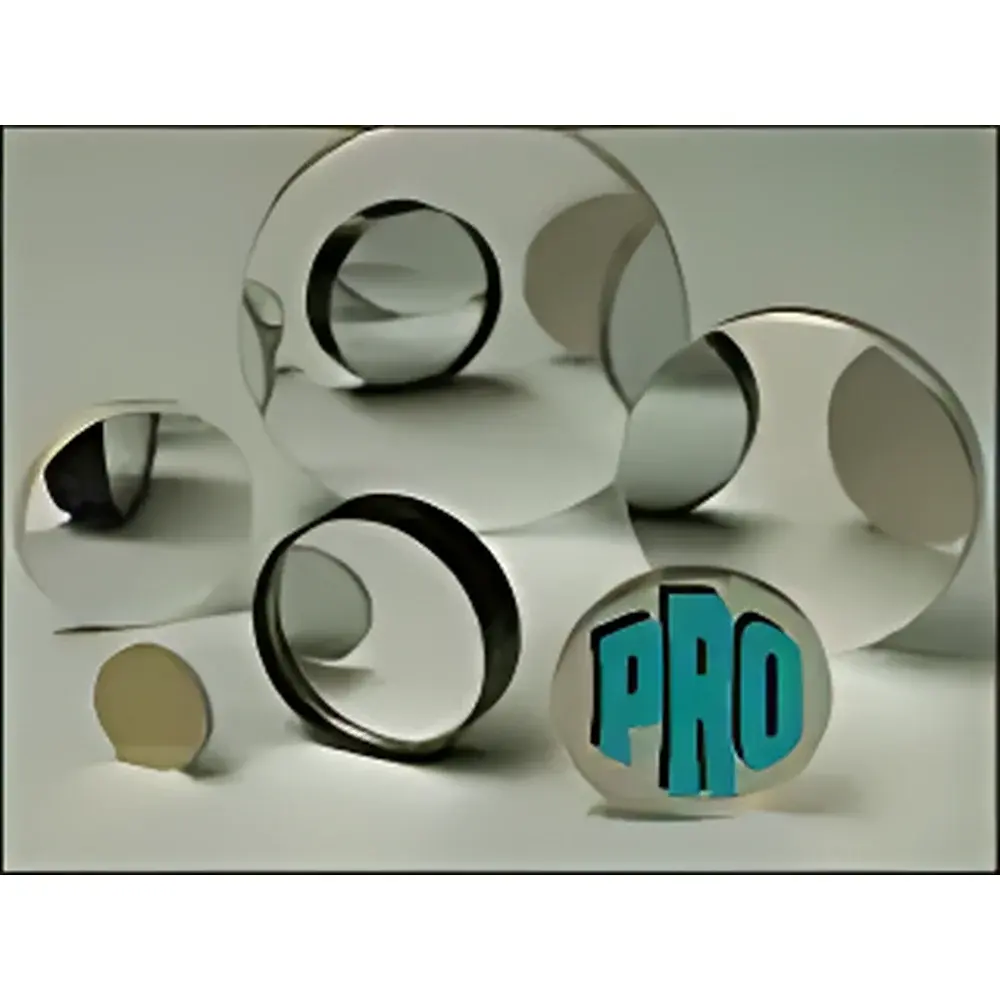
Deep UV Bandpass Filter (122–320 nm)
| Origin | USA |
|---|---|
| Manufacturer Type | Authorized Distributor |
| Origin Category | Imported |
| Model | Deep UV Bandpass Filter |
| Price Range | USD 140–420 |
| Component Category | Optical Element |
Overview
The Deep UV Bandpass Filter (122–320 nm) is a high-performance optical interference filter engineered for precise spectral selection in vacuum ultraviolet (VUV) and deep ultraviolet (DUV) wavelength regimes. Designed using multi-layer dielectric thin-film deposition on fused silica or calcium fluoride (CaF₂) substrates—selected for their exceptional transmission below 190 nm—the filter operates on the principle of constructive and destructive interference to isolate narrow spectral bands with high out-of-band rejection. Its spectral performance supports critical applications requiring photon energy resolution in the 3.88–10.16 eV range, including synchrotron beamline instrumentation, laser-induced fluorescence (LIF), UV Raman spectroscopy, photolithography alignment systems, and space-based astronomical sensors. Unlike broadband UV filters, these bandpass elements maintain >50% peak transmittance (Tmax) while achieving optical density (OD) ≥4 outside the passband—ensuring effective suppression of stray light and harmonic contamination.
Key Features
- Wavelength coverage from 122 nm (Lyman-α line) to 320 nm (near-UV edge), with discrete standard center wavelengths aligned to atomic emission lines (e.g., Hg 253.7 nm, ArF 193 nm, KrF 248 nm, XeCl 308 nm)
- Narrow to medium bandwidth options: Full Width at Half Maximum (FWHM) ranging from 10 nm to 60 nm, enabling trade-offs between spectral resolution and signal throughput
- High peak transmission: ≥50% minimum T at specified λc, validated per ISO 9050:2003 for spectral transmittance measurement
- Standard substrate diameters: 12.7 mm (0.5″), 25.4 mm (1.0″), and custom sizes up to 50.8 mm; thickness tolerance ±0.1 mm per MIL-O-13830A
- Substrate material options: High-purity fused silica (for λ ≥ 180 nm) or synthetic CaF₂ (for extended VUV transmission down to 122 nm)
- Hard-coated, ion-assisted deposition (IAD) multilayer stacks ensuring environmental stability per MIL-C-48497A, with humidity resistance up to 95% RH and thermal cycling compliance from –40°C to +70°C
Sample Compatibility & Compliance
This filter series is compatible with standard kinematic mounts, lens tubes, and filter wheels used in UV-grade optical breadboards (e.g., Thorlabs KBS, Newport UVP series). All filters are supplied with individual spectral transmittance certification traceable to NIST SRM 2065 (deuterium lamp standard) and calibrated on a PerkinElmer Lambda 950 UV/VIS/NIR spectrophotometer equipped with a deuterium/halogen source and VUV accessory. The manufacturing process complies with ISO 10110-7 (optical component surface quality) and meets cleanliness requirements per ISO 14644-1 Class 5 cleanroom assembly. For regulated environments—including clinical diagnostics platforms and pharmaceutical QC labs—the filters support audit-ready documentation packages aligned with FDA 21 CFR Part 11 electronic record integrity standards when integrated into validated instrument subsystems.
Software & Data Management
No embedded firmware or driver software is required, as these are passive optical components. However, spectral data files (CSV and SDF format) for each filter lot—including measured T(λ) curves, FWHM, blocking OD spectra, and angle-of-incidence (AOI) shift profiles—are provided digitally via secure download portal. These datasets integrate natively with common optical design and analysis tools such as Zemax OpticStudio (via .DAT import), ASAP, FRED, and Python-based libraries (e.g., scipy.interpolate and numpy for spectral convolution modeling). Optional API access enables automated spectral library synchronization with LIMS or ELN systems for traceability in GLP-compliant laboratories.
Applications
- Astronomy & Space Instrumentation: Solar Lyman-α imaging, planetary atmospheric UV spectroscopy (e.g., MAVEN IUVS), and EUV/VUV calibration sources
- Biomedical Research: DNA/Protein quantification at 260/280 nm, tryptophan fluorescence excitation (280 nm), and UV-induced apoptosis studies
- Laser Systems: Line selection for excimer lasers (ArF, KrF, XeCl), frequency-doubled Ti:sapphire systems, and DUV lithography tool monitoring
- Raman Spectroscopy: Resonant enhancement in deep-UV Raman (e.g., 244 nm excitation for carbon nanotube characterization)
- OEM Integration: Embedded in handheld UV spectrometers, portable fluorescence readers, and semiconductor wafer inspection tools requiring stable, low-autofluorescence filtering
FAQ
What substrate material is recommended for use below 185 nm?
Calcium fluoride (CaF₂) is required for transmission below 185 nm due to its superior VUV transparency; fused silica exhibits strong absorption onset near 180 nm.
Can these filters be used at non-normal incidence?
Yes, but center wavelength shifts blueward with increasing AOI; angular tuning curves are provided per lot and must be incorporated into optical design simulations.
Is cleaning possible without damaging the coating?
Yes—using spectroscopic-grade acetone followed by dry nitrogen purge; avoid ultrasonic baths or abrasive wipes per ISO 10110-7 surface handling guidelines.
Do you provide custom center wavelengths or bandwidths?
Yes—custom designs are available with lead times of 8–12 weeks; minimum order quantity applies for non-standard specifications.
Are these filters suitable for high-power UV laser applications?
They are rated for average power densities ≤50 mW/cm² at 193 nm (ArF); for pulsed lasers, damage threshold testing (ISO 21254) is recommended prior to integration.





