
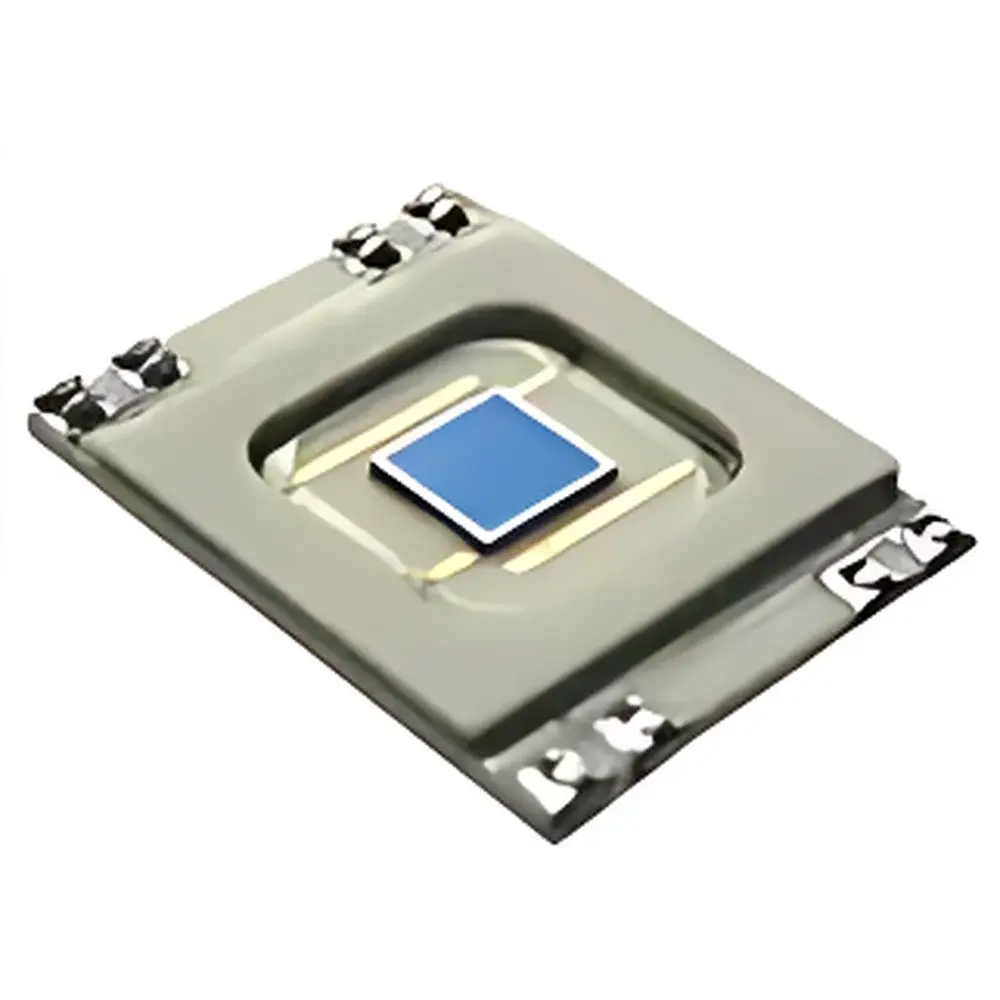
Newopto PSD Series Position-Sensitive Detector (PSD)
| Brand | First Sensor |
|---|---|
| Active Area Options | 3.5×1 mm² to 20×20 mm² |
| Spectral Response Peak | 865 nm |
| Operating Voltage | 10 V |
| Load Resistance | 50 Ω |
| Rise Time | 200 ns to 4000 ns |
| Package Types | SO8, SMD, SO16, CERpin, CERsmd, LCC10G |
| Axis Configuration | Single-axis and Dual-axis variants |
| Material | Silicon-based PIN photodiode architecture |
Overview
The Newopto PSD Series Position-Sensitive Detector is a high-precision optoelectronic sensor engineered for real-time, analog position measurement of focused light spots across one or two spatial dimensions. Based on the lateral photovoltaic effect—where photogenerated carriers drift under an internal electric field gradient—the device outputs continuous, linear voltage or current signals proportional to the centroid position of incident illumination on its active surface. Unlike quadrant detectors that rely on discrete segment comparison, PSDs provide inherently smooth, sub-microradian resolution tracking without pixelation artifacts or dead zones. This makes them particularly suitable for applications demanding high bandwidth, analog linearity, and dynamic alignment feedback—such as laser beam stabilization, optical tweezers positioning, atomic force microscope (AFM) cantilever deflection monitoring, and precision interferometric alignment systems.
Key Features
- True analog position sensing with no quantization error or interpolation required
- Wide active area selection—from compact 3.5×1 mm single-axis devices to large-format 20×20 mm dual-axis models enabling ±10 mm displacement detection per axis
- High-speed response: rise times ranging from 200 ns (for narrow-area configurations) to 4 µs (for 20×20 mm active regions), supporting kHz-range closed-loop control
- Silicon PIN diode architecture optimized for near-infrared sensitivity, with peak responsivity at 865 nm—ideal for common laser sources including 785 nm, 808 nm, and 850 nm diodes
- Low-noise, low-capacitance design compatible with standard 50 Ω termination and 10 V bias operation
- Multiple package options—including industry-standard SO8, SO16, surface-mount (SMD), ceramic pin-grid (CERpin), ceramic SMD (CERsmd), and leadless chip carrier (LCC10G)—ensuring mechanical compatibility with OEM optical mounts and PCB integration workflows
- Stable temperature coefficient and long-term drift performance validated under controlled laboratory conditions per IEC 60747-5-2 for optoelectronic semiconductor devices
Sample Compatibility & Compliance
The PSD series is designed for integration into both research-grade optical benches and industrial metrology platforms. It accepts collimated or focused beams with spot diameters from 1 mm, provided irradiance remains within the linear photodiode operating range (typically 10 µW to 10 mW for silicon devices). All variants comply with RoHS Directive 2011/65/EU and are manufactured in accordance with ISO 9001-certified processes. While not certified for medical or aerospace use out-of-the-box, the devices meet baseline requirements for traceable calibration per ISO/IEC 17025 when used with NIST-traceable reference sources and calibrated readout electronics. For GLP/GMP environments, users may implement audit-ready signal conditioning and data logging protocols aligned with FDA 21 CFR Part 11 guidelines.
Software & Data Management
No proprietary firmware or embedded software resides on the PSD itself—it functions as a passive transducer requiring external signal conditioning. Compatible readout solutions include lock-in amplifiers (e.g., Zurich Instruments HF2LI), programmable gain instrumentation amplifiers (e.g., Texas Instruments INA128), and FPGA-based acquisition systems. Reference LabVIEW VIs and Python libraries (via PyVISA or NumPy-based ADC interfacing) are available from third-party developers for centroid calculation, real-time plotting, and PID loop implementation. Raw analog outputs support direct digitization using 16-bit or higher resolution ADCs; typical system-level position resolution achieves 0.1–1 µm depending on optical magnification, signal-to-noise ratio, and amplifier stability.
Applications
- Laser beam pointing stabilization in ultrafast laser systems and cavity-dumped oscillators
- Real-time focus tracking in confocal microscopy and adaptive optics wavefront sensors
- Non-contact displacement measurement in MEMS mirror actuation and piezoelectric stage calibration
- Optical lever detection in scanning probe microscopy (SPM) and nanoindentation systems
- Alignment verification in fiber-optic coupling stations and free-space optical interconnects
- Dynamic vibration analysis via reflected beam deflection on rotating or oscillating surfaces
FAQ
What is the difference between a PSD and a quadrant detector?
PSDs generate continuous analog output proportional to light spot centroid position, offering superior linearity and no dead zones. Quadrant detectors produce four discrete signals requiring ratio-based computation, introducing nonlinearity near segment boundaries and reduced accuracy for defocused or elliptical spots.
Can this PSD be used with pulsed lasers?
Yes—provided pulse repetition rate exceeds device rise time inverse (e.g., >500 kHz for 200 ns models) and average power stays within specified limits. Thermal saturation must be evaluated for high-duty-cycle operation.
Is calibration required before use?
Factory calibration is not provided; however, first-order linear calibration can be performed using a motorized translation stage and collimated source. Nonlinearity correction tables may be generated empirically for critical applications.
Are custom active areas or spectral ranges available?
First Sensor offers engineering support for tailored designs—including extended IR response (InGaAs), UV-enhanced coatings, and hybrid multi-element arrays—but these require minimum order quantities and extended lead times.




