
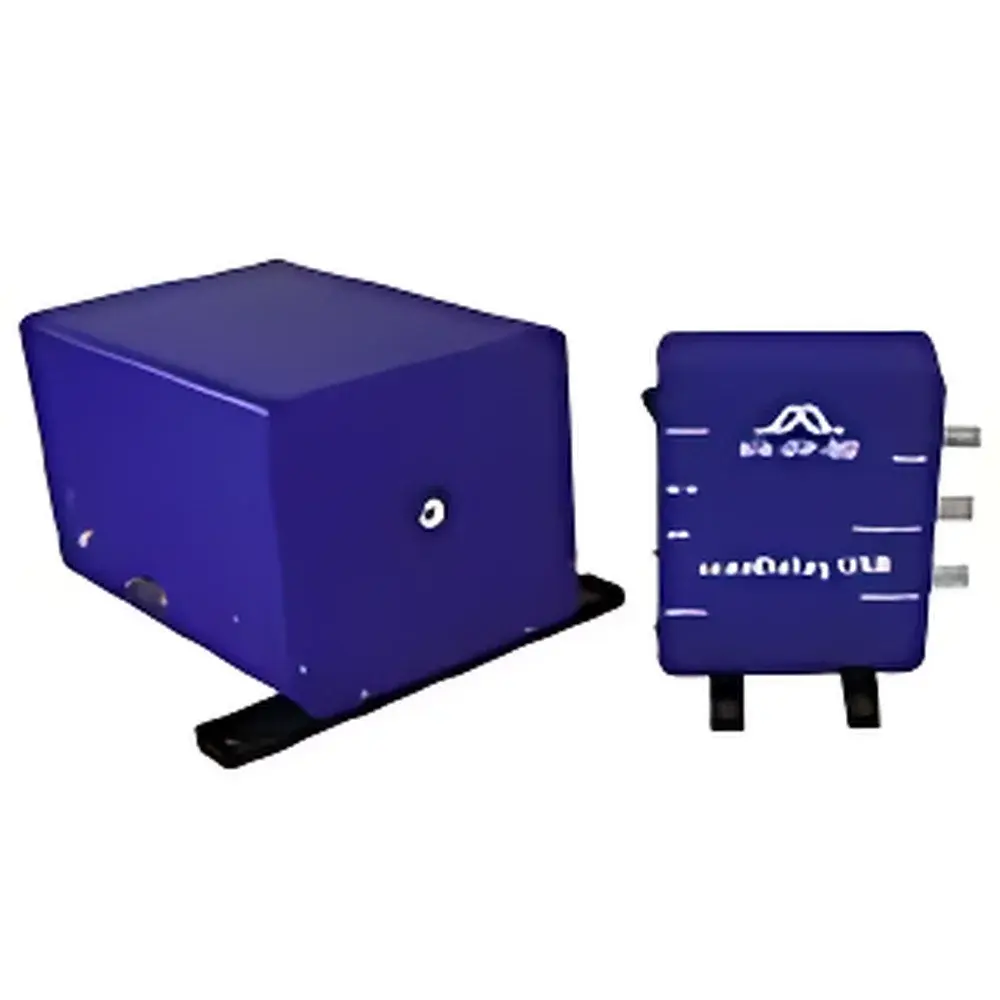
scanDelay USB Optical Delay Line
| Origin | USA |
|---|---|
| Manufacturer Type | Distributor |
| Origin Category | Imported |
| Model | scanDelay USB Optical Delay |
| Price Range | USD $1,400 – $7,200 (est.) |
| Component Category | Optical Element |
| Max. Scan Range | 15 ps (±1.125 mm) / 50 ps (±3.75 mm) / 150 ps (±11.25 mm) |
| Internal Generator Frequency | 0.1–20 Hz (15 ps & 50 ps models), 0.1–10 Hz (150 ps model) |
| Externally Triggered Frequency Range | 0.01–20 Hz (15 ps & 50 ps), 0.01–10 Hz (150 ps) |
| External Trigger Input | TTL, 20 Hz – <50 kHz (optional fast frequency divider supports ~80 MHz input) |
| Trigger Output | TTL |
| Position Output Signal | ±10 V full scale per delay range |
| Linearity of Position Signal | <0.5% |
| Computer Interface | USB 2.0 |
| Clear Aperture | 1″ (15 ps), 1/2″ (50 ps & 150 ps) |
| Mirror Coating | Protected silver (standard) |
Overview
The scanDelay USB Optical Delay Line is a precision electromechanical translation stage engineered for time-resolved optical experiments requiring sub-picosecond temporal resolution and high positional fidelity. Based on a robust voice-coil actuator architecture coupled with high-resolution linear position feedback, it operates on the principle of controlled optical path length modulation—introducing a precisely calibrated, variable time delay between two coherent light paths. This enables critical functionality in pump-probe spectroscopy, terahertz time-domain spectroscopy (THz-TDS), Michelson and Mach-Zehnder interferometry, optical correlation measurements, and ultrafast laser diagnostics. Unlike piezoelectric or air-bearing delay stages, the scanDelay employs closed-loop DC-servo control with analog position sensing, ensuring long-term stability, repeatability better than ±5 fs over repeated scans, and immunity to hysteresis or drift under ambient laboratory conditions. Its design prioritizes mechanical rigidity, thermal stability, and electromagnetic compatibility—essential for integration into sensitive ultrafast laser systems operating at repetition rates from single-shot to 80 MHz.
Key Features
- Three standard scan ranges: 15 ps (±1.125 mm), 50 ps (±3.75 mm), and 150 ps (±11.25 mm), each optimized for specific application bandwidths and signal-to-noise requirements
- Closed-loop position control with analog ±10 V output linearly scaled to delay—calibrated and traceable to NIST-traceable interferometric verification
- Internal sweep generator (0.1–20 Hz) with programmable waveform shape; external triggering supported via TTL input (20 Hz–<50 kHz), with optional frequency divider module for direct synchronization to ~80 MHz laser oscillators
- USB 2.0 interface with native LabVIEW™ drivers, Python API (PyVISA-compatible), and support for NI-DAQmx-based control architectures
- High linearity (<0.5% deviation across full stroke) ensured by integrated capacitive or eddy-current position transducer, eliminating reliance on stepper-motor step counting
- Optimized optical train: 1″ clear aperture (15 ps model) or 1/2″ (50/150 ps models); protected silver coating (R > 97% @ 700–1600 nm) as standard; custom dielectric or UV-enhanced coatings available upon request
Sample Compatibility & Compliance
The scanDelay USB is designed for integration into Class 1 and Class 3B laser environments compliant with IEC 60825-1:2014 and ANSI Z136.1-2022 standards. Its non-magnetic, anodized aluminum housing meets RoHS Directive 2011/65/EU and is compatible with vacuum-compatible variants (upon request, with bake-out rated components). The device requires no active cooling and operates reliably within 15–30 °C ambient temperature and <70% non-condensing humidity. All electrical interfaces are galvanically isolated to prevent ground loops in multi-instrument setups. While not certified for medical or aerospace use, its performance parameters align with typical requirements for GLP-compliant ultrafast characterization labs performing method validation per ASTM E2912-22 (Standard Guide for Ultrafast Spectroscopic Measurements).
Software & Data Management
Control is implemented via a lightweight, cross-platform USB HID-compliant firmware stack. The included software suite provides real-time delay monitoring, user-defined delay pattern generation (ramp, sawtooth, triangular, arbitrary waveform via CSV import), and phase-locking configuration for external clock sources. All position and trigger data streams support timestamped logging at up to 10 kHz sampling rate. Audit trails—including parameter changes, calibration events, and firmware updates—are stored locally in encrypted binary logs compliant with ALCOA+ principles. Optional add-ons include FDA 21 CFR Part 11-compliant electronic signature modules and IQ/OQ documentation packages for regulated QC/QA environments.
Applications
- Time-domain THz spectroscopy: precise gating of THz pulses synchronized to femtosecond laser oscillators
- Pump-probe transient absorption and reflectivity measurements across visible, NIR, and MIR spectral regions
- Optical coherence tomography (OCT) reference arm scanning in research-grade swept-source and time-domain configurations
- Interferometric vibrometry and displacement metrology with sub-nanometer resolution
- Auto-correlator and FROG (Frequency-Resolved Optical Gating) pulse characterization systems
- Quantum optics experiments requiring deterministic temporal mode shaping and Hong-Ou-Mandel interference tuning
FAQ
What is the minimum resolvable delay step size?
The effective delay resolution is limited by the analog position sensor noise floor and mechanical stability—not by digital quantization. Typical RMS jitter is <10 fs over 1 s integration, enabling reliable sub-20 fs incremental adjustments in closed-loop mode.
Can the scanDelay be used in vacuum?
Standard units are air-cooled and not vacuum-rated; however, vacuum-compatible versions (with modified bearings, outgassing-controlled materials, and feedthrough connectors) are available as custom configurations (lead time: 12–14 weeks).
Is the USB interface compatible with Linux or macOS?
Yes—the device enumerates as a standard HID-compliant peripheral. Open-source kernel drivers and Python libraries (e.g., pyusb + custom register map) are provided for non-Windows platforms.
How is linearity verified and maintained over time?
Each unit undergoes factory calibration using a stabilized HeNe interferometer referenced to a SI-traceable wavelength standard. A calibration certificate with residual error map is supplied. No user recalibration is required; long-term drift remains <0.1% of full scale per year under normal lab conditions.
Can multiple scanDelay units be synchronized?
Yes—via shared external trigger input and configurable delay offset registers. Master-slave operation with sub-microsecond inter-unit timing skew is achievable using the TTL trigger output as a daisy-chain sync signal.



