
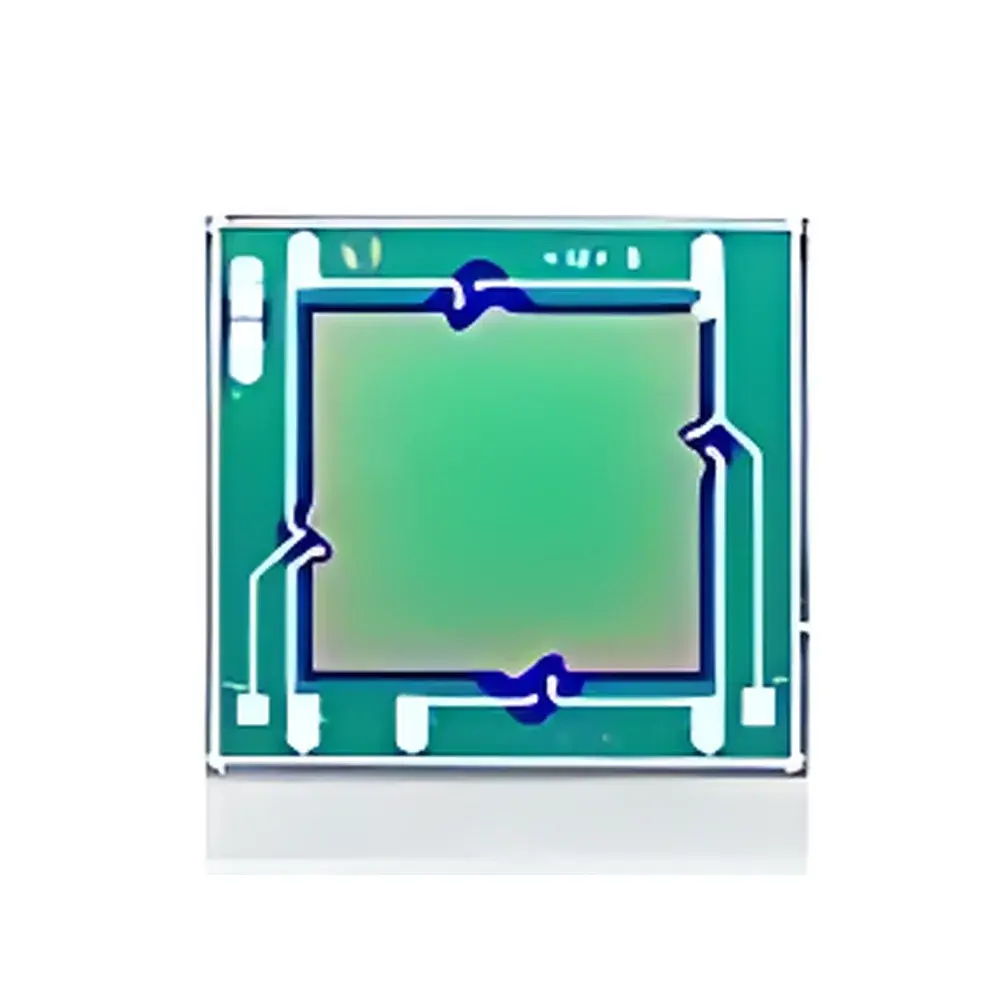
First Sensor SL21K-100k-A/GXX Pressure Sensor Die
| Brand | First Sensor |
|---|---|
| Origin | Germany |
| Model | SL21K-100k-A/GXX |
| Pressure Range | 100 kPa |
| Output Sensitivity | 40–70–130 mV @ 5 V excitation |
| Technology | STARe (Sensor Technology for Advanced Resistors) |
| Category | Optical Instrument Component |
| Compliance | RoHS, REACH, AEC-Q200 qualified (industrial variants) |
Overview
The First Sensor SL21K-100k-A/GXX is a high-stability silicon-based pressure sensor die engineered for integration into precision OEM measurement systems. Unlike optical transducers or capacitive sensing elements, this device employs advanced piezoresistive micro-machining technology—specifically First Sensor’s proprietary STARe (Sensor Technology for Advanced Resistors) platform—to deliver robust, repeatable pressure response in demanding physical environments. The die operates on a Wheatstone bridge configuration with laser-trimmed resistors, enabling high linearity and low thermal drift across its full operating temperature range (–40 °C to +125 °C). Designed as a bare-die component rather than a packaged module, it requires hermetic bonding or encapsulation by the end-user during system-level assembly—making it ideal for custom optical-hybrid instrumentation where space constraints, thermal matching, or signal integrity are critical design parameters.
Key Features
- STARe-based piezoresistive sensing architecture optimized for long-term stability and hysteresis <0.1 %FS
- Bare-die form factor (no housing, no leads): dimensions 2.2 mm × 2.2 mm × 0.6 mm; compatible with flip-chip, wire-bond, or anodic bonding processes
- Full-scale output of 40–70–130 mV at 5 V excitation, with built-in temperature compensation circuitry (TCR < ±100 ppm/K)
- Designed for operation in corrosive, oil-immersed, or high-vibration environments—validated per IEC 60068-2 mechanical shock and humidity testing protocols
- RoHS-compliant and REACH-conformant; select variants meet AEC-Q200 stress test requirements for automotive-grade reliability
- Low power consumption (<10 mW typical at 5 V), suitable for battery-operated or low-noise optical subsystems requiring minimal thermal load
Sample Compatibility & Compliance
The SL21K-100k-A/GXX die is intended for integration into opto-mechanical assemblies where pressure feedback must coexist with optical path integrity—for example, in tunable laser cavities with pressure-controlled cavity length, vacuum chamber monitoring in interferometric metrology setups, or sealed optical sensor housings subject to ambient barometric variation. Its silicon nitride passivation layer ensures compatibility with common optical adhesives (e.g., NOA61, UV-curable epoxies) and avoids outgassing in ultra-high-vacuum (UHV) optical chambers (tested to <1×10⁻⁹ mbar·L/s total desorption rate). Compliance includes ISO 9001-certified manufacturing, traceable wafer-level calibration data per batch, and documentation supporting GLP/GMP-aligned validation workflows—including raw calibration certificates with uncertainty budgets referenced to NIST-traceable deadweight testers.
Software & Data Management
As a passive analog die, the SL21K-100k-A/GXX does not include embedded firmware or digital interfaces. However, First Sensor provides comprehensive integration support: application notes for low-noise analog signal conditioning (including recommended instrumentation amplifier topologies and PCB layout guidelines to minimize EMI coupling near optical detectors), reference designs for 24-bit sigma-delta ADC interfacing (e.g., ADS1256), and MATLAB-compatible calibration coefficient files (span, offset, TCS, nonlinearity correction polynomials). For regulated environments—such as medical device OEMs developing FDA 510(k)-cleared optical diagnostics platforms—the manufacturer supplies audit-ready documentation packages compliant with 21 CFR Part 11 requirements, including electronic signature-capable calibration logs and change control records for wafer lot revisions.
Applications
- Optical cavity pressure stabilization in external-cavity diode lasers (ECDLs) and fiber laser pump modules
- Real-time barometric compensation in portable Raman spectrometers and FTIR sampling heads
- Sealed optical encoder housing pressure monitoring for aerospace-grade inertial measurement units (IMUs)
- Process gas pressure feedback in photolithography stepper environmental control systems
- OEM integration into laser-induced breakdown spectroscopy (LIBS) sample chambers requiring dynamic pressure profiling during ablation
- Compact pressure reference nodes in distributed fiber Bragg grating (FBG) sensor networks with hybrid electro-optic readout
FAQ
Is the SL21K-100k-A/GXX supplied with calibration data?
Yes—each wafer lot includes NIST-traceable calibration reports specifying full-scale output, zero-offset, thermal coefficients, and nonlinearity error bands across –20 °C to +85 °C.
Can this die be bonded directly to glass or fused silica substrates?
Yes; the die features a standard SiO₂/Si₃N₄ stack compatible with anodic bonding to borosilicate glass (e.g., BK7) and fusion bonding to crystalline quartz under controlled cleanroom conditions.
What is the recommended excitation voltage range for optimal SNR?
5.0 V ±0.05 V DC is specified for nominal performance; operation between 3.3 V and 10 V is possible but requires recalibration of sensitivity and thermal coefficients.
Does First Sensor offer evaluation boards for this die?
No—evaluation is performed at the OEM level using customer-specific carrier PCBs; however, First Sensor provides detailed schematics and Gerber files for reference interface circuits.
How is long-term drift characterized for this sensor die?
Accelerated life testing per MIL-STD-883H Method 1008 shows <0.2 %FS/year typical drift under constant 50 °C bias, validated over 10,000 hours of continuous operation.




