
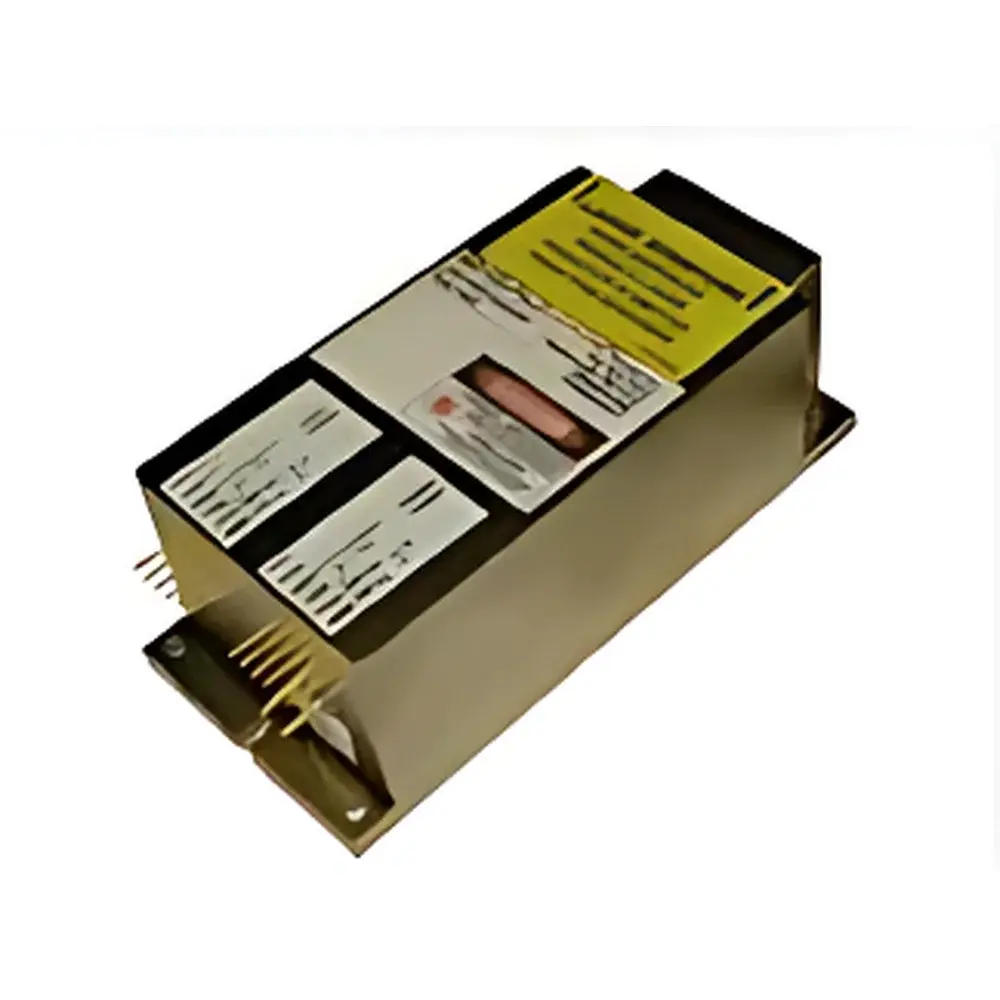
Sheaumann Laser MIR-Pac 2.94 µm Continuous-Wave Solid-State Laser
| Brand | Sheaumann Laser |
|---|---|
| Origin | USA |
| Manufacturer Type | Authorized Distributor |
| Import Status | Imported |
| Model | MIR-Pac |
| Laser Type | Solid-State Mid-Infrared Laser |
| Wavelength | 2.94 µm (2940 nm) |
| Output Power | 1 W / 1.5 W (CW, free-space or fiber-coupled) |
| Spatial Mode | TEM₀₀, M² < 1.2 |
| Spectral Bandwidth | < 0.5 cm⁻¹ |
| Wavelength Stability | < ±1 cm⁻¹ |
| Beam Diameter | < 2.0 mm |
| Beam Divergence | < 20 mrad |
| Pointing Stability | < ±5% of beam divergence |
| Intensity Noise (10 Hz–100 kHz) | < 1.0% RMS |
| Long-Term Power Stability | < ±2.0% over 8 h |
| Polarization | Random |
| Warm-up Time | < 5 min |
| Operating Ambient Temperature | 15–40 °C |
| Power Dissipation | < 100 W |
| Laser Head Dimensions | 114 × 52 × 38 mm³ |
| Laser Head Weight | 0.82 kg |
| Driver Option | DRV-002 High-Power Laser Diode & TEC Controller |
Overview
The Sheaumann Laser MIR-Pac 2.94 µm continuous-wave (CW) solid-state laser is engineered for precision mid-infrared (MIR) applications requiring high spectral purity and stable output in the molecular fingerprint region. Operating at 2940 nm—coinciding with the strong OH-stretch absorption peak in water and biological tissues—the laser leverages robust diode-pumped solid-state architecture to deliver narrow-linewidth, diffraction-limited output (TEM₀₀, M² < 1.2). Its design integrates a monolithic gain medium with active thermal stabilization via integrated thermoelectric cooling (TEC), enabling consistent performance across laboratory, industrial, and clinical environments. Unlike tunable OPO or quantum cascade laser systems, the MIR-Pac provides fixed-wavelength operation optimized for reliability, low noise, and rapid thermal equilibration (< 5 min warm-up), making it suitable for integration into OEM instrumentation where footprint, power efficiency, and long-term repeatability are critical.
Key Features
- Stable CW output at 2940 nm with selectable power levels: 1 W (free-space) or 1.5 W (fiber-coupled variants)
- Diffraction-limited beam quality (M² < 1.2) ensuring high focusability and minimal divergence (< 20 mrad)
- Narrow spectral bandwidth (< 0.5 cm⁻¹) and wavelength stability (< ±1 cm⁻¹) supporting high-resolution spectroscopic interrogation
- Low-intensity noise (< 1.0% RMS, 10 Hz–100 kHz) essential for lock-in detection, heterodyne sensing, and interferometric applications
- Compact laser head (114 × 52 × 38 mm³, 0.82 kg) with integrated driver interface and TEC control
- Flexible output configuration: collimated free-space beam or SMF-28-compatible fiber coupling (FC/PC or FC/APC options)
- Compliant with IEC 60825-1:2014 Class 4 laser safety requirements; includes interlock-ready connectors and emission indicators
Sample Compatibility & Compliance
The 2940 nm emission wavelength exhibits strong absorption in aqueous media, hydroxyl-bearing polymers, and organic compounds—enabling selective interaction with biological tissue, pharmaceutical excipients, and moisture-sensitive packaging films. This makes the MIR-Pac compatible with non-contact ablation, real-time moisture mapping, and photoacoustic spectroscopy workflows. The system meets mechanical and electromagnetic compatibility standards per EN 61326-1 (industrial measurement equipment) and conforms to RoHS 2015/863/EU. For regulated environments—including ISO 13485-certified medical device manufacturing or GLP-compliant analytical labs—the laser’s long-term power stability (< ±2.0% over 8 h) and traceable calibration support audit-ready documentation. Optional DRV-002 driver includes analog modulation input (0–5 V), TTL blanking, and digital communication (RS-232/USB) for synchronization with data acquisition systems under FDA 21 CFR Part 11-compliant software architectures.
Software & Data Management
While the MIR-Pac operates as a hardware-integrated source rather than a standalone instrument, its driver interface supports seamless integration into third-party control ecosystems. The DRV-002 controller provides open-command protocols (ASCII over RS-232 or USB virtual COM port), enabling programmable setpoint adjustment, real-time monitoring of diode current, TEC voltage, and case temperature, and logging of operational parameters at user-defined intervals. LabVIEW™, Python (PySerial), and MATLAB® drivers are available upon request. All logged data—including timestamps, power readings, and thermal metrics—can be exported in CSV format for traceability and statistical process control (SPC) analysis. When deployed in automated platforms (e.g., inline packaging inspection or surgical guidance systems), the laser’s fast modulation capability (< 100 ns rise/fall time) and jitter-free triggering ensure synchronization with high-speed cameras or acoustic detectors without external timing hardware.
Applications
- Medical & Biophotonics: Precise soft-tissue ablation, dental caries removal, and minimally invasive surgery leveraging water-selective photothermal interaction
- Industrial Sensing: In-line moisture content monitoring in paper, textiles, and pharmaceutical tablet coatings using absorption-based transmission or reflectance geometry
- Scientific Research: Pump source for difference-frequency generation (DFG), calibration reference for FTIR spectrometers, and excitation source in mid-IR photoacoustic microscopy
- Materials Processing: Selective polymer welding, thin-film ablation, and laser-induced forward transfer (LIFT) of bioactive compounds
- Defense & Remote Sensing: Eye-safe LIDAR and differential absorption LIDAR (DIAL) for atmospheric H₂O vapor profiling
FAQ
Is this laser FDA-cleared for medical use?
No—this is a Class 4 laser subsystem intended for integration into FDA-cleared or CE-marked medical devices. End-user responsibility includes full system-level regulatory validation per IEC 60601-2-22 and relevant regional directives.
Can the output be fiber-coupled to a hollow-core photonic crystal fiber?
Yes—custom coupling solutions are available for specialty fibers including Kagome-type or inhibited-coupling HC-PCFs optimized for 2.94 µm transmission; contact technical support for mode-field matching and damage threshold assessment.
What cooling method does the laser require?
The integrated TEC is driven by the DRV-002 controller; no external chiller is needed. Ambient air convection suffices within the specified 15–40 °C operating range. Forced-air cooling may extend duty cycle in high-ambient environments.
Is wavelength tuning possible?
No—the MIR-Pac is a fixed-wavelength source. For tunable MIR output, consider hybrid systems combining this laser with nonlinear frequency conversion stages (e.g., AgGaSe₂ OPGs) or consult our QCL/OPO portfolio.
Do you provide beam profiling data and M² measurement reports?
Yes—each unit ships with a calibrated beam parameter measurement report (ISO 11146-compliant), including far-field divergence, beam waist location, and M² values derived from 10-point knife-edge scans.






