
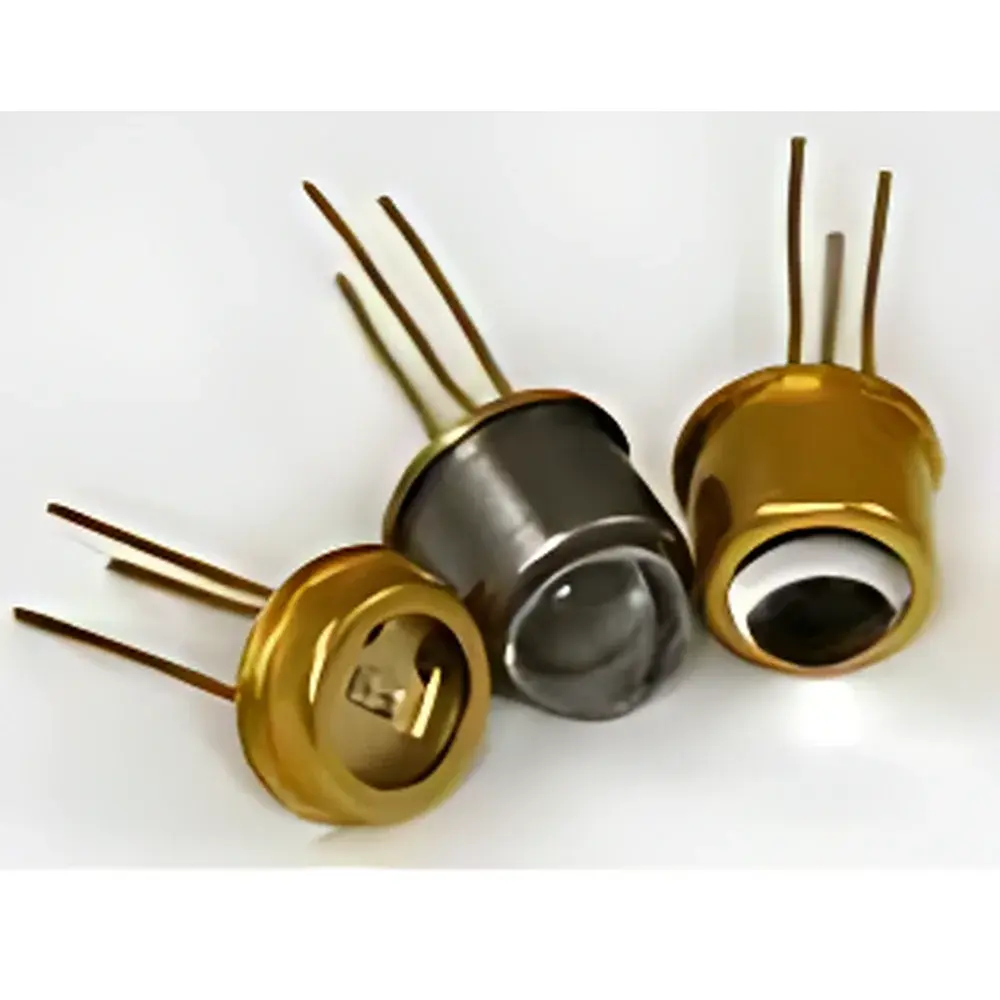
SET UV TOP Series AlGaN/GaN Ultraviolet LED Light Source
| Brand | SET / Sensor Electronic Technology |
|---|---|
| Origin | USA |
| Model | UV TOP Series |
| Component Type | UV Light Source |
| Spectral Range | 240–370 nm |
| Package Options | TO-18, TO-39 |
| Emission Configurations | Flat Window (120° full-angle divergence), Hemispherical Lens (7° full-angle quasi-collimated), Spherical Lens (focused + 7° quasi-collimated), Fiber-Coupled |
| Wavelength Options | Discrete peaks from 240 nm to 355 nm (e.g., 275 nm, 310 nm) with ceramic SMD variants available |
| Optical Power Output | 10 µW to 800 µW (varies by wavelength, package, and lens type) |
| Viewing Angle | 7° (collimated), 120° (broad emission) |
| Compliance | RoHS-compliant packaging, JEDEC-standard hermetic sealing for TO-can variants |
Overview
The SET UV TOP Series represents a family of high-stability, narrow-band ultraviolet light sources engineered for precision optical instrumentation and laboratory-grade applications. Built upon mature AlGaN/GaN heterostructure semiconductor technology, these LEDs emit discrete spectral lines across the deep-UV to near-UV range (240–370 nm), enabling targeted excitation in photochemical, spectroscopic, and fluorescence-based measurement systems. Unlike broadband UV lamps or mercury arc sources, the UV TOP Series delivers inherent spectral purity, rapid turn-on/turn-off response (10,000 hours at rated drive current). The series is optimized for integration into compact analytical platforms where thermal management, electrical noise immunity, and spatial coherence are essential design constraints.
Key Features
- Monochromatic UV output with center wavelengths precisely controlled from 240 nm to 355 nm, including commonly specified lines at 275 nm and 310 nm
- Multiple hermetically sealed package formats: TO-18 and TO-39 metal cans with industry-standard pinouts, plus ceramic surface-mount (SMD) variants for reflow-compatible PCB integration
- Four optical emission configurations: flat-window (120° Lambertian emission), hemispherical lens (7° full-angle quasi-collimation), spherical lens (focused beam + 7° collimation), and fiber-coupled versions compatible with SMA-905 or FC/PC connectors
- Stable radiometric output over temperature (–40°C to +85°C case temperature) with integrated thermal compensation circuitry in driver modules
- Compliant with JEDEC J-STD-020 moisture sensitivity level (MSL) 1 for TO-can devices; RoHS and REACH certified materials throughout
- Available with dedicated constant-current drivers: UV TOP-PS-DC (benchtop DC input) and UV TOP-PS-AC/DC (universal AC line input with isolated output)
Sample Compatibility & Compliance
The UV TOP Series is designed for use in regulated and research-grade environments requiring traceable performance and repeatable illumination. Devices meet IEC 62471 Photobiological Safety classification for UV hazard assessment (Risk Group 1 or 2 depending on output power and exposure geometry). For analytical instrument OEMs, the series supports compliance with ISO/IEC 17025 calibration traceability when paired with NIST-traceable spectroradiometric characterization reports. In pharmaceutical and clinical settings, UV TOP emitters are routinely deployed in UV-curable adhesive curing stations (per ISO 10993-12), nucleic acid quantification systems (aligned with USP endotoxin assay illumination requirements), and ozone-free disinfection validation tools. All TO-can variants undergo 100% burn-in and binning for peak wavelength (±2 nm tolerance) and radiant flux (±15% at nominal drive current), ensuring batch-to-batch consistency required for GLP and GMP-aligned workflows.
Software & Data Management
While the UV TOP Series operates as a standalone analog light source, it is fully compatible with third-party digital control ecosystems via TTL or analog voltage modulation inputs (0–5 V). When integrated with SET’s optional UV TOP-PS-DC driver, users gain access to programmable pulse width modulation (PWM) up to 10 kHz, adjustable current limits (1–100 mA), and real-time temperature monitoring via onboard thermistor feedback. Data logging of drive current, junction temperature, and cumulative operating hours is supported through RS-232 or USB-C interfaces—enabling audit-ready records compliant with FDA 21 CFR Part 11 for electronic signatures and data integrity. Instrumentation software developers can leverage SET’s publicly documented SCPI command set for automated spectral calibration routines, intensity stabilization loops, and multi-channel synchronization in hyperspectral imaging or flow cytometry platforms.
Applications
- Fluorescence excitation in portable biosensors (e.g., DNA intercalator dyes, tryptophan detection)
- UV-curable resin initiation in microfluidic device fabrication and 3D printed optics
- Gas-phase photolysis cells for NO₂, SO₂, and ozone monitoring (per EPA Method TO-15 and ISO 13964)
- Optical alignment and fiducial marking in semiconductor lithography tooling
- UV-Vis spectrophotometer reference sources and wavelength calibration standards
- Fiber-optic sensing heads for distributed UV absorption spectroscopy in industrial process streams
- Phototherapy dose control modules in dermatological and dental curing systems
FAQ
What is the typical forward voltage and recommended drive current for UV TOP devices?
Forward voltage ranges from 5.2 V to 7.8 V depending on wavelength and temperature; constant-current operation between 20 mA and 100 mA is recommended for optimal radiometric stability and lifetime.
Are UV TOP LEDs suitable for continuous-wave (CW) or pulsed operation?
All models support both CW and pulsed modes; maximum pulse frequency is 10 kHz with duty cycle ≤50% to maintain thermal equilibrium.
Can UV TOP emitters be used in vacuum or inert-gas environments?
Yes—TO-18 and TO-39 packages feature welded metal housings rated for ultra-high vacuum (UHV) compatibility and nitrogen-purged operation.
Is spectral irradiance data available for each wavelength variant?
Yes—SET provides full spectral power distribution (SPD) curves, FWHM values, and angular intensity profiles in IESNA LM-63 format upon request.
Do UV TOP devices require external heat sinking?
For operation above 50 mA or ambient temperatures exceeding 40°C, active or passive thermal management (e.g., aluminum submounts with thermal interface material) is strongly advised to maintain wavelength stability and output linearity.





