
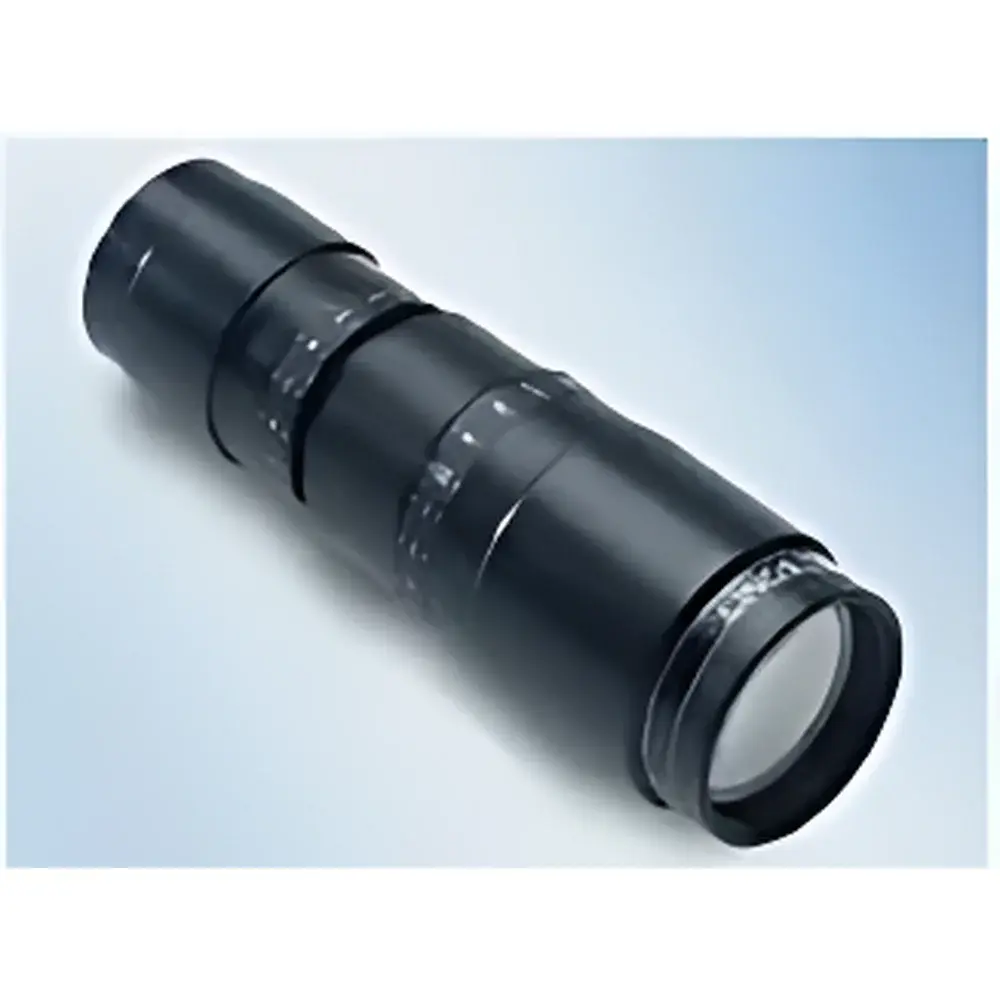
Linos newopto Galilean Variable Laser Beam Expander
| Brand | Linos |
|---|---|
| Origin | Germany |
| Model | newopto |
| Wavelength Range | 355–1064 nm |
| Expansion Ratio | 2×–8× (variable, manual or motorized) |
| Max. Input Beam Diameter (1/e² Gaussian) | 3.4–8 mm |
| Max. Output Beam Diameter | 31 mm |
| Number of Lens Elements | 4 |
| Entrance Lens Material | Fused Silica (Quartz) |
| Mounting Diameter | 37.6 mm |
| Compliance | ISO 10110 optical surface specifications, RoHS-compliant housing |
Overview
The Linos newopto Galilean Variable Laser Beam Expander is an engineered optical component designed for precise beam diameter control in demanding laser-based applications. Operating on the Galilean telescope principle—comprising a negative (diverging) front lens and a positive (converging) rear lens—it achieves variable magnification without introducing internal focus points or beam waist shifts within the optical path. This architecture eliminates the risk of air breakdown or thermal lensing at high peak powers, making it especially suitable for pulsed nanosecond and femtosecond laser systems. Unlike Keplerian designs, the Galilean configuration maintains a compact physical footprint and inherently avoids spatial filtering effects, preserving beam wavefront fidelity and M² characteristics. The expander is optimized for collimated input beams and delivers diffraction-limited performance across its specified wavelength range (355 nm to 1064 nm), supporting both continuous-wave and Q-switched sources used in industrial, scientific, and metrological environments.
Key Features
- Precision-engineered Galilean optical layout with four-element all-spherical design for minimal wavefront distortion and high transmission efficiency (>95% per surface with broadband AR coating)
- Variable magnification from 2× to 8× (standard) or up to 10× (1064 nm variant), adjusted via precision-threaded barrel translation mechanism
- Fused silica (quartz) entrance lens ensuring high laser-induced damage threshold (LIDT > 5 J/cm² @ 1064 nm, 10 ns pulse) and low thermal expansion coefficient
- Robust aluminum housing with black anodized finish, compatible with standard Ø37.6 mm kinematic and lens-mounting platforms
- Motorized version available with integrated stepper motor and RS-232/USB interface for programmable expansion ratio control and repeatability within ±0.05×
- Optical surfaces manufactured to ISO 10110-5 specifications (scratch-dig ≤ 10–5, surface irregularity λ/10 PV @ 633 nm)
Sample Compatibility & Compliance
The newopto expander accommodates input Gaussian beams with 1/e² diameters ranging from 3.4 mm (at 355 nm) to 8 mm (at 532 nm, 633 nm, 780 nm, 830 nm, and 1064 nm), delivering a consistent maximum output beam diameter of 31 mm regardless of expansion setting. It is compatible with TEM₀₀ and low-order multimode beams, provided input divergence remains below 1.5 mrad. All optical coatings meet MIL-C-48497A durability standards and are certified RoHS-compliant. The mechanical design conforms to DIN 31850 mounting interfaces, enabling seamless integration into OEM laser processing heads and laboratory optical tables. For regulated environments—including ISO 13485-certified medical device manufacturing or FDA-regulated analytical instrumentation—the expander supports traceable calibration documentation and can be supplied with individual test reports (including transmitted wavefront error and spectral transmittance curves).
Software & Data Management
The motorized variant includes firmware-compatible drivers for Windows/Linux and Python API support (via PySerial), enabling synchronization with motion controllers, power meters, and beam profiling systems. Configuration parameters—including current magnification factor, motor position, temperature drift compensation coefficients, and usage log timestamps—are stored in non-volatile memory. Audit trails comply with GLP/GMP data integrity requirements when paired with validated host software. No proprietary cloud service or telemetry is embedded; all data remains local unless explicitly exported by the user. Firmware updates are performed via signed binary upload to ensure system integrity and prevent unauthorized modification.
Applications
- Laser material processing: beam shaping prior to galvanometric scanning in micromachining, thin-film ablation, and selective laser melting
- Ultrafast optics: pre-compensation of pulse broadening in CPA systems and seeding of optical parametric amplifiers
- Interferometry and metrology: scaling beam size for improved fringe contrast in heterodyne detection and gravitational wave sensor alignment
- Biophotonics: optimizing illumination profiles in confocal microscopy, optical trapping, and flow cytometry excitation paths
- Defense and aerospace: beam conditioning for free-space optical communication terminals and LIDAR transmitter modules
- Academic research: fundamental studies of nonlinear frequency conversion efficiency as a function of beam intensity and Rayleigh length
FAQ
What is the maximum average power the expander can handle?
Thermal load capacity depends on wavelength, beam profile, and cooling conditions. At 1064 nm with a top-hat profile and forced-air convection, the standard model is rated for ≤150 W average power. For CW powers exceeding 50 W, optional water-cooled mounts are available.
Can this expander be used with ultrashort pulses (e.g., <100 fs)?
Yes—provided group delay dispersion (GDD) compensation is applied externally. The standard fused silica design introduces ~35 fs² of GDD per expansion stage; custom chirped mirror pairs or prism compressors may be integrated upstream.
Is vacuum compatibility available?
Standard units are not vacuum-rated, but custom versions with vacuum-compatible adhesives, outgassing-tested lubricants, and CF-flange mounting options can be supplied under NDA.
Do you provide beam propagation modeling files (Zemax, Code V, or Synopsys OpticStudio)?
Yes—Zemax .zmx files for all wavelength-specific configurations are included with purchase, along with measured MTF and PSF datasets for validation.
How is collimation verified during assembly?
Each unit undergoes interferometric collimation verification using a Zygo Verifire™ XP interferometer, with final adjustment performed under helium atmosphere to minimize refractive index fluctuations.





