
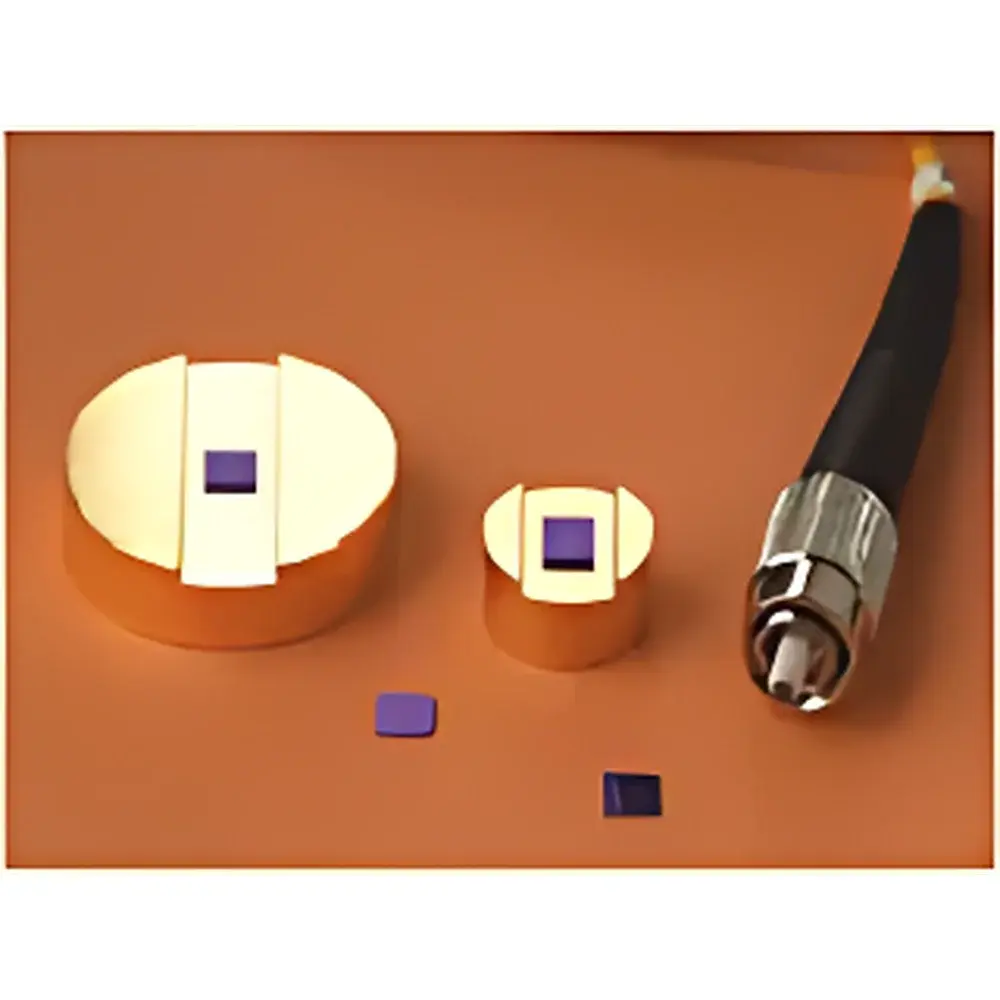
BATOP SAM-1064-1-1ps-x Saturable Absorber Mirror
| Brand | BATOP |
|---|---|
| Origin | Germany |
| Model | SAM-1064-1-1ps-x |
| Component Type | Optical Element |
| Mounting Options | Unmounted (450 µm thickness), Mounted (4 mm × 4 mm chip), or Fiber-Pigtailed (FC/PC or FC/APC) |
| Wavelength | 1064 nm |
| Saturation Fluence | ~1 µJ/cm² (typ.) |
| Recovery Time | ~1 ps |
| Reflectivity (HR) | >99.9% at design wavelength |
| Cavity Structure | AlAs/GaAs Bragg stack with low-temperature GaAs (LT-GaAs) saturable absorber layer |
| Compliance | RoHS-compliant, ISO 9001-manufactured wafers |
Overview
The BATOP SAM-1064-1-1ps-x is a semiconductor-based Saturable Absorber Mirror engineered for passive mode-locking of solid-state and fiber lasers operating at 1064 nm. It functions as an integrated optoelectronic element combining a high-reflectivity distributed Bragg reflector (DBR) and an ultrafast LT-GaAs absorber layer within a monolithic GaAs epitaxial structure. The device operates on the principle of intensity-dependent nonlinear absorption: at low incident fluence, it exhibits high optical loss due to ground-state absorption; above a threshold fluence (~1 µJ/cm²), the absorber saturates, enabling near-instantaneous (10 MHz) and high-average-power (>1 W) conditions typical in industrial and scientific laser systems.
Key Features
- Monolithic AlAs/GaAs quarter-wave stack DBR with >99.9% peak reflectivity centered at 1064 nm ±2 nm
- Epitaxially grown low-temperature GaAs (LT-GaAs) saturable absorber layer with sub-picosecond carrier recombination dynamics
- Precisely controlled absorber thickness (1 ps nominal saturation time) optimized for Nd:YAG, Nd:YVO₄, and Yb-doped fiber laser harmonics
- Three standardized mechanical configurations: unmounted chip (450 µm thick, bare die), mounted chip (4 mm × 4 mm on copper or brass heatsink with optional thermoelectric cooling interface), and fiber-pigtailed variants (FC/PC or FC/APC connectors compatible with HI1060 or PM1060 fibers)
- No glue or polymer interfaces — all optical layers are lattice-matched and grown in-situ, eliminating thermal delamination risk and enabling CW power handling up to 500 mW (with proper heatsinking)
- Manufactured under ISO 9001-certified cleanroom conditions; full traceability per wafer lot, including spectral reflectance mapping and time-resolved pump-probe characterization reports
Sample Compatibility & Compliance
The SAM-1064-1-1ps-x is compatible with standard optical mounts (e.g., Thorlabs KM100, Newport UVPD series) and integrates seamlessly into Ti:sapphire-pumped OPOs, diode-pumped solid-state oscillators, and all-fiber MOPA architectures. Its surface is AR-coated on the backside (for unmounted variants) to suppress parasitic etaloning. All devices comply with EU RoHS Directive 2011/65/EU and are shipped with material declaration documentation. While not a medical or safety-critical device, its performance parameters align with common laser cavity design requirements referenced in ISO/TR 11146-3:2020 (laser beam parameters — nonlinear optical components) and support GLP-compliant laser development workflows where component-level calibration traceability is required.
Software & Data Management
BATOP provides downloadable spectral reflectance data (CSV format) and time-resolved absorption recovery curves (via pump-probe measurement) for each production lot. No proprietary firmware or driver software is required — the SAM is a passive, alignment-sensitive optical component. However, integration into automated test benches (e.g., using LabVIEW or Python-controlled motorized rotation stages) is supported via standardized mechanical footprint dimensions and documented angular sensitivity (±0.5° tolerance for optimal saturation depth). For regulatory environments requiring audit trails (e.g., FDA 21 CFR Part 11–compliant R&D labs), users may log installation date, cavity position, and measured pulse duration stabilization metrics in their internal LIMS or ELN systems.
Applications
- Passive mode-locking of Nd:YVO₄, Nd:YAG, and Yb:KGW oscillators for sub-200 fs pulse generation
- Self-starting pulse formation in compact microchip lasers and waveguide lasers
- Timing jitter reduction in synchronized amplifier chains (e.g., OPCPA pump sources)
- Nonlinear frequency conversion seeding where low-amplitude ASE suppression is critical
- Ultrafast spectroscopy pump-probe delay line stabilization via intracavity pulse shortening
- Research-grade validation of carrier dynamics models in low-dimensional semiconductor heterostructures
FAQ
What is the damage threshold of the SAM-1064-1-1ps-x?
For CW operation with proper thermal management (copper mount, active cooling), the maximum average power density is 500 mW over a 100 µm spot. For pulsed operation (1064 nm, 100 fs, 80 MHz), the fluence limit is 10 µJ/cm² per pulse — exceeding this may induce irreversible defect formation in the LT-GaAs layer.
Can this SAM be used at wavelengths other than 1064 nm?
No — its Bragg stack is designed for narrowband reflectivity centered at 1064 nm. Off-center use results in significantly reduced reflectivity and unpredictable saturation behavior. BATOP offers dedicated variants for 800 nm, 980 nm, 1550 nm, and other bands.
Is vacuum compatibility guaranteed?
Unmounted and mounted variants (without epoxy or soldered fiber pigtails) are vacuum-compatible up to 10⁻⁶ mbar when baked at ≤80°C. Fiber-pigtailed versions require verification of connector adhesive outgassing per NASA ASTM E595 specifications.
How should I align the SAM in my cavity?
Align for normal incidence first using a HeNe alignment laser; then fine-tune angle (±0.3°) while monitoring pulse build-up time and RF spectrum noise floor to maximize modulation depth and minimize Q-switching instability.
Does BATOP provide custom designs?
Yes — custom center wavelengths (±5 nm tolerance), tailored saturation fluences (0.1–10 µJ/cm²), and hybrid configurations (e.g., SAM + intracavity birefringent filter) are available under NRE agreement with minimum order quantities.




