
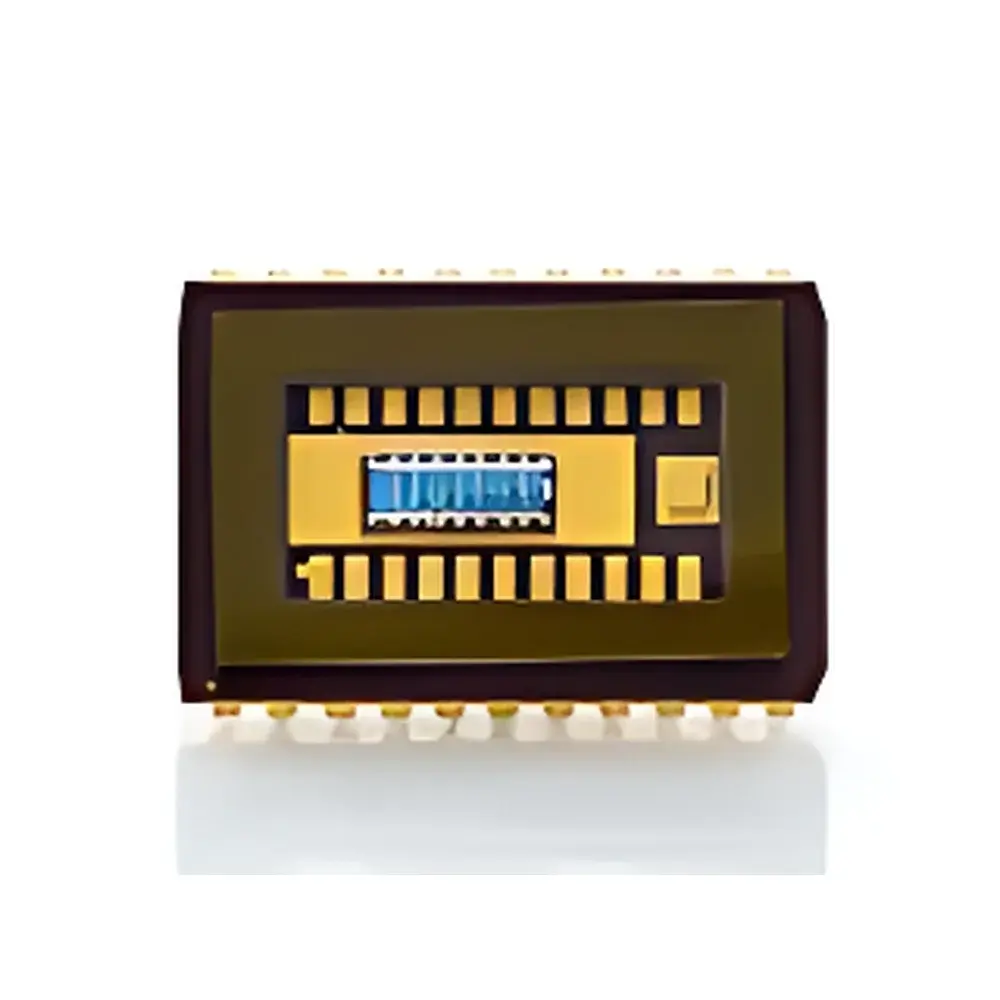
First Sensor APD Array Series – Linear and Matrix Avalanche Photodiode Arrays
| Brand | First Sensor |
|---|---|
| Origin | Germany |
| Model | 8AA0.4-9, 16AA0.13-9 (SOJ22GL & DIL18), 25AA0.04-9/25AA0.16-9 (BGA), 64AA0.04-9 (BGA), QA4000-9 (TO8Si) |
| Spectral Range | 760–910 nm |
| Quantum Efficiency | >80% |
| Package Types | SOJ22GL, DIL18, BGA, TO8Si |
| Temperature Compensation | NTC or PTC integrated |
| Element Count | 8, 16, 25 (5×5), 64 (8×8), Quadrant (4-element) |
Overview
The First Sensor APD Array Series comprises high-sensitivity, silicon-based linear and matrix avalanche photodiode (APD) arrays engineered for time-critical, low-light optical detection in demanding industrial and scientific applications. These devices operate on the principle of internal carrier multiplication via controlled avalanche gain—enabling photon-limited signal amplification with sub-nanosecond response times and high signal-to-noise ratios. Optimized for the near-infrared (NIR) spectrum from 760 nm to 910 nm, the arrays deliver quantum efficiency exceeding 80% across this band—making them ideal for pulsed laser reception in LiDAR systems, time-of-flight (ToF) distance measurement, and high-resolution optical scanning. All variants feature monolithic integration of active elements with built-in temperature compensation circuitry (NTC or PTC), ensuring stable gain calibration over ambient operating ranges (−40 °C to +85 °C). The series adheres to ISO 9001-certified manufacturing protocols at First Sensor’s German production facilities, guaranteeing batch-to-batch consistency and long-term reliability under continuous bias operation.
Key Features
- High quantum efficiency (>80%) across 760–910 nm NIR band—optimized for common pulsed laser diodes (e.g., 850 nm VCSELs and 905 nm edge-emitters)
- Monolithic array architectures: linear (8- and 16-element), matrix (25-element 5×5 and 64-element 8×8), and quadrant (QA4000-9) configurations
- Integrated temperature compensation: NTC thermistors (SOJ22GL/DIL18 variants) or PTC elements (BGA variants) for real-time gain stabilization
- Low dark current density (<1 nA/mm² at M = 100) and high gain uniformity (±5% typical across elements)
- Robust packaging options: SOJ22GL (surface-mount), DIL18 (through-hole), BGA (high-density interconnect), and TO8Si (hermetic metal-can for high-reliability environments)
- Compatible with standard APD bias supplies (up to −200 V) and fast transimpedance amplifiers (TIA) for analog output or digitization via high-speed ADCs
Sample Compatibility & Compliance
The First Sensor APD Array Series is designed for integration into OEM optical receiver modules used in automotive-grade ADAS LiDAR, industrial ToF sensors, and laboratory-grade optical time-domain reflectometers (OTDR). Each device complies with RoHS 2015/863/EU and REACH (EC) No. 1907/2006 directives. The TO8Si-packaged QA4000-9 quadrant APD meets MIL-STD-883H mechanical shock and vibration requirements for aerospace instrumentation. All arrays support GLP-compliant calibration traceability through First Sensor’s certified test reports—including spectral responsivity curves, gain vs. bias voltage characterization, and element-to-element crosstalk measurements (<−35 dB at 1 MHz).
Software & Data Management
While the APD arrays themselves are analog front-end components, they interface seamlessly with industry-standard data acquisition platforms including National Instruments PXIe systems, Keysight DAQ modules, and custom FPGA-based receivers. First Sensor provides comprehensive SPICE models and spectral response datasets (CSV format) for system-level simulation in MATLAB, Python (SciPy), and LTspice. For production test environments, the arrays support automated parametric testing workflows compliant with ASTM E178-22 (Standard Practice for Dealing with Outlying Observations) and ISO/IEC 17025:2017—enabling full audit trails, calibration history logging, and pass/fail reporting aligned with FDA 21 CFR Part 11 electronic record requirements when deployed in regulated manufacturing settings.
Applications
- Automotive and robotics LiDAR: multi-channel return signal capture for point-cloud generation and object classification
- Precision industrial distance sensing: mm-level resolution in factory automation, robotic guidance, and AGV navigation
- Optical coherence tomography (OCT) receiver arrays for ophthalmic and dermatological imaging systems
- Laser-induced breakdown spectroscopy (LIBS) detectors requiring spatially resolved plasma emission analysis
- Free-space optical communication (FSOC) terminals with adaptive aperture alignment using quadrant APDs
- Scientific instrumentation: fluorescence lifetime imaging (FLIM), time-resolved photoluminescence, and single-photon counting correlation setups (when operated in Geiger mode with quenching circuitry)
FAQ
What is the maximum recommended reverse bias voltage for these APD arrays?
The absolute maximum reverse bias is device-specific and documented in First Sensor’s official datasheets—for example, 8AA0.4-9 and 16AA0.13-9 are rated up to −180 V; 25AA0.16-9 and 64AA0.04-9 up to −200 V. Operation above specified limits risks irreversible breakdown.
Do these APD arrays require active cooling?
No active cooling is required for standard operation within −40 °C to +60 °C ambient. However, for sustained high-gain operation (>M = 150) at elevated temperatures, thermoelectric coolers (TECs) are recommended to maintain gain stability and minimize dark current drift.
Are evaluation boards available for rapid prototyping?
Yes—First Sensor partners with leading module suppliers (e.g., Hamamatsu Photonics, Thorlabs, and Laser Components) to offer plug-and-play evaluation kits with integrated HV bias regulation, TIA stages, and USB-digital interfaces supporting real-time waveform capture and histogram analysis.
Can these arrays be customized for non-standard pixel pitches or spectral bands?
First Sensor offers tailored design-in support—including mask-layer modifications, anti-reflection coating optimization for specific wavelengths (e.g., 1064 nm), and hybrid integration with CMOS readout ICs—subject to minimum order quantities and NRE agreements.





