
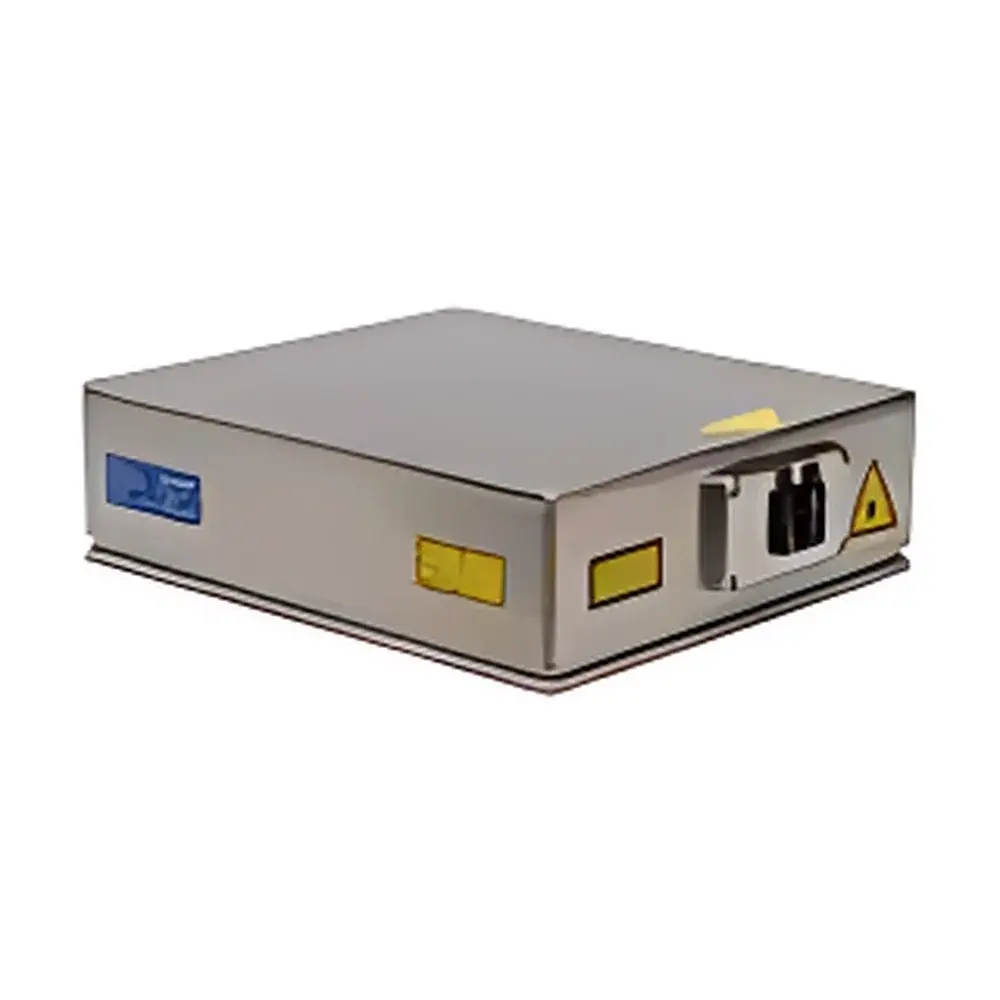
CryLas FQCW-266 Continuous-Wave Single-Frequency UV Laser System
| Origin | Germany |
|---|---|
| Manufacturer Type | Authorized Distributor |
| Origin Category | Imported |
| Model | CryLas FQCW-266 |
| Core Technology | Diode-Pumped Solid-State (DPSS) Q-Switched Frequency-Quadrupled Nd:YAG Laser |
| Output Wavelength | 266 nm |
| Output Power Options | 10 / 50 / 100 / 200 mW |
| Power Tunability | 20–110% of rated output |
| Spectral Linewidth | <300 kHz |
| Coherence Length | >1000 m |
| Beam Quality (M²) | <1.3 |
| Polarization Ratio | >100:1 (vertical) |
| Beam Diameter | 0.55 mm ±20% |
| Full Beam Divergence | <0.8 mrad |
| Beam Pointing Stability | <3 μrad/K |
| Power Stability (8 h) | <1% RMS |
| Intensity Noise (100 kHz–10 MHz) | <0.5% RMS |
| Warm-up Time | <15 min |
| Operating Temperature | 20–50 °C |
| Cooling Method | Conductive |
| Control Interfaces | RS232, USB |
| Safety Compliance | IEC 60825-1 Class 4 |
| Laser Head Dimensions | 379 × 270 × 91 mm |
| Control Unit Dimensions | 363 × 325 × 115 mm |
| Laser Head Weight | 17 kg |
| Control Unit Weight | 5.3 kg |
| Max. Power Consumption | 200 W |
Overview
The CryLas FQCW-266 is a diode-pumped, solid-state, continuous-wave (CW), single-frequency ultraviolet laser system engineered for high-stability, narrow-linewidth operation at 266 nm. Based on frequency-quadrupled Nd:YAG technology, it delivers diffraction-limited TEM00 output with exceptional spectral purity and long coherence length—enabling precise interference-based measurements where phase stability and minimal temporal jitter are critical. Unlike pulsed UV sources, the FQCW-266 provides true CW emission without relaxation oscillations or pulse-to-pulse fluctuations, making it suitable for applications demanding uninterrupted photon flux and sub-kHz linewidth control. Its conductive cooling architecture eliminates reliance on water chillers or forced-air systems, enhancing operational reliability in vibration-sensitive environments such as optical metrology labs and semiconductor cleanrooms.
Key Features
- Single-frequency CW operation with intrinsic linewidth <300 kHz and coherence length exceeding 1000 m—validated via heterodyne beat-note analysis
- Diffraction-limited beam quality (M² < 1.3) and Gaussian spatial profile (TEM00) ensuring optimal coupling into single-mode fibers and high-NA objectives
- Low-intensity noise (<0.5% RMS, 100 kHz–10 MHz bandwidth) and superior power stability (<1% RMS over 8 hours), essential for quantitative photoluminescence quantum yield measurements
- Thermally robust mechanical design with beam pointing stability <3 μrad/K, minimizing realignment needs during extended thermal cycling
- Fully integrated control unit with RS232 and USB interfaces supporting remote power modulation, status monitoring, and interlock management per IEC 60825-1 safety requirements
- Compact, modular architecture: laser head (379 × 270 × 91 mm) and separate control unit (363 × 325 × 115 mm) facilitate integration into OEM platforms and multi-axis optical benches
Sample Compatibility & Compliance
The FQCW-266 is compatible with standard UV-grade fused silica optics, CaF2 lenses, and broadband dielectric coatings optimized for 266 nm transmission. Its vertical linear polarization (>100:1 extinction ratio) enables straightforward integration with polarizing beam splitters, waveplates, and photoelastic modulators used in ellipsometry and stress-induced birefringence mapping. The system conforms to EN 60825-1:2014 (IEC 60825-1) Class 4 laser safety standards, incorporating redundant hardware interlocks, key-switch activation, and emergency stop circuitry. It supports GLP-compliant operation through audit-trail-capable firmware logging of runtime parameters—including temperature logs, output power history, and fault codes—facilitating traceability in regulated R&D environments.
Software & Data Management
CryLas provides the proprietary LaserControl Suite, a Windows-based application enabling real-time monitoring of laser status, closed-loop power adjustment via analog/digital inputs, and automated warm-up sequence management. The software exports timestamped measurement logs in CSV format compatible with MATLAB, Python (NumPy/Pandas), and LabVIEW environments. For integration into automated test systems, the RS232/USB command set follows SCPI-like syntax (e.g., :POWER:SET 50.0, :STATUS:QUERY?) and supports full programmability under ISO/IEC 17025-accredited calibration workflows. Firmware updates preserve configuration persistence and include cryptographic signature verification to ensure integrity in GMP-aligned instrument qualification protocols.
Applications
- Raman spectroscopy: High-coherence 266 nm excitation enables resonance-enhanced detection of low-cross-section vibrational modes in wide-bandgap semiconductors (e.g., GaN, SiC) and carbon allotropes (graphene, nanotubes)
- Wafer inspection and defect metrology: Sub-micron resolution imaging using UV dark-field scattering, supported by stable beam pointing and low-noise irradiance for statistical process control (SPC) in fab environments
- Photoluminescence (PL) and time-resolved PL: CW excitation avoids carrier pile-up effects observed with pulsed UV sources, improving quantification accuracy in perovskite thin-film and quantum dot characterization
- Interferometric lithography and holography: Coherence length >1000 m permits large-area interference patterning without path-length stabilization, reducing complexity in maskless nanofabrication setups
- UV fluorescence lifetime imaging (FLIM): Compatible with time-correlated single-photon counting (TCSPC) systems requiring stable, narrow-linewidth excitation to resolve picosecond-scale decay kinetics
FAQ
Is the FQCW-266 compliant with FDA 21 CFR Part 11 for electronic records in regulated laboratories?
Yes—the embedded firmware supports user authentication, electronic signatures, and immutable audit trails for all critical parameter changes, meeting ALCOA+ data integrity principles required under 21 CFR Part 11 and EU Annex 11.
Can the laser be integrated into vacuum chambers or ultra-high vacuum (UHV) environments?
The laser head is not UHV-rated; however, its fiber-coupled variants (optional) enable external beam delivery through UV-grade viewport windows, preserving chamber integrity while maintaining beam quality.
What is the recommended maintenance interval and calibration protocol?
Annual performance verification is advised, including power meter recalibration traceable to NIST standards, beam profiling, and spectral linewidth validation using a scanning Fabry–Pérot interferometer.
Does the system support analog modulation for lock-in detection schemes?
Yes—0–5 V analog input allows direct amplitude modulation up to 100 kHz, fully compatible with commercial lock-in amplifiers for noise-suppressed signal recovery in low-light spectroscopy.




