
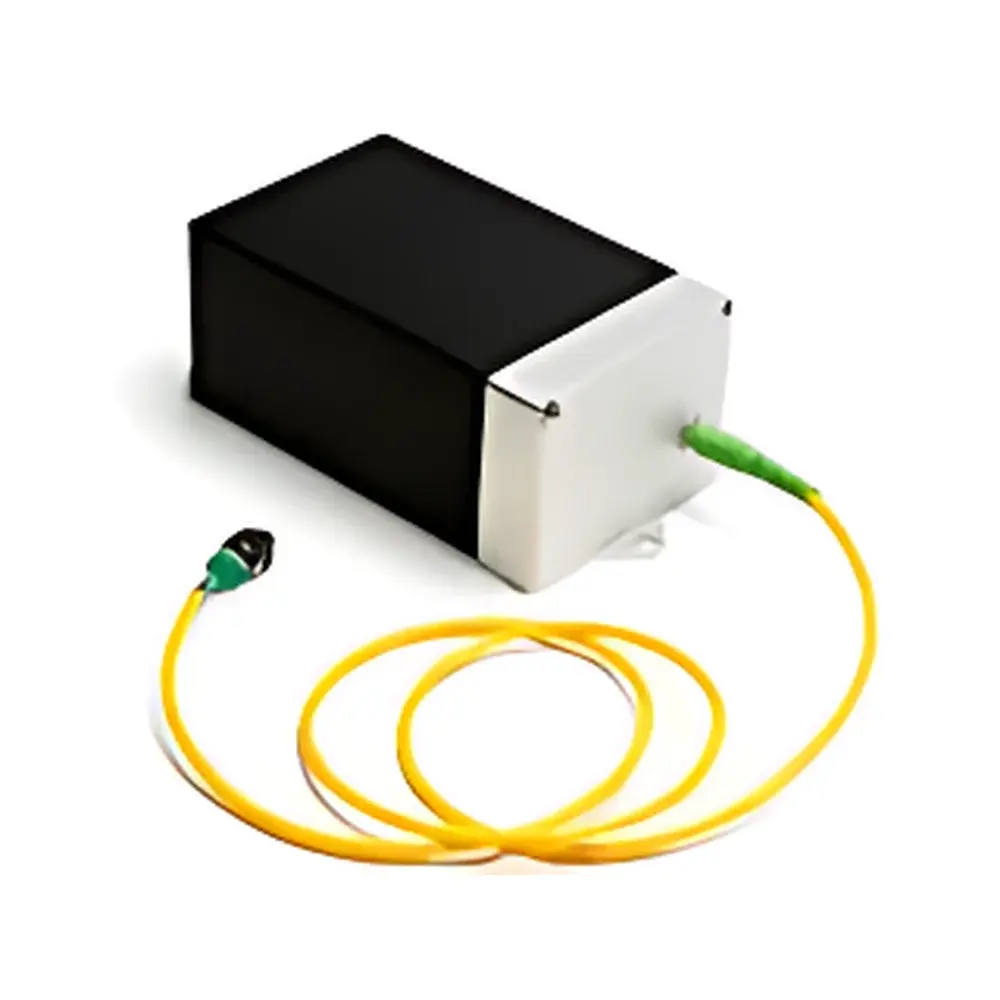
Cobolt Tailored Fiber-Coupled Laser Systems
| Brand | Cobolt |
|---|---|
| Origin | Sweden |
| Model | Cobolt |
| Wavelength Options | 473 nm, 491 nm, 515 nm, 532 nm, 561 nm, 594 nm |
| Max Output Power (Fiber-Coupled) | 35–150 mW |
| Fiber Type | 1 m Single-Mode or Polarization-Maintaining Fiber, 3 mm Jacket, NA < 0.12 |
| Polarization Extinction Ratio | > 100:1 |
| Output Connector | FC/APC (non-collimated, OEM-customizable) |
| Power Stability (8 h, ±3°C) | < 3% |
| Intensity Noise | Equivalent to Free-Space Version |
| Total System Power Consumption | < 35 W (typ. < 15 W) |
| Operating Temperature | 10–40 °C |
| Max Laser Head Baseplate Temp. | 50 °C |
| Laser Head Dimensions | 117 × 60 × 45 mm |
| Controller Dimensions | 192 × 72 × 28 mm |
| Communication Interface | RS-232 |
| Safety Compliance | CDRH-compliant (key-switch or auto-start variants) |
Overview
Cobolt Tailored Fiber-Coupled Laser Systems are engineered for high-reliability integration into OEM optical instrumentation platforms requiring stable, diffraction-limited beam delivery via single-mode or polarization-maintaining fiber. These lasers operate on solid-state DPSS (diode-pumped solid-state) or frequency-doubled semiconductor principles—depending on wavelength—and feature hermetically sealed, factory-aligned optical paths with permanently affixed fiber pigtails. Unlike modular free-space lasers, the fiber is fused directly into the laser housing and cannot be detached or realigned post-manufacture, ensuring long-term pointing stability, minimal mode hop risk, and immunity to mechanical drift under thermal cycling or vibration. Designed explicitly for embedded applications—including flow cytometry, confocal microscopy, Raman spectroscopy, and industrial metrology—the system delivers TEM00 output with low spatial noise and high polarization fidelity, making it suitable for interferometric and polarization-sensitive measurement architectures.
Key Features
- Fully integrated fiber-coupled architecture with factory-optimized coupling efficiency and alignment retention over lifetime
- Multiple visible-wavelength options (473–594 nm) covering key spectral bands for fluorescence excitation and atomic transitions
- Polarization-maintaining (PM) fiber option with extinction ratio >100:1, enabling stable input for waveplates, modulators, and nonlinear crystals
- Compact dual-module design: thermally isolated laser head (117 × 60 × 45 mm) and low-profile controller (192 × 72 × 28 mm) for space-constrained enclosures
- RS-232 digital interface supporting remote power control, status monitoring, and error logging—compatible with LabVIEW, Python, and PLC-based automation frameworks
- CDRH-compliant safety architecture with configurable operation modes: key-switch enabled (wavel-04-03-pwr-300) or auto-start (wavel-04-03-pwr-400) for seamless integration into automated workflows
- Thermal management optimized for continuous-wave operation within ambient ranges of 10–40 °C; baseplate temperature limited to ≤50 °C under full load
Sample Compatibility & Compliance
The Cobolt fiber-coupled laser series supports integration with standard optical components including acousto-optic modulators (AOMs), electro-optic modulators (EOMs), fiber Bragg gratings (FBGs), and photonic integrated circuits (PICs). Its FC/APC non-collimated output is compatible with industry-standard SMF-28, PM1550, or custom-index fibers. All units comply with IEC 60825-1:2014 (Laser Product Safety) and FDA 21 CFR Part 1040.10/1040.11 (U.S. CDRH requirements). The controller firmware implements basic audit trail functionality for GLP/GMP-aligned environments, with timestamped operational logs accessible via RS-232. While not inherently 21 CFR Part 11 compliant, the system supports external validation protocols through deterministic command-response behavior and repeatable power ramping profiles.
Software & Data Management
No proprietary GUI is bundled; operation relies on ASCII-based RS-232 command sets documented in the Cobolt OEM Integration Manual (v3.2+). Commands include POWER ON/OFF, SET POWER [mW], QUERY TEMP, and STATUS. Real-time power feedback is available via analog monitor output (0–5 V = 0–100% setpoint). Third-party drivers exist for MATLAB, Python (pySerial), and National Instruments DAQ systems. Data logging requires external acquisition—no onboard memory or USB interface is provided. For traceable calibration, users may perform periodic verification using NIST-traceable photodiode power meters (e.g., Thorlabs S120VC) referenced to ISO/IEC 17025-accredited labs.
Applications
- OEM integration into clinical analyzers requiring multi-wavelength excitation (e.g., hematology counters, microplate readers)
- Stabilized pump sources for fiber amplifiers and supercontinuum generation in broadband OCT systems
- Reference sources in metrology-grade interferometers where polarization purity and amplitude stability are critical
- Seed lasers for ultrafast amplifier systems requiring low-noise CW injection
- Embedded illumination in portable Raman spectrometers targeting pharmaceutical raw material ID (per USP & EP monographs)
- Atomic physics setups involving laser cooling of alkali vapors (e.g., Rb D2 line at 780 nm is not offered; however, 532 nm and 561 nm serve as repump or trapping candidates in hybrid configurations)
FAQ
Is the fiber length customizable beyond 1 meter?
Yes—standard configurations ship with 1 m fiber, but lengths from 0.5 m to 5 m are available upon request. Longer fibers require recalibration of output power due to attenuation and may affect polarization extinction ratio depending on bend radius and jacket type.
Can I replace the FC/APC connector with an FC/PC or SMA variant?
Connector type is fully customizable for OEM orders. FC/PC, SMA-905, and angled or non-angled variants are supported; lead time increases by 2–3 weeks for non-standard termination.
Does the system support analog modulation?
No analog modulation input is provided. Modulation must be implemented externally using AOMs or EOMs driven by TTL or analog voltage signals synchronized with the laser’s enable line.
What is the typical warm-up time to achieve specified power stability?
Full thermal equilibrium is reached within 30 minutes after cold start. Power stability specification (<3% over 8 hours) assumes ambient temperature variation ≤±3°C and uninterrupted operation.
Are these lasers compliant with RoHS and REACH directives?
Yes—all Cobolt laser modules manufactured after January 2021 meet EU RoHS Directive 2011/65/EU and REACH Regulation (EC) No. 1907/2006, including SVHC screening reports available upon request.





