
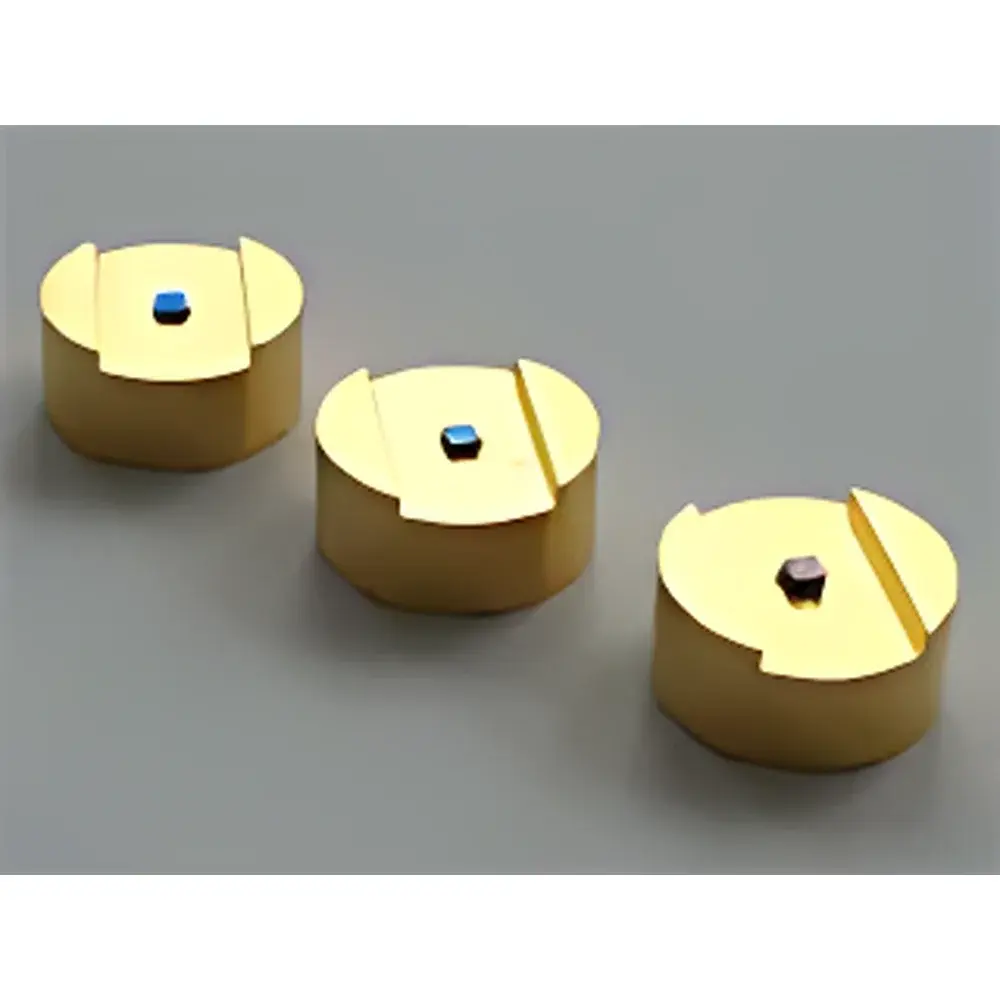
BATOP MC-1064 Series Monolithic Saturable Absorber Mirror (SAM) for Passively Q-Switched Microchip Lasers
| Brand | BATOP |
|---|---|
| Origin | Germany |
| Product Type | Monolithic Saturable Absorber Mirror |
| Substrate | High-Reflectivity Distributed Bragg Reflector (DBR) |
| Active Layer | Nd:YVO₄ bonded to mirror substrate |
| Pump Wavelength | 808 nm |
| Lasing Wavelength | 1064 nm |
| Pulse Duration Options | ~90 ps or ~150 ps |
| Pulse Energy | 4 nJ (90 ps) / 10 nJ (150 ps) |
| Repetition Rate Range | 100 kHz – 3 MHz |
| Operating Temperature | 20–25 °C (stabilized) |
| Damage Threshold | >500 MW/cm² (for 1064 nm, 100 ps pulses) |
Overview
The BATOP MC-1064 Series Monolithic Saturable Absorber Mirror (SAM) is a compact, integrated optoelectronic component engineered for passive Q-switching in diode-pumped solid-state microchip lasers. Unlike discrete saturable absorbers requiring external alignment, this device integrates a high-reflectivity distributed Bragg reflector (DBR) mirror with a directly bonded Nd:YVO₄ crystal layer—forming a monolithic cavity end mirror that simultaneously provides high small-signal reflectivity (>99.9% at 1064 nm) and controllable nonlinear absorption. Its operation relies on ground-state bleaching of the Nd³⁺ ions under 808 nm optical pumping, enabling self-starting, stable passive Q-switching without active electronics or RF drivers. Designed for integration into sub-cm-length laser cavities, the MC-1064 SAM supports robust, alignment-insensitive generation of nanosecond-to-picosecond pulses—making it a critical enabler for miniaturized, field-deployable pulsed laser sources in industrial and scientific applications.
Key Features
- Monolithic architecture: DBR mirror + epitaxially bonded Nd:YVO₄ layer eliminates air gaps and interfacial losses, ensuring high optical damage threshold and long-term stability
- Two standardized pulse duration variants: MC-1064-90ps (≈90 ps FWHM, 4 nJ pulse energy) and MC-1064-150ps (≈150 ps FWHM, 10 nJ pulse energy)
- Wide repetition rate tunability: 100 kHz to 3 MHz via pump power adjustment—enabling flexible trade-offs between average power, pulse energy, and thermal load
- Optimized for 808 nm diode pumping: High absorption cross-section at pump wavelength ensures efficient inversion and low lasing threshold
- Hermetically sealed, uncooled operation: No active temperature stabilization required within standard lab environments (20–25 °C ambient)
- Surface-normal incidence design: Simplifies integration into linear or folded microchip cavities with minimal beam walk-off
Sample Compatibility & Compliance
The MC-1064 SAM is compatible with standard 1064 nm microchip laser platforms using Nd:YVO₄ or Nd:YAG gain media. Its spectral response aligns with ISO 11146-compliant beam characterization workflows and supports traceable calibration against NIST-traceable photodiodes and autocorrelators. The device meets RoHS Directive 2011/65/EU for hazardous substance restrictions and conforms to IEC 60825-1:2014 safety requirements for Class 4 laser components. While not certified to FDA 21 CFR Part 11, its deterministic optical behavior and reproducible Q-switching performance support GLP-compliant documentation protocols when deployed in regulated R&D environments (e.g., metrology labs, aerospace LIDAR development).
Software & Data Management
As a passive optical component, the MC-1064 SAM does not incorporate embedded firmware or digital interfaces. However, its performance parameters—including pulse duration, energy, and repetition rate—are fully characterizable using industry-standard instrumentation: optical spectrum analyzers (OSA), fast photodiodes with GHz bandwidth, and intensity autocorrelators (e.g., FR-103XL). Experimental data acquired during laser qualification can be logged and archived using MATLAB, LabVIEW, or Python-based acquisition frameworks compliant with IEEE 1588 Precision Time Protocol (PTP) for time-stamped pulse train analysis. Integration with commercial laser control software (e.g., Thorlabs Kinesis, Newport Motion Control Suite) enables synchronized pump current ramping and real-time repetition rate mapping.
Applications
- Laser micromachining: Precision ablation of metals, ceramics, and polymers with minimal heat-affected zones due to picosecond-scale pulse widths
- Time-of-flight LIDAR: High peak power and stable pulse-to-pulse timing enable sub-millimeter ranging resolution in autonomous vehicle and topographic mapping systems
- Frequency conversion seeding: As a reliable 1064 nm source for intracavity SHG (532 nm), THG (355 nm), or OPO pumping in compact nonlinear optical systems
- Optical time-domain reflectometry (OTDR): Short pulses improve spatial resolution in fiber fault localization and distributed sensing
- Fundamental ultrafast optics research: Investigation of carrier dynamics, saturable absorption kinetics, and cavity-dumping phenomena in monolithic resonators
FAQ
What pump power range is recommended for stable Q-switching with the MC-1064 SAM?
Typical thresholds range from 150–300 mW (free-space coupled) depending on cavity geometry and output coupler transmission; maximum recommended pump power is 1.2 W to avoid thermal lensing-induced mode instability.
Can the MC-1064 SAM be used with Nd:YAG instead of Nd:YVO₄ gain media?
Yes—though Nd:YVO₄ offers higher absorption at 808 nm and broader emission bandwidth, the SAM’s 1064 nm reflectivity and saturation fluence are compatible with Nd:YAG-based microchip designs.
Is custom coating available for alternate wavelengths (e.g., 946 nm or 1342 nm)?
BATOP offers tailored DBR designs upon request; lead time and minimum order quantities apply for non-standard wavelength configurations.
How is pulse duration measured and verified for these devices?
Pulse width is characterized using second-harmonic generation (SHG) autocorrelation with <10 fs resolution; all specifications are validated per ISO 13697:2021 for ultrashort pulse measurement uncertainty.
Does the SAM require anti-reflection coating on the incident side?
No—the front surface is AR-coated at both 808 nm (pump) and 1064 nm (laser) by default; custom AR options are available for oblique-incidence configurations.






