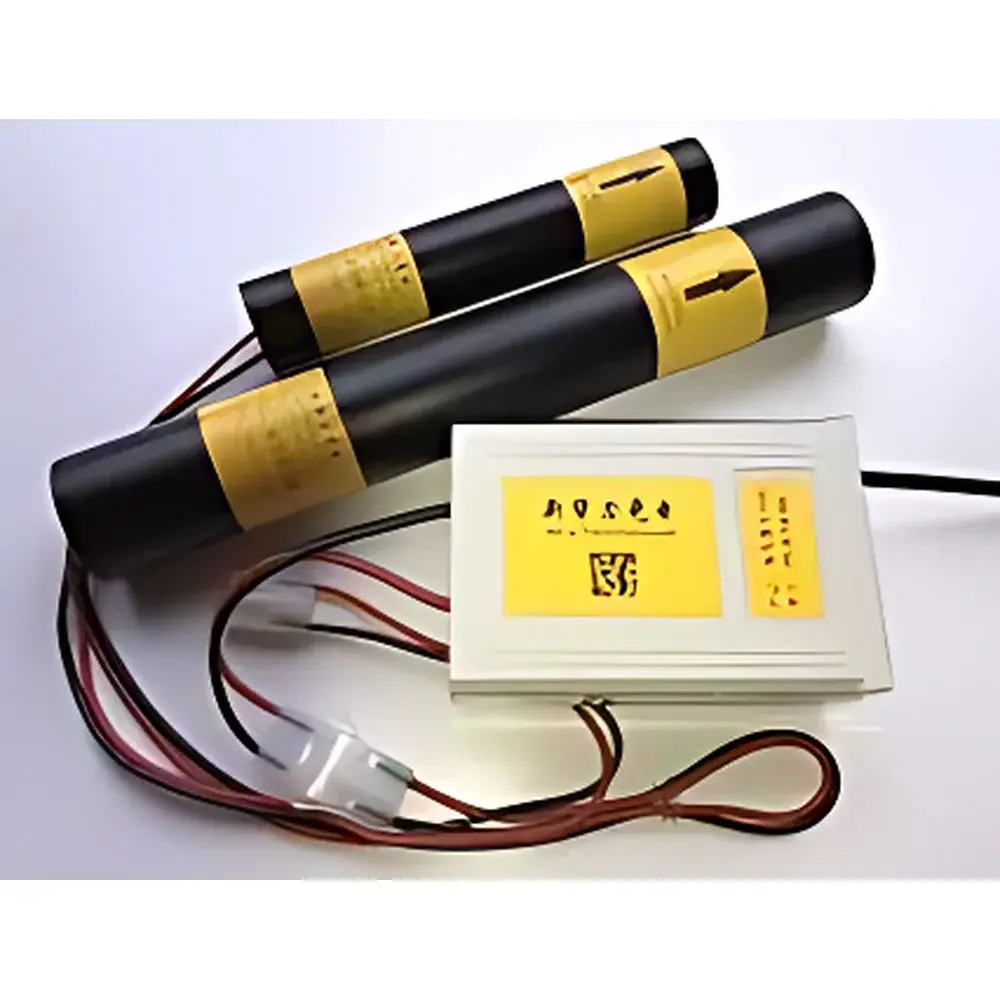
NewOpto NO-633-3-P Helium-Neon Laser System
| Brand | NewOpto |
|---|---|
| Origin | Zhejiang, China |
| Type | Gas Laser Source |
| Wavelength | 633 nm |
| Output Power | 3.0 mW |
| Polarization | Linear (POL) |
| Beam Mode | TEM₀₀ |
| Operating Voltage | 230 V AC |
| Cooling | Air-Cooled |
| Lifetime | ≥20,000 hours |
| Warm-up Time | <15 min |
| Beam Diameter | ~0.65 mm |
| Divergence | <1.5 mrad |
| Stability (Power) | ±1% over 8 hrs |
| Frequency Stability (for stabilized variants) | <±1 MHz |
| Compliance | CE, RoHS |
| Mounting | Standard Ø25.4 mm kinematic base compatible |
Overview
The NewOpto NO-633-3-P is a continuous-wave (CW), air-cooled helium-neon (HeNe) laser system engineered for high spectral purity, long-term amplitude stability, and diffraction-limited beam quality at the fundamental wavelength of 632.8 nm (commonly referenced as 633 nm). As a classic gas discharge laser, it operates on the 3s²→2p⁴ transition in neon atoms, optically pumped by electron collision excitation within a sealed plasma tube filled with a precise He:Ne gas mixture (typically 10:1). Its output exhibits intrinsic narrow linewidth (<1.5 GHz), low relative intensity noise (RIN < −90 dB/Hz), and excellent spatial coherence—making it a primary reference source in metrology, interferometry, and calibration-critical optical instrumentation. Unlike diode lasers, the HeNe platform delivers inherently stable polarization and minimal mode-hopping behavior, eliminating the need for external polarization control or active frequency stabilization in many precision applications.
Key Features
- TEM₀₀ Gaussian beam profile with M² < 1.1, enabling efficient coupling into single-mode fibers and high-resolution optical systems
- Linearly polarized output (POL) with extinction ratio >500:1, directly usable in ellipsometry, polarimetry, and stress-birefringence analysis
- Hermetically sealed, all-metal-ceramic plasma tube with proprietary cathode design ensuring >20,000 hours operational lifetime and resistance to thermal drift
- Integrated high-voltage DC power supply with soft-start circuitry and current regulation to suppress arc initiation transients
- Passive thermal management via finned aluminum housing; no forced-air cooling or water circulation required
- Compliant with IEC 60825-1:2014 Class 3R laser safety requirements; includes aperture shutter and key-controlled enable interface
Sample Compatibility & Compliance
The NO-633-3-P is designed for integration into OEM instruments and laboratory-grade analytical platforms requiring traceable, stable visible-light sources. It is routinely deployed in ISO/IEC 17025-accredited calibration labs for wavelength verification against NIST-traceable standards (e.g., in laser wavelength meters per ASTM E2750). The device meets CE marking requirements under the EU Electromagnetic Compatibility Directive 2014/30/EU and RoHS 2011/65/EU. Its mechanical interface conforms to standard Ø25.4 mm lens tube mounting protocols (e.g., Thorlabs SM1, Newport 8-32 threaded flanges), facilitating drop-in replacement in existing interferometer, spectrometer, and particle sizing systems. For regulated environments—including pharmaceutical QC labs operating under FDA 21 CFR Part 11—the laser’s deterministic startup behavior and absence of firmware-based control logic simplify validation documentation.
Software & Data Management
As a hardware-level light source, the NO-633-3-P operates independently of software control; however, its stability characteristics support seamless integration into automated data acquisition workflows. When used with compliant instrumentation (e.g., Michelson interferometers, FTIR spectrometers, or dynamic light scattering systems), the laser’s inherent power and frequency consistency reduce the need for real-time feedback correction, thereby improving measurement reproducibility across multi-hour acquisition sequences. For users requiring monitoring, optional analog monitor photodiode outputs (0–5 V proportional to output power) are available upon request. All units ship with factory calibration certificates documenting initial power, polarization orientation, beam pointing stability (<5 µrad/hour), and warm-up transient response—records suitable for GLP/GMP audit trails.
Applications
- Interferometric Metrology: Primary wavelength reference in heterodyne and homodyne interferometers for sub-nanometer displacement measurement (e.g., semiconductor wafer stage positioning, gravitational wave detector alignment)
- Spectroscopic Calibration: Wavelength anchor in Raman spectrometers (PerkinElmer, Bruker, Thermo Fisher), FTIR systems, and tunable laser characterization setups
- Particle Sizing & Scattering: Illumination source in laser diffraction particle analyzers (ISO 13320) and dynamic light scattering (DLS) instruments where coherence length (>20 cm) and low speckle contrast are critical
- Biophotonics Instrumentation: Excitation source in confocal microscopes, flow cytometers, and DNA sequencing platforms requiring stable 633 nm illumination with minimal phototoxicity
- Polarization-Sensitive Measurements: Core component in ellipsometers, Mueller matrix polarimeters, and photoelastic stress analysis systems due to its well-defined linear polarization axis
FAQ
What is the typical coherence length of the NO-633-3-P?
Coherence length is approximately 20–25 cm, derived from its natural linewidth of ~1.5 GHz and consistent with standard unstabilized HeNe lasers.
Is this laser suitable for use in vacuum environments?
No—the unit is not vacuum-rated; the external power supply and housing are designed for ambient atmospheric operation only.
Can the polarization axis be rotated mechanically?
Yes, the output beam features a fixed linear polarization orientation relative to the housing; rotation is achievable via external half-wave plates mounted on kinematic mounts.
Does the laser include beam expansion or collimation optics?
No—output is delivered as a raw Gaussian beam (Ø ≈ 0.65 mm, divergence <1.5 mrad); collimation or expansion must be implemented externally using standard achromatic doublets or beam expanders.
What is the recommended warm-up period before achieving full spectral stability?
Full thermal equilibrium and power stabilization are achieved within 12–15 minutes after power-on, as verified by internal temperature sensors and output monitoring.