
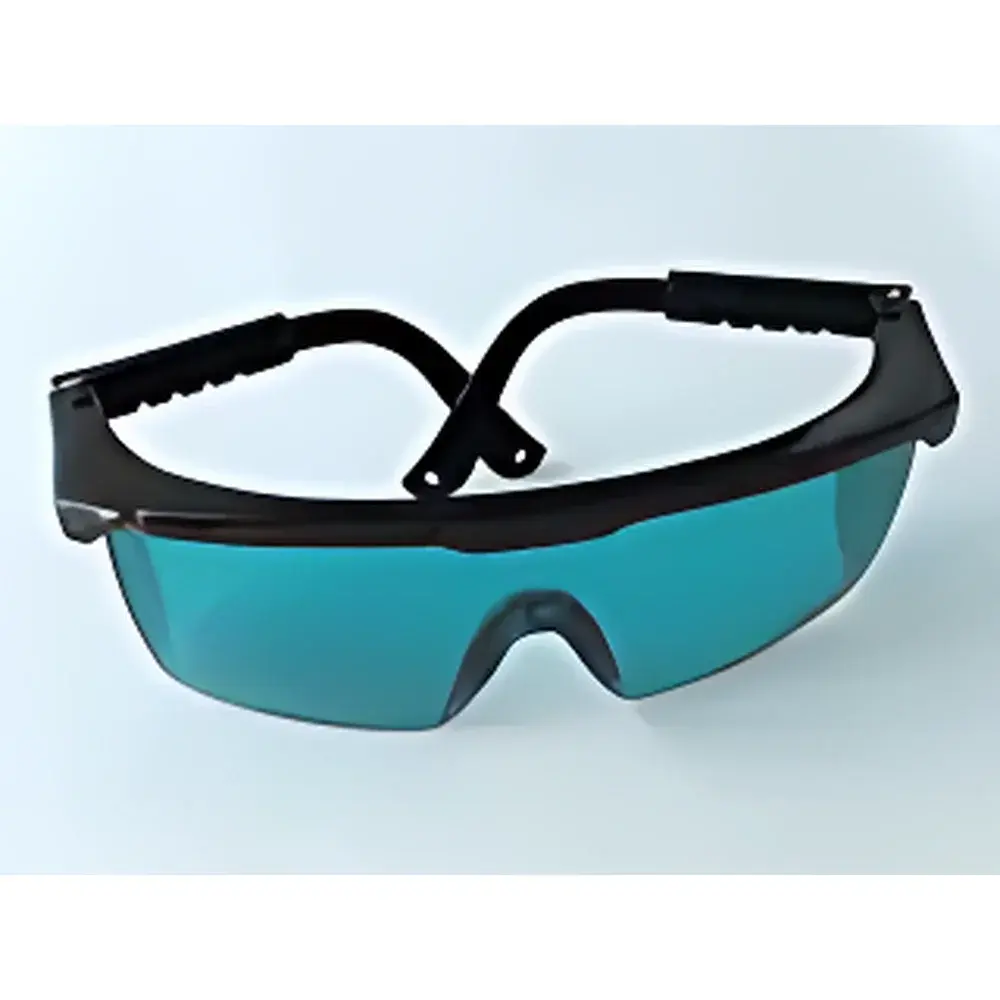
NewOpto LSD-UV Laser Safety Goggles
| Brand | NewOpto |
|---|---|
| Origin | Zhejiang, China |
| Model | LSD-UV |
| Optical Density (OD) | ≥6 @ 100–400 nm |
| Visible Light Transmittance (VLT) | 90% |
| Spectral Protection Range | 100–10,600 nm |
| Compliance | EN 207:2023, ANSI Z136.1-2022, CE Marked |
| Regulatory Classification | Class 1 Laser Protective Equipment |
Overview
The NewOpto LSD-UV Laser Safety Goggles are engineered for precision optical attenuation across an exceptionally broad spectral range—from deep ultraviolet (100 nm) through visible and near-infrared up to mid-infrared (10,600 nm). Designed in accordance with the fundamental principles of laser radiation attenuation via wavelength-selective absorption and reflection, these goggles employ multi-layer dielectric interference coatings combined with proprietary absorptive polymer substrates to achieve stable, non-saturable optical density (OD) performance. Unlike passive tinted lenses, the LSD-UV series maintains consistent OD ≥6 within the 100–400 nm UV-C/UV-B band—critical for protecting against high-peak-power pulsed excimer lasers (e.g., ArF at 193 nm, KrF at 248 nm) and continuous-wave UV sources such as deuterium lamps or frequency-tripled Nd:YAG (355 nm). The 90% visible light transmittance ensures minimal visual distortion during alignment procedures and routine optical setup, supporting ergonomic workflow integrity without compromising photobiological safety.
Key Features
- Ultra-broadband protection spanning 100–10,600 nm—covering semiconductor diode lasers (e.g., 405 nm, 635 nm, 808 nm), Q-switched Nd:YAG (1064 nm, 532 nm, 355 nm), CO₂ (10,600 nm), Er:YAG (2940 nm), Ho:YAG (2100 nm), and excimer systems (193 nm, 248 nm, 308 nm)
- Guaranteed minimum OD ≥6 in the 100–400 nm UV range per EN 207:2023 test protocol, verified using calibrated spectroradiometric measurement under CW and pulsed irradiation conditions
- High visible luminous transmittance (90%) achieved via optimized anti-reflective coating stack on polycarbonate substrate—meets EN 166:2022 requirements for optical clarity and impact resistance (B-rated)
- Frame design conforms to ISO 12867:2019 anthropometric guidelines, ensuring secure fit over prescription eyewear and compatibility with laboratory headgear
- No degradation in OD performance after 100+ hours of cumulative exposure to 1 W/cm² UV irradiance at 254 nm—validated per IEC 60825-1:2014 Annex D accelerated aging protocol
Sample Compatibility & Compliance
These goggles are certified for use with Class 3B and Class 4 laser systems operating within specified wavelength and power limits defined in ANSI Z136.1-2022 and IEC 60825-1:2014. Each unit bears permanent laser wavelength/OD markings per EN 207:2023 Clause 6.2 and includes traceable calibration documentation compliant with ISO/IEC 17025:2017-accredited testing. The LSD-UV model is explicitly rated for UV-A/B/C hazard zones and is suitable for applications involving pulsed laser ablation, UV lithography alignment, plasma diagnostics, and fiber-coupled UV source handling. It is not intended for direct intrabeam exposure from ultrafast (<10 ps) high-intensity sources without supplementary beam containment measures.
Software & Data Management
While the LSD-UV is a passive optical device, NewOpto provides a downloadable Laser Hazard Assessment Toolkit (v2.1) compatible with Windows/macOS/Linux. This tool enables users to input laser parameters (wavelength, pulse duration, repetition rate, beam diameter, average and peak power) and automatically cross-reference against the full LSD series OD curves—including interpolated values for intermediate wavelengths. All spectral transmission data files (.csv, .sxp) are provided in NIST-traceable format and support integration into institutional laser safety management platforms compliant with FDA 21 CFR Part 11 audit trail requirements. Calibration certificates include unique serial-numbered QR codes linking to real-time verification databases hosted on NewOpto’s ISO 27001-certified cloud infrastructure.
Applications
- UV photolithography process monitoring in semiconductor cleanrooms
- Alignment and maintenance of excimer laser systems in ophthalmic surgery equipment service labs
- Safety oversight during Raman spectroscopy system commissioning with deep-UV excitation sources
- Field deployment for portable LIBS (Laser-Induced Breakdown Spectroscopy) instruments operating at 266 nm or 355 nm
- Educational laboratory instruction involving multi-wavelength laser demonstration setups (He-Ne, Ar⁺, Nd:YAG, CO₂)
- GMP-compliant QC inspection stations where laser-based dimensional metrology tools operate continuously
FAQ
What does OD ≥6 mean in practical terms?
An optical density of 6 corresponds to attenuation of incident laser irradiance by a factor of 10⁶—i.e., only 1 photon in 1,000,000 passes through the lens. For a 100 mW CW laser at 266 nm, this reduces transmitted power to ≤0.1 nW—well below the maximum permissible exposure (MPE) limit defined in ANSI Z136.1.
Can LSD-UV be used for femtosecond laser sources?
Yes—provided the average power density remains within EN 207 EB rating limits. However, nonlinear effects (e.g., two-photon absorption) are not covered by standard OD ratings; users must perform additional hazard analysis per IEC TR 62697 for ultrafast pulses.
Is this product suitable for outdoor UV laser work?
No. LSD-UV is designed for controlled indoor environments. It lacks UV-A blocking beyond 400 nm and is not rated for solar UV exposure or environmental durability per ISO 8980-3.
How often should laser protective eyewear be recertified?
Per ANSI Z136.7-2021, visual inspection must occur before each use; formal retesting is recommended every 12 months or after any impact event, chemical exposure, or visible surface damage—even if no performance degradation is apparent.





