
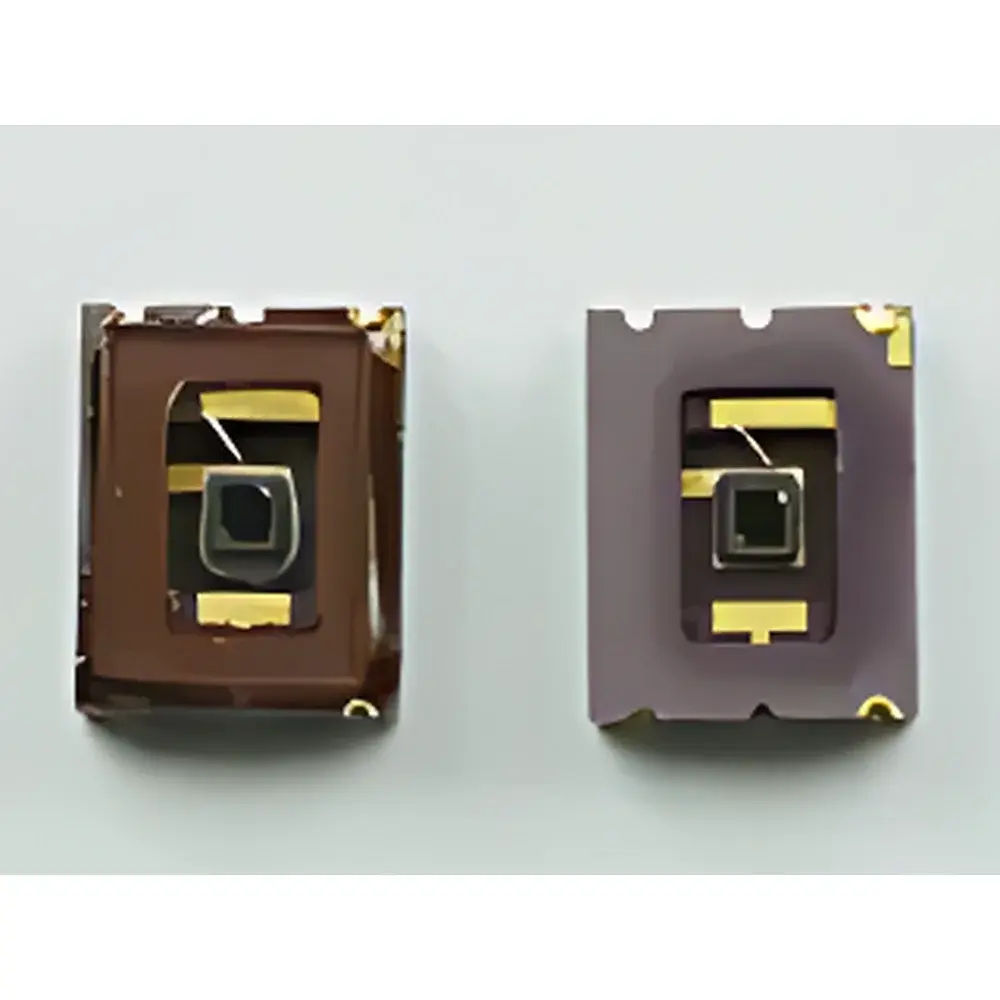
First Sensor NewOpto InGaAs Photodetector
| Brand | First Sensor |
|---|---|
| Origin | Germany |
| Model | NewOpto |
| Active Area | up to 7.1 mm² |
| Spectral Range | 600–1700 nm |
| Dark Current | as low as 2 nA (typ.) |
| Responsivity | up to 0.95 A/W @ 1550 nm |
| Package Options | TO-52, TO-5i, LCC6.1 (SMD) |
| Operating Voltage | 5 V (photovoltaic mode) |
Overview
The First Sensor NewOpto InGaAs photodetector is a high-performance near-infrared (NIR) and short-wave infrared (SWIR) detection solution engineered for precision optical measurement applications requiring reliable responsivity beyond the silicon cutoff. Based on lattice-matched indium gallium arsenide (In0.53Ga0.47As) epitaxial technology on InP substrates, these detectors operate in photovoltaic mode without bias, delivering low-noise performance with excellent linearity and thermal stability. Designed for integration into laser-based systems, spectroscopic analyzers, fiber-optic communication test benches, and industrial process monitoring platforms, the NewOpto series supports spectral response from 600 nm (with visible-enhanced variants) up to 1700 nm—covering critical bands including 850 nm VCSELs, 1064 nm Nd:YAG lasers, 1310/1550 nm telecom wavelengths, and SWIR molecular absorption features.
Key Features
- High quantum efficiency across 900–1700 nm; visible-enhanced versions extend responsivity down to 600 nm
- Low dark current: as low as 2 nA (typ.) at room temperature for 0.7 mm diameter devices, enabling high signal-to-noise ratio in low-light conditions
- Multiple active area options: 0.7 mm², 2.6 mm², and 7.1 mm² configurations to balance sensitivity, speed, and spatial resolution requirements
- Robust packaging variants: hermetically sealed TO-52 and TO-5i metal can packages for high-reliability OEM integration, plus LCC6.1 surface-mount ceramic packages compatible with automated PCB assembly
- No external bias required—operates in zero-bias photovoltaic mode, minimizing power supply complexity and eliminating shot noise associated with reverse bias
- Stable spectral responsivity with ±5% uniformity across wafer batches, traceable to NIST-calibrated reference detectors
Sample Compatibility & Compliance
The NewOpto InGaAs detectors are compatible with standard free-space optical alignment setups and fiber-pigtailed configurations (FC/PC or SMA connectors via optional coupling adapters). All devices comply with RoHS 2015/863/EU directives and meet JEDEC J-STD-020 moisture sensitivity level (MSL) 3 for SMD variants. While not certified for medical or aerospace use out-of-the-box, the underlying InGaAs die fabrication adheres to ISO 9001:2015-controlled cleanroom processes at First Sensor’s German manufacturing facility. For regulated environments—including pharmaceutical QC labs or GLP-compliant analytical workflows—the detectors may be incorporated into validated instrument subsystems meeting ASTM E275, ISO/IEC 17025, and FDA 21 CFR Part 11 data integrity requirements when paired with compliant signal conditioning electronics and software.
Software & Data Management
These detectors are analog output devices and do not include embedded firmware or digital interfaces. Integration requires external transimpedance amplification and analog-to-digital conversion. Reference design files—including schematic diagrams, layout guidelines for low-noise PCB routing, and SPICE models for common TO and LCC footprints—are available under NDA from First Sensor’s technical support portal. When integrated into OEM instruments, the detectors support full audit trail functionality when connected to host systems compliant with IEC 62304 (medical device software lifecycle) or IEEE 11073 (health informatics interoperability standards). Calibration certificates—including spectral responsivity curves and dark current vs. temperature plots—are provided per batch and archived for ≥10 years per ISO/IEC 17025 clause 7.8.3.
Applications
- Laser power and energy monitoring for industrial CO2, fiber, and diode lasers operating between 1064 nm and 1550 nm
- FTIR and dispersive spectrometers targeting hydrocarbon, water vapor, and polymer characterization in the 1100–1600 nm region
- Optical time-domain reflectometry (OTDR) receivers for telecom network fault localization
- Gas sensing platforms utilizing tunable diode laser absorption spectroscopy (TDLAS) at methane (1653 nm), CO (1567 nm), or ammonia (1512 nm) absorption lines
- SWIR imaging arrays for sorting, moisture analysis, and counterfeit detection in food, pharmaceutical, and recycling industries
- Research-grade photon correlation spectroscopy where low dark current enables sub-picoampere photocurrent resolution
FAQ
What is the maximum operating temperature for the TO-5i packaged PC7.1-i detector?
The absolute maximum case temperature is +85 °C; continuous operation above +60 °C requires derating of dark current specifications per datasheet Figure 4.
Can these detectors be used in photodiode array configurations?
Yes—LCC6.1 SMD variants support pick-and-place assembly and are commonly deployed in linear 8- to 32-element arrays for miniature spectrometers.
Is spectral calibration included with shipment?
Each production lot undergoes spectral responsivity verification at three wavelengths (650 nm, 1310 nm, 1550 nm); full spectral curve calibration is available as an optional add-on service.
Do you offer custom anti-reflection coatings?
Standard AR coating is optimized for 1000–1600 nm; custom broadband (600–1700 nm) or narrowband (±10 nm FWHM) coatings are available upon request with minimum order quantities.
Are these detectors suitable for pulsed laser detection with nanosecond rise times?
Rise time is primarily determined by junction capacitance and load resistance; typical values range from 1.2 ns (PC0.7-i, 50 Ω termination) to 8.5 ns (PC7.1-i, 50 Ω), as verified by time-resolved photocurrent measurements per IEC 61228 Annex B.




