
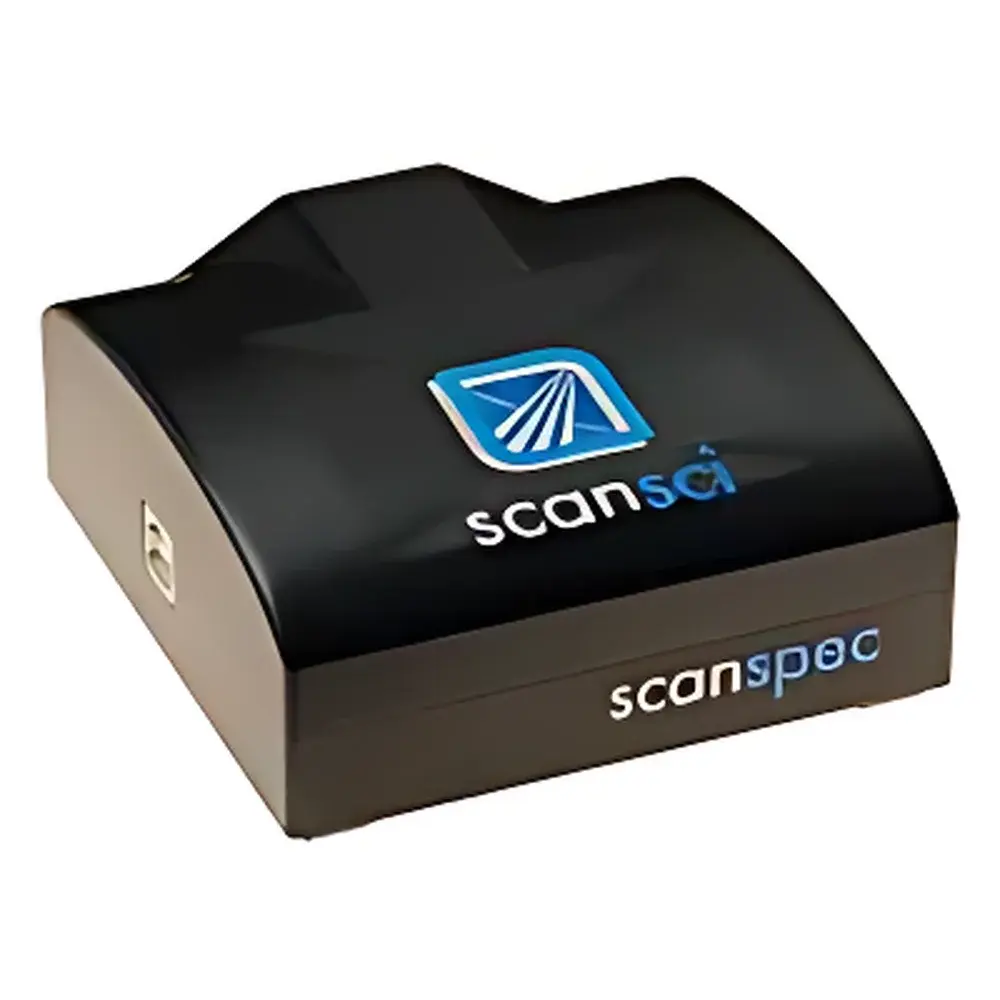
ScanSci ScanSpec Series Fiber Optic Spectrometer
| Brand | ScanSci |
|---|---|
| Wavelength Range | UV (200–600 nm), UV-VIS (250–800 nm), VIS (400–850 nm), VIS-NIR (500–1000 nm) |
| Grating Blaze Wavelength | 300 nm / 400 nm / 500 nm / 750 nm |
| Optical Resolution (FWHM) | <2.5 nm (with 50 µm slit) |
| Integration Time | 1 ms – 30 s |
| Detector Type | CCD |
| Warranty | 2 years (non-human-induced failure) |
Overview
The ScanSci ScanSpec Series Fiber Optic Spectrometer is a compact, high-stability benchtop-grade spectrometer engineered for precision spectral acquisition in research laboratories, industrial process monitoring, and OEM integration environments. Based on the Czerny-Turner optical architecture with fixed grating and optimized collimating/focusing optics, it delivers consistent wavelength calibration and radiometric stability across its four configurable spectral bands. Each variant employs a thermally stabilized CCD linear array detector with 2048 or 3648 active pixels (model-dependent), enabling high signal-to-noise ratio (SNR) measurements without active cooling—ideal for portable or embedded deployment. The spectrometer’s modular design supports direct coupling to SMA905-compatible optical fibers (core diameters from 50 µm to 600 µm), allowing seamless integration into custom optical paths for absorption, reflectance, transmission, fluorescence, chemiluminescence, photoluminescence, and irradiance measurement configurations.
Key Features
- Four standardized spectral configurations: ScanSpec UV (200–600 nm), UV-VIS (250–800 nm), VIS (400–850 nm), and VIS-NIR (500–1000 nm), each optimized with a dedicated blazed grating for maximum diffraction efficiency at its specified blaze wavelength.
- Optical resolution ≤2.5 nm FWHM (measured with 50 µm input slit and standard 10 µm pixel pitch CCD), ensuring reliable peak separation for multi-component spectral analysis.
- Programmable integration time ranging from 1 millisecond to 30 seconds, supporting both transient event capture and low-light signal averaging.
- USB 2.0 interface with vendor-provided SDK (C/C++, Python, LabVIEW, MATLAB) for deterministic trigger synchronization, hardware-level exposure control, and real-time data streaming up to 100 spectra/s (depending on resolution mode and host system).
- Rugged aluminum alloy housing with internal thermal mass design minimizes wavelength drift (<0.05 nm/°C typical), maintaining calibration integrity during extended operation without active temperature stabilization.
- Compliant with RoHS and CE directives; designed for long-term reliability under continuous duty cycles in controlled laboratory and light-industrial settings.
Sample Compatibility & Compliance
The ScanSpec series interfaces with a broad range of sample presentation formats—including cuvette holders, integrating spheres, fiber-coupled reflection probes, collimated beam setups, and free-space optical benches—enabling adaptability across solid, liquid, and gas-phase measurements. Its spectral response is traceable to NIST-calibrated tungsten-halogen and deuterium lamp standards, supporting routine instrument validation per ISO/IEC 17025 requirements. When used with optional calibrated light sources and reference standards, the system meets ASTM E308 (colorimetry), ASTM E1331 (reflectance), and ISO 13406-2 (radiance uniformity) test protocols. Data acquisition workflows can be configured to satisfy GLP/GMP documentation needs via timestamped metadata logging and user-defined audit trails.
Software & Data Management
The ScanSpec platform ships with ScanSpectra Control Suite—a cross-platform application offering real-time spectrum visualization, dark/baseline correction, peak identification, spectral math (e.g., absorbance = log10(I0/I)), and export to CSV, TXT, or HDF5 formats. For regulated environments, optional FDA 21 CFR Part 11-compliant software modules provide electronic signature support, role-based access control, and immutable audit logs for all calibration updates, measurement sessions, and file exports. All raw spectral data retain native pixel-wavelength mapping and detector gain/offset metadata, ensuring full traceability during post-processing or third-party analysis.
Applications
- UV-Vis quantitative analysis of aqueous and organic solutions (e.g., protein concentration via Bradford assay, nitrate detection in environmental water)
- In-line monitoring of LED phosphor emission profiles and OLED electroluminescence spectra
- Color measurement and spectral power distribution (SPD) characterization of lighting systems
- Fluorescence lifetime pre-screening via steady-state excitation-emission matrix (EEM) mapping
- Chemical reaction kinetics tracking using time-resolved absorbance changes at selected wavelengths
- Thin-film thickness estimation via interference fringe analysis in reflectance mode
- OEM integration into handheld analyzers, agricultural sensors, and educational lab kits
FAQ
What spectral calibration options are available?
Factory calibration uses NIST-traceable continuum and line sources; users may perform wavelength and intensity recalibration using optional calibration kits (deuterium/tungsten-halogen lamps, mercury-argon pen-ray source).
Is the spectrometer compatible with third-party fiber probes?
Yes—all models accept standard SMA905-terminated fibers; probe NA, core diameter, and jacket type must match optical throughput specifications to avoid vignetting or saturation.
Can integration time be triggered externally?
Yes—TTL-compatible external trigger input supports synchronized acquisition with pulsed lasers, motorized stages, or process control signals.
Does the system support radiometric calibration?
Radiometric sensitivity (µW/nm per digital count) can be applied via user-loaded calibration files; absolute irradiance accuracy depends on traceable source characterization and optical path consistency.
What is the typical wavelength repeatability over 24 hours?
Under stable ambient conditions (±1°C), peak centroid deviation remains within ±0.1 nm for repeated measurements of mercury emission lines.




