
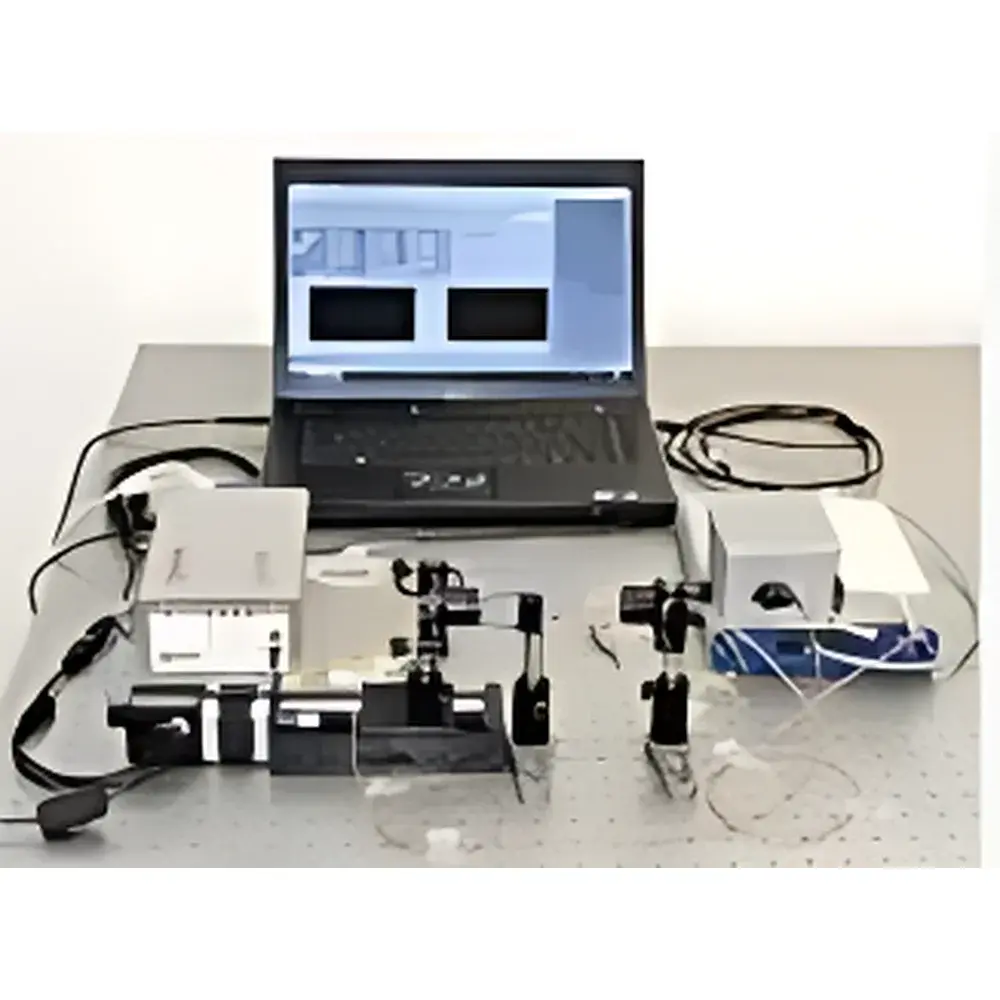
Batop newopto Fiber-Coupled THz Time-Domain Spectrometer
| Brand | Batop |
|---|---|
| Origin | Germany |
| Model | newopto |
| Spectral Range | 0.1–2.5 THz |
| Spectral Resolution | 2 GHz |
| Signal-to-Noise Ratio (at 0.4 THz) | 1000 |
| Minimum Scan Time | 0.5 s |
| THz Beam Diameter | 12 mm |
| Laser Source | Fiber-Coupled Femtosecond Laser (1060 nm) |
| THz Emitter | PCA-40-05-10-1060-c-f (fiber-coupled photoconductive antenna with THz lens) |
| THz Detector | PCA-44-06-10-1060-c-f (fiber-coupled photoconductive antenna with THz lens) |
| Delay Line | Mechanical stage with 1 ns time delay range |
| Electronics | Pulse generator + lock-in amplifier |
| Software | T3DS spectrometer control and analysis suite (pre-installed on dedicated laptop) |
| Optional Accessories | Manual XY substrate holder (50 mm travel), PTFE-based aspheric THz lenses, silicon substrate lenses |
Overview
The Batop newopto Fiber-Coupled THz Time-Domain Spectrometer is a turnkey, laboratory-grade system engineered for high-fidelity terahertz spectroscopy in both transmission and reflection geometries. Based on the principle of optical rectification and electro-optic sampling—or, in this configuration, photoconductive generation and detection—the instrument leverages ultrafast fiber-integrated femtosecond laser pulses at 1060 nm to produce and coherently detect broadband THz radiation. The time-domain architecture enables direct measurement of the electric field waveform of THz pulses, allowing simultaneous extraction of amplitude and phase information without Kramers–Kronig transformation. With a spectral coverage spanning 0.1 to 2.5 THz and a resolution of 2 GHz (determined by the maximum optical delay path length), the system supports quantitative dielectric characterization—including complex refractive index (n, κ), absorption coefficient, and conductivity—of non-conducting and semiconducting materials under ambient or controlled environments.
Key Features
- Fully integrated fiber-coupled architecture minimizes alignment sensitivity and enhances long-term operational stability.
- Pre-aligned photoconductive antenna (PCA) modules—emitter (PCA-40-05-10-1060-c-f) and detector (PCA-44-06-10-1060-c-f)—mounted with optimized THz focusing optics, delivering a collimated 12 mm beam diameter at the sample plane.
- High-dynamic-range lock-in detection synchronized to the laser repetition rate, achieving a signal-to-noise ratio of ≥1000 at 0.4 THz after 0.5 s averaging per scan.
- Mechanical delay line with 1 ns full-scale temporal scanning range, enabling sub-picosecond time-resolution and precise control over THz pulse sampling window.
- Dedicated control electronics including pulse generator, low-noise signal amplifier, and high-speed DAQ board for real-time waveform acquisition and averaging.
- T3DS software suite pre-installed on an industrial-grade laptop, supporting automated calibration, spectral deconvolution, material parameter fitting (e.g., Drude–Lorentz models), and batch processing compliant with GLP documentation requirements.
Sample Compatibility & Compliance
The system accommodates solid, thin-film, and powdered samples up to 50 × 50 mm via the optional manual XY substrate holder (50 mm travel range). Transmission measurements are optimized for low-absorbing dielectrics (e.g., polymers, pharmaceutical tablets, ceramics, semiconductor wafers), while reflection mode enables non-contact characterization of coated substrates and layered structures. All optical and electronic subsystems conform to IEC 61000-6-3 (EMC emission) and IEC 61000-6-2 (immunity) standards. The T3DS software supports audit-trail logging and user-access controls aligned with FDA 21 CFR Part 11 requirements for regulated laboratories conducting QC/QA in pharmaceutical or materials R&D contexts.
Software & Data Management
T3DS provides a modular, scriptable interface for instrument control, data acquisition, and post-processing. Core functionalities include time-domain gating, Fourier transformation with apodization, baseline correction, and multi-layer optical modeling using transfer-matrix formalism. Raw .tdm files store full time-domain waveforms with metadata (laser power, delay step, ambient temperature/humidity if external sensors are connected). Export formats include ASCII, HDF5, and MATLAB-compatible .mat—ensuring interoperability with third-party analysis platforms such as Python (SciPy, NumPy), OriginLab, or COMSOL Multiphysics. Version-controlled software updates are distributed via secure HTTPS portal; all releases undergo internal validation against ASTM E2974-22 (Standard Guide for Terahertz Spectroscopy) benchmarks.
Applications
- Pharmaceutical solid-state analysis: polymorph identification, hydration state mapping, and tablet coating thickness quantification.
- Security and defense: non-invasive detection of concealed explosives, narcotics, and illicit substances through spectral fingerprinting.
- Advanced materials science: carrier dynamics in 2D materials (graphene, TMDCs), phonon resonances in perovskites, and interfacial charge transfer in organic photovoltaics.
- Quality assurance of composite laminates and polymer films: delamination detection, filler dispersion homogeneity, and moisture ingress monitoring.
- Academic research in ultrafast physics: coherent control of THz-driven spin precession, light-induced superconductivity, and nonlinear THz spectroscopy.
FAQ
What laser wavelength does the system use, and why is 1060 nm advantageous?
The integrated fiber laser operates at 1060 nm, offering superior thermal management, reduced water absorption in air compared to 800 nm systems, and compatibility with low-dark-current InGaAs-based PCAs—enabling higher dynamic range and improved signal stability over extended acquisition periods.
Can the system perform reflection-mode measurements without hardware modification?
Yes. The standard optical layout includes interchangeable mirror mounts and adjustable THz parabolic optics, permitting rapid reconfiguration between transmission and reflection geometries without recalibration or realignment of core components.
Is the T3DS software compatible with networked lab environments and LIMS integration?
T3DS supports TCP/IP-based remote control and exports structured metadata in JSON format, facilitating direct ingestion into enterprise LIMS platforms. Audit trails and electronic signatures comply with ISO/IEC 17025:2017 Annex A.2 for accredited testing laboratories.
What level of technical support and calibration services does Batop provide internationally?
Batop offers factory-certified annual performance verification (including spectral response, SNR, and time-domain jitter assessment) via authorized service partners in North America, EMEA, and APAC regions. On-site installation and application training are available upon request.




