
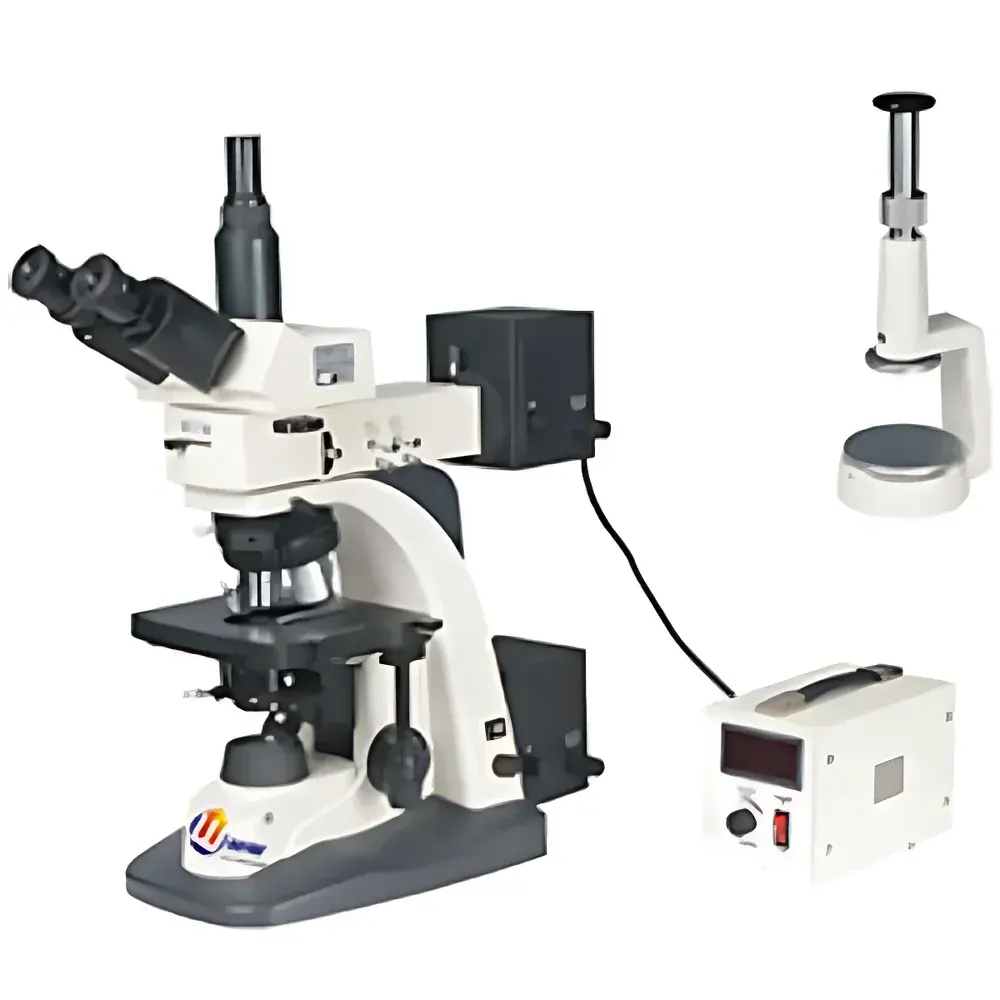
YANRUN 10XB Upright Polarizing Metallurgical Microscope
| Brand | YANRUN |
|---|---|
| Origin | Shanghai, China |
| Manufacturer Type | Direct Manufacturer |
| Product Type | Upright Metallurgical Microscope |
| Eyepieces | Wide-Field 10× (Φ25 mm), Wide-Field 10× (Φ20 mm) with 0.1 mm reticle scale |
| Trinocular Head | 30° inclined hinge-type, interpupillary adjustment 50–75 mm |
| Objective Turret | Quadruple nosepiece with DIC slot |
| Infinity-Corrected Plan Objectives | 5×/0.10 (WD 29.4 mm), 10×/0.25 (WD 16 mm), 20×/0.40 (WD 10.6 mm), 40×/0.60 (WD 5.4 mm) |
| Mechanical Stage | Dual-layer, 190 × 160 mm, travel range 80 × 50 mm |
| Focus Mechanism | Coaxial coarse/fine focusing with rack-and-pinion drive |
| Condenser | NA 1.25 Abbe condenser with adjustable iris diaphragm and filter holder |
| Illumination | Reflected-light halogen illumination (adjustable aperture and field diaphragms) |
| Polarization System | Rotatable analyzer (0–360°), polarizer and analyzer both removable from optical path |
| Filter Set | Slide-in green, blue, and neutral density filters |
| Calibration Tool | 0.01 mm stage micrometer |
| Standard Accessories | Main unit, trinocular observation tube, pair of 10× eyepieces, four objectives (5×, 10×, 20×, 40×), 12 V halogen lamp, Abbe condenser, polarization kit, filter set, stage micrometer, certificate of conformity, warranty card, and user manual |
Overview
The YANRUN 10XB Upright Polarizing Metallurgical Microscope is an engineered solution for high-fidelity microstructural analysis of opaque, reflective specimens—primarily metals, alloys, ceramics, and coated materials. Designed around an infinity-corrected optical pathway, the system delivers consistent resolution, flat-field imaging, and chromatic aberration correction across its full magnification range. Its dual-illumination architecture supports both reflected-light (epi-illumination) and transmitted-light observation modes, enabling comprehensive characterization under brightfield, darkfield, and polarized light conditions. The inclusion of a precision rotatable analyzer and removable polarizer permits quantitative birefringence assessment, extinction angle measurement, and crystallographic orientation analysis—critical for phase identification in anisotropic materials such as titanium alloys, ferritic steels, and geological thin sections prepared for metallurgical evaluation.
Key Features
- Infinity-corrected plan apochromatic objective lens set (5×, 10×, 20×, 40×) with specified working distances and numerical apertures optimized for high-resolution surface topography and grain boundary delineation.
- Trinocular head with 30° inclination and interpupillary adjustment (50–75 mm) accommodates ergonomic long-duration operation and enables simultaneous visual observation and optional camera coupling.
- Quadruple revolving nosepiece incorporating dedicated slots for Differential Interference Contrast (DIC) components—providing future upgradeability to contrast-enhanced imaging without optical realignment.
- Coaxial coarse/fine focusing mechanism featuring rack-and-pinion transmission and 2 µm fine-focus graduation ensures repeatable, sub-micron Z-axis positioning essential for focused ion beam (FIB) site targeting and serial sectioning alignment.
- Dual-path illumination system: Reflected halogen source with independent aperture and field diaphragms for optimal Köhler illumination in epi-mode; transmitted 12 V / 50 W halogen lamp with voltage-independent dimming (85–230 V AC input) for stable intensity control in transparent or semi-transparent sample analysis.
- NA 1.25 Abbe condenser with centerable iris diaphragm and integrated filter holder supports precise contrast modulation in transmitted brightfield and darkfield configurations.
Sample Compatibility & Compliance
The 10XB accepts standard metallurgical specimen formats—including polished metallographic mounts (up to 30 mm diameter), embedded cross-sections, and fracture surfaces mounted on 76 × 26 mm glass slides or aluminum stubs. Its 190 × 160 mm mechanical stage with 80 × 50 mm travel range facilitates systematic grid-based scanning of large-area samples. The microscope conforms to ISO 8578:2017 (Metallographic specimen preparation) and supports workflows aligned with ASTM E3-22 (Standard Guide for Preparation of Metallographic Specimens) and ASTM E112-21 (Standard Test Methods for Determining Average Grain Size). While not certified for GLP/GMP-regulated environments out-of-the-box, its mechanical stability, calibrated reticle eyepieces (0.1 mm scale), and traceable stage micrometer (0.01 mm) provide foundational metrological integrity suitable for internal QA/QC laboratories conducting routine microstructure audits per ISO/IEC 17025 requirements.
Software & Data Management
The base configuration does not include integrated digital imaging hardware or proprietary software. However, the trinocular port is mechanically standardized to C-mount (1″, 32 TPI) and compatible with third-party USB3/UVC-compliant CMOS cameras (e.g., IDS Imaging, Basler, or Lumenera models). When paired with open-architecture image analysis platforms—including ImageJ/Fiji (NIH), Olympus cellSens (via SDK), or Thermo Scientific™ HistoQuest™—the system supports particle size distribution, grain area fraction, phase quantification, and linear intercept measurements. All calibration parameters (e.g., pixel-to-µm conversion using the 0.01 mm stage micrometer) are manually configurable within these environments. Audit trail functionality depends entirely on the selected software stack; no native 21 CFR Part 11 compliance features are embedded in the optical instrument itself.
Applications
- Qualitative and semi-quantitative metallographic examination of ferrous and non-ferrous alloys per ISO 643 and ASTM E112.
- Polarized light analysis of twinning, deformation bands, and second-phase precipitates in aluminum, magnesium, and nickel-based superalloys.
- Failure analysis of fatigue cracks, intergranular corrosion, and weld heat-affected zones (HAZ).
- Quality assurance of thermal spray coatings, brazed joints, and sintered powder metallurgy parts.
- Geological thin-section evaluation where mineral birefringence and extinction angles inform petrographic classification.
- Educational use in university materials science laboratories for hands-on instruction in crystal optics and microstructural interpretation.
FAQ
Is the YANRUN 10XB compliant with FDA 21 CFR Part 11?
No—the instrument itself contains no electronic data capture, user authentication, or audit trail mechanisms required for Part 11 compliance. Regulatory adherence must be implemented at the software level when integrating digital imaging and analysis tools.
Can I upgrade to DIC or fluorescence capability?
DIC is supported via the quadruple nosepiece’s dedicated slot; however, no fluorescence excitation source or emission filter set is included or natively supported due to the absence of a fluorescence-grade light path and barrier filters.
What is the maximum specimen height clearance?
With the 5× objective installed and condenser fully retracted, vertical clearance between the stage and objective front lens exceeds 29 mm—sufficient for most standard metallographic mounts and low-profile holders.
Does the polarization system support quantitative retardation measurement?
The rotating analyzer enables angular measurement of extinction positions but lacks a calibrated compensator (e.g., λ-plate or Berek compensator); therefore, absolute retardation values cannot be determined without external accessory integration.
Are replacement halogen lamps and fuses available through YANRUN?
Yes—original-specification 12 V / 50 W halogen lamps and compatible fuse types are supplied directly by YANRUN as consumable spare parts under OEM part numbers.





