
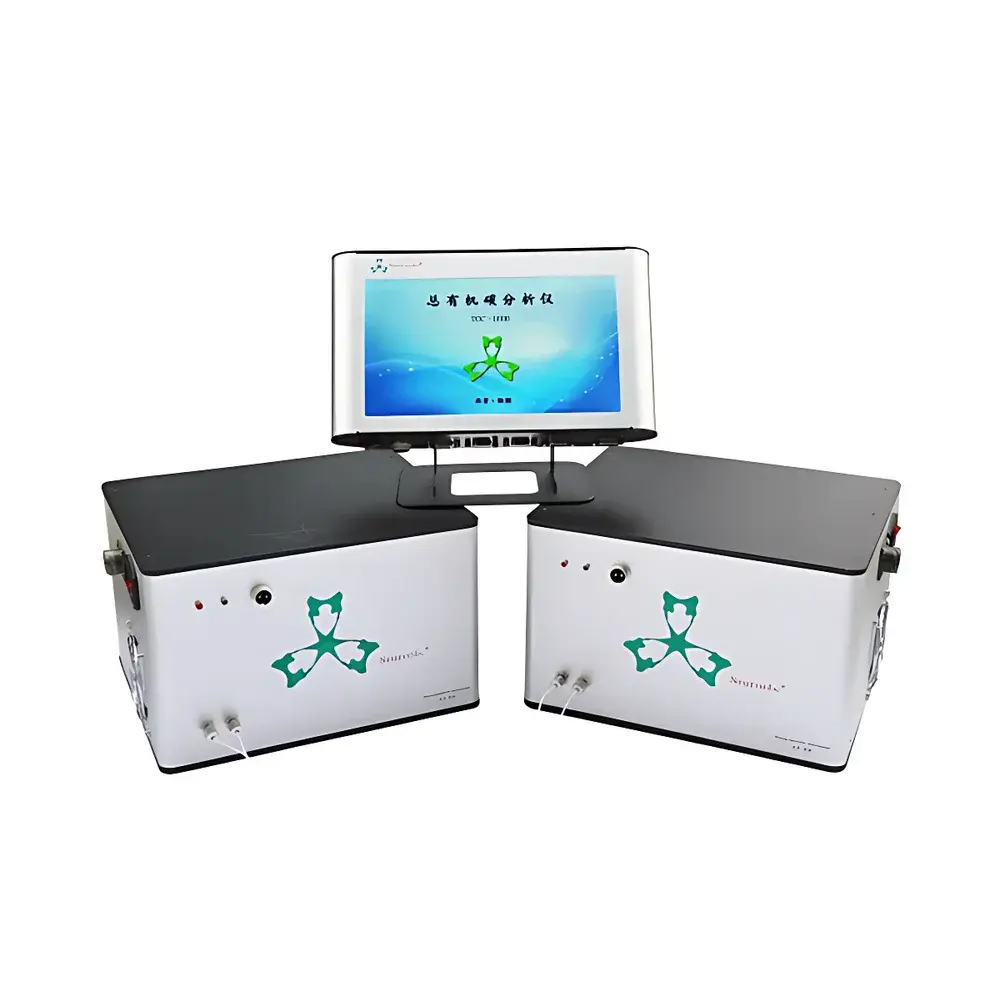
NeuronBC TOC5.0 Online Total Organic Carbon Analyzer
| Brand | NeuronBC |
|---|---|
| Origin | Beijing, China |
| Model | TOC5.0 |
| Instrument Type | Online TOC Analyzer |
| Detection Principle | Direct Conductivity Method |
| Oxidation Method | UV Photolysis (Static UV Oxidation) |
| Measurement Range | 1–1000 ppb (as C) |
| Accuracy | ±5% of reading |
| Resolution | 0.001 mg/L |
| Detection Limit | 0.001 mg/L |
| Repeatability | ±5% RSD |
| Sample Temperature Range | 0–100 °C |
| Conductivity Range | 0.055–6.000 µS/cm |
| Environmental Operating Temperature | 5–65 °C |
| Relative Humidity | ≤85% RH |
| Power Supply | 220 V ±10%, 50 Hz ±10% |
| Response Time | <5 minutes |
| Drift | ±5% FS/24 h |
| Rated Power per Detection Unit | 50 W |
| Sample Inlet/Outlet Tubing | 1 mm ID PTFE tubing with 50-series quick-connect fittings |
| Communication Interface | RS-485 (supports up to 8 detection units per TA-D500 data terminal) |
| Display | 10-inch capacitive touchscreen HMI |
Overview
The NeuronBC TOC5.0 Online Total Organic Carbon Analyzer is an engineered solution for continuous, real-time monitoring of total organic carbon in ultrapure and high-purity water systems. It operates on the direct conductivity detection principle following UV photolysis oxidation—a method standardized in ASTM D5997, USP , and EP 2.2.44 for pharmaceutical water quality assurance. In this process, dissolved organic compounds are oxidized to CO₂ under low-pressure 185/254 nm UV light in a static quartz reaction chamber; the resulting CO₂ dissolves in the carrier water stream, altering its specific conductivity, which is measured by a high-stability dual-electrode conductivity cell. The system’s architecture supports distributed deployment: one TA-D500 central data terminal synchronously acquires, logs, visualizes, and alarms across up to eight independent TOC TA-5.0 detection units—each equipped with its own dedicated UV oxidation module and conductivity sensor—enabling multi-point surveillance of critical water loops without signal interference or cross-contamination.
Key Features
- Modular design with scalable topology: 1 × TA-D500 data terminal + 1–8 × TOC TA-5.0 detection units, enabling flexible integration into complex water distribution networks.
- Static UV oxidation using dual-wavelength (185 nm + 254 nm) low-pressure mercury lamps ensures complete mineralization of non-purgeable organic carbon (NPOC), including recalcitrant compounds such as methanol, ethanol, and low-molecular-weight organic acids.
- High-fidelity conductivity detection with temperature-compensated dual-electrode cell (0.055–6.000 µS/cm range), calibrated traceably to NIST-traceable KCl standards.
- 10-inch industrial-grade capacitive touchscreen HMI with intuitive navigation, multilingual UI support (English, Chinese, Spanish), and embedded configuration wizard for alarm thresholds, sampling intervals, and unit scaling.
- RS-485 communication interface compliant with Modbus RTU protocol; supports time-stamped historical data retrieval, remote firmware updates, and audit-ready event logging.
- PTFE fluidic path (1 mm ID tubing) with ISO 5211-compliant 50-series push-to-connect fittings minimizes adsorption, leaching, and carryover—critical for sub-ppb-level measurements in pharmaceutical and semiconductor applications.
- Onboard thermal management maintains stable internal ambient conditions across 5–65 °C operating environments, ensuring long-term baseline stability and <±5% FS drift over 24 hours.
Sample Compatibility & Compliance
The TOC5.0 is validated for use with purified water (PW), water for injection (WFI), and ultrapure water (UPW) per pharmacopeial requirements (USP , EP 2.2.44, JP 17). Its design conforms to GMP Annex 1 (2022) recommendations for continuous monitoring of water quality attributes and supports FDA 21 CFR Part 11 compliance when paired with optional electronic signature and audit trail modules. All wetted materials—including quartz oxidation chamber, PTFE capillary, and stainless-steel sample manifold—are USP Class VI certified and extractables-tested per ICH Q5C guidelines. The system meets electromagnetic compatibility (EMC) requirements per IEC 61326-1 and safety standards per IEC 61010-1.
Software & Data Management
The TA-D500 data terminal runs embedded Linux-based firmware with deterministic real-time scheduling. It stores ≥12 months of second-resolution TOC data (including conductivity, temperature, UV lamp status, and error codes) in encrypted SQLite databases. Data export is supported via USB mass storage (CSV/Excel) or optional Ethernet/Wi-Fi gateway for integration into SCADA, MES, or LIMS platforms. Built-in reporting tools generate daily summary reports with statistical process control (SPC) charts (X̄-R, Cpk), deviation alerts, and calibration verification logs. Audit trails record all user actions—including parameter changes, calibration events, and data deletions—with immutable timestamps and operator IDs.
Applications
- Pharmaceutical manufacturing: Continuous TOC verification of PW/WFI loops during production, cleaning validation, and environmental monitoring per EU GMP Annex 1 and FDA guidance on process analytical technology (PAT).
- Semiconductor fabrication: Monitoring UPW quality at point-of-use in wafer cleaning, photoresist development, and chemical mechanical polishing (CMP) rinse lines where TOC < 1 ppb is required to prevent microcontamination.
- Power generation: Real-time assessment of condensate polisher effluent and boiler feedwater integrity to detect early-stage organic fouling in steam cycles.
- Biotechnology facilities: In-line verification of buffer preparation systems and chromatography eluent purity prior to column loading.
- Research laboratories: Long-term stability studies of water purification systems, including EDI, RO, and ultrafiltration performance tracking.
FAQ
What oxidation method does the TOC5.0 employ, and why is static UV preferred for ultrapure water applications?
It uses static UV photolysis (185/254 nm) without added persulfate or high-temperature catalysis—minimizing reagent contamination risk and enabling reliable measurement in low-conductivity matrices (<0.1 µS/cm) where combustion-based methods suffer from poor signal-to-noise ratio.
Can the system be integrated into existing plant automation infrastructure?
Yes. RS-485 Modbus RTU output enables native integration with DeltaV, Siemens PCS7, Honeywell Experion, and Rockwell FactoryTalk systems. Optional analog 4–20 mA outputs and digital relay alarms are available for hardwired interlocks.
How is calibration verified in-situ without interrupting operation?
The TA-D500 supports automated zero-checks using certified low-TOC water (e.g., Milli-Q® Reference Water) and span verification with potassium hydrogen phthalate (KHP) standard—both executed via programmable maintenance schedules with full traceability.
Is the instrument suitable for hot water sanitization cycles?
Yes. The detection unit accommodates sample temperatures up to 100 °C, and its PTFE fluid path remains chemically inert during SIP (steam-in-place) cycles at 121 °C—provided external cooling is applied upstream to maintain inlet temperature within specification.
What data security and regulatory compliance features are included?
Role-based access control (RBAC), password-protected configuration, electronic signatures for calibration entries, and tamper-evident audit logs satisfy ALCOA+ principles and facilitate inspection readiness for FDA, EMA, and PMDA audits.
Related Products







