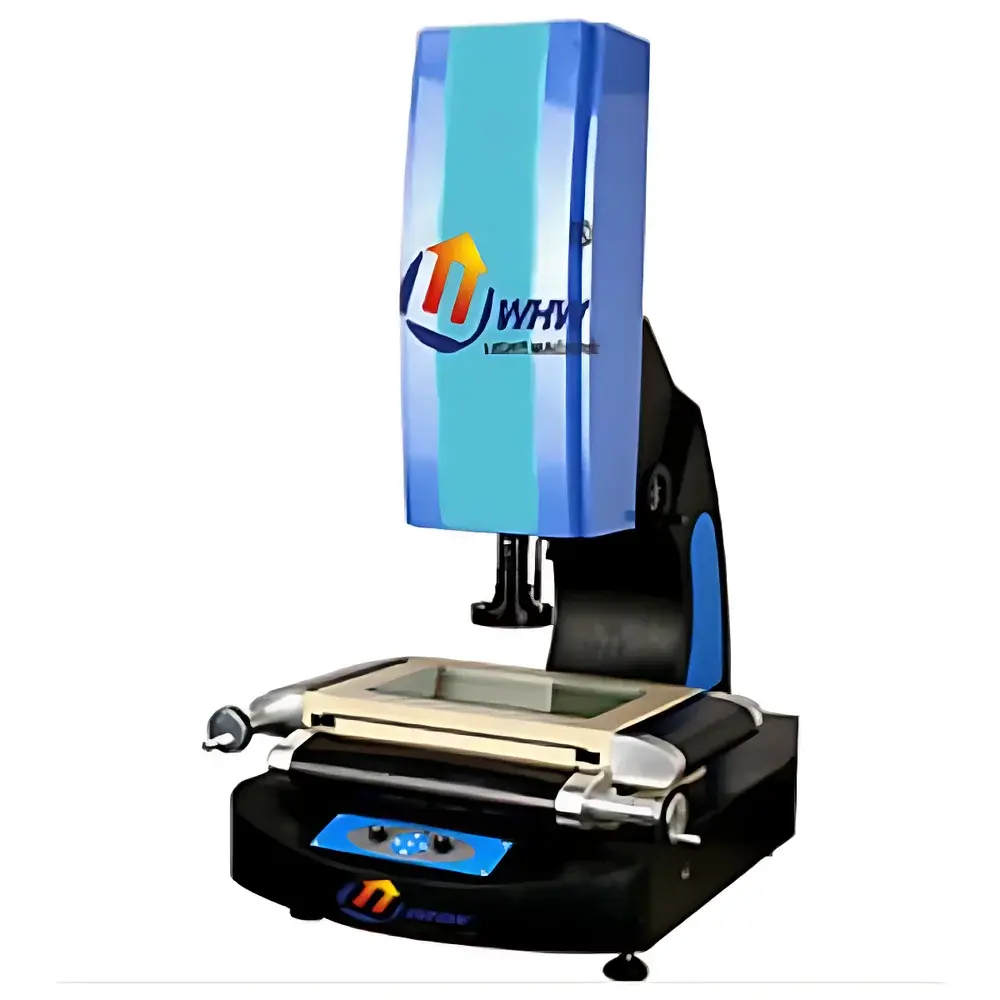
YANRUN YR-D3020 Non-Contact Vision Measuring Machine
| Brand | YANRUN |
|---|---|
| Origin | Shanghai, China |
| Manufacturer Type | Direct Manufacturer |
| Country of Origin | China |
| Model | YR-D3020 |
| Tabletop Metal Dimensions (mm) | 458 × 358 |
| Glass Stage Dimensions (mm) | 250 × 350 |
| Motion Travel (X×Y, mm) | 300 × 200 |
| Overall Dimensions (mm) | 930 × 670 × 1100 |
| Stage Load Capacity | ≥450 kg |
| Stage Footprint & Height (mm) | 1120 × 730 × 780 |
| Drive Mechanism | Linear Guide Rails (X/Y), Precision Lead Screw (Z) |
| Z-Axis Vertical Travel (mm) | 250 |
| Digital Readout Resolution (X/Y/Z) | 0.0005 mm |
| Positioning Accuracy (X/Y, � | m): ≤(3 + L/200) |
| Imaging System | High-Resolution Color CCD Camera |
| Total Video Magnification | 30–230× (up to 440× with 2× Auxiliary Objective) |
| Illumination | Four-Quadrant Independent LED Brightfield/Darkfield Control |
| Power Supply | AC 220 V ±10%, 50 Hz |
| Operating Environment | 20 °C ±3 °C, 45–75% RH |
Overview
The YANRUN YR-D3020 Non-Contact Vision Measuring Machine is an optomechanical metrology system engineered for high-precision geometric measurement of 2D and 3D features without physical probe contact. It operates on the principle of digital image acquisition, edge detection, and sub-pixel coordinate reconstruction—leveraging calibrated optical magnification, fixed-focus imaging geometry, and deterministic stage motion to deliver traceable dimensional data. Designed for quality control laboratories, precision machining shops, and R&D facilities, the YR-D3020 supports ISO 10360-compliant verification of length, angle, radius, position, parallelism, perpendicularity, and profile tolerances in accordance with GD&T standards (ASME Y14.5 / ISO 1101). Its rigid granite base, thermally stabilized optical path, and vibration-damped mechanical architecture ensure long-term repeatability under controlled environmental conditions (20 °C ±3 °C, 45–75% RH), meeting foundational requirements for GLP-aligned measurement workflows.
Key Features
- High-stability mechanical platform with ≥450 kg load capacity and integrated 1120 × 730 × 780 mm granite support table for thermal mass and vibration isolation
- Dual-stage design: 458 × 358 mm machined metal stage for heavy-duty part placement and 250 × 350 mm optical-grade transparent glass stage for backlit silhouette measurement
- Precision motion system: X/Y axes driven by low-hysteresis linear guide rails with 0.0005 mm encoder resolution; Z-axis equipped with anti-backlash lead screw enabling 250 mm vertical travel with fine focus control
- Optical imaging subsystem comprising a progressive-scan color CCD sensor and motorized 0.7–4.5× zoom lens assembly, delivering calibrated total magnifications from 30× to 230× (extendable to 440× using optional 2× auxiliary objective)
- Four-quadrant programmable LED illumination with independent intensity control for optimized contrast across diverse surface finishes—supporting both brightfield edge detection and darkfield defect visualization
- Compliance-ready hardware architecture: RS-232 and USB interfaces for external device synchronization; onboard non-volatile memory for calibration file storage and audit trail generation
Sample Compatibility & Compliance
The YR-D3020 accommodates parts up to 300 mm (X) × 200 mm (Y) × 250 mm (Z), with unrestricted height clearance above the glass stage. It measures metallic, ceramic, polymer, and composite components—including stamped sheet metal, machined housings, PCBs, injection-molded connectors, and microfluidic substrates—provided surfaces exhibit sufficient optical contrast for edge segmentation. The system satisfies fundamental metrological requirements per ISO/IEC 17025 for test equipment validation and supports documented calibration against NIST-traceable step gauges and radius standards. While not pre-certified for FDA 21 CFR Part 11, its firmware architecture permits integration into validated environments via third-party electronic signature and audit log modules compliant with GMP/GLP documentation protocols.
Software & Data Management
The YR-D3020 operates with YANRUN’s proprietary MetroVision™ measurement software, providing intuitive CAD-based alignment, automatic feature recognition (lines, circles, arcs, slots, polygons), and GD&T evaluation per ASME Y14.5-2018. All measurement routines generate timestamped XML reports containing raw pixel coordinates, compensated dimensional results, uncertainty estimates (based on Eqs. 1–3 of ISO 15530-3), and operator ID metadata. Data export options include CSV, DXF, PDF, and STEP formats. Software supports multi-user role permissions, password-protected parameter modification, and configurable report templates aligned with internal QA checklists or customer-specific PPAP documentation requirements.
Applications
- First-article inspection of CNC-machined aerospace brackets and turbine blade fixtures
- Dimensional verification of medical device housings (ISO 13485 environments) including wall thickness, port location, and sealing surface flatness
- PCB component placement accuracy assessment (SMT stencil alignment validation)
- Tooling verification for injection molds—cavity depth, gate diameter, ejector pin positioning
- Automotive gasket and O-ring cross-sectional analysis for compression set prediction
- Academic metrology research involving uncertainty propagation modeling in vision-based measurement chains
FAQ
What is the maximum permissible part weight supported on the glass stage?
The glass stage is rated for static loads ≤5 kg. For heavier components (>5 kg), direct placement on the metal stage is required.
Does the system support automated measurement routines for batch inspection?
Yes—MetroVision™ supports script-based programming (VBScript-compatible) for unattended cycle execution, pass/fail thresholding, and SPC charting via integrated X-bar/R functionality.
Is Z-axis measurement traceable to national standards?
Z-axis height measurements are calibrated using certified gauge blocks and verified per ISO 10360-2 Annex B; full 3D volumetric error mapping requires optional laser interferometer validation.
Can the illumination system be upgraded for coaxial or structured light projection?
The base configuration does not include coaxial or structured light modules; however, the optical flange interface complies with C-mount standards, enabling third-party accessory integration.
What documentation is provided for regulatory audits?
Standard delivery includes Factory Calibration Certificate (traceable to CNAS-accredited lab), User Manual, Software Validation Summary, and Maintenance Log template—all formatted for inclusion in ISO 9001 or IATF 16949 quality system records.