
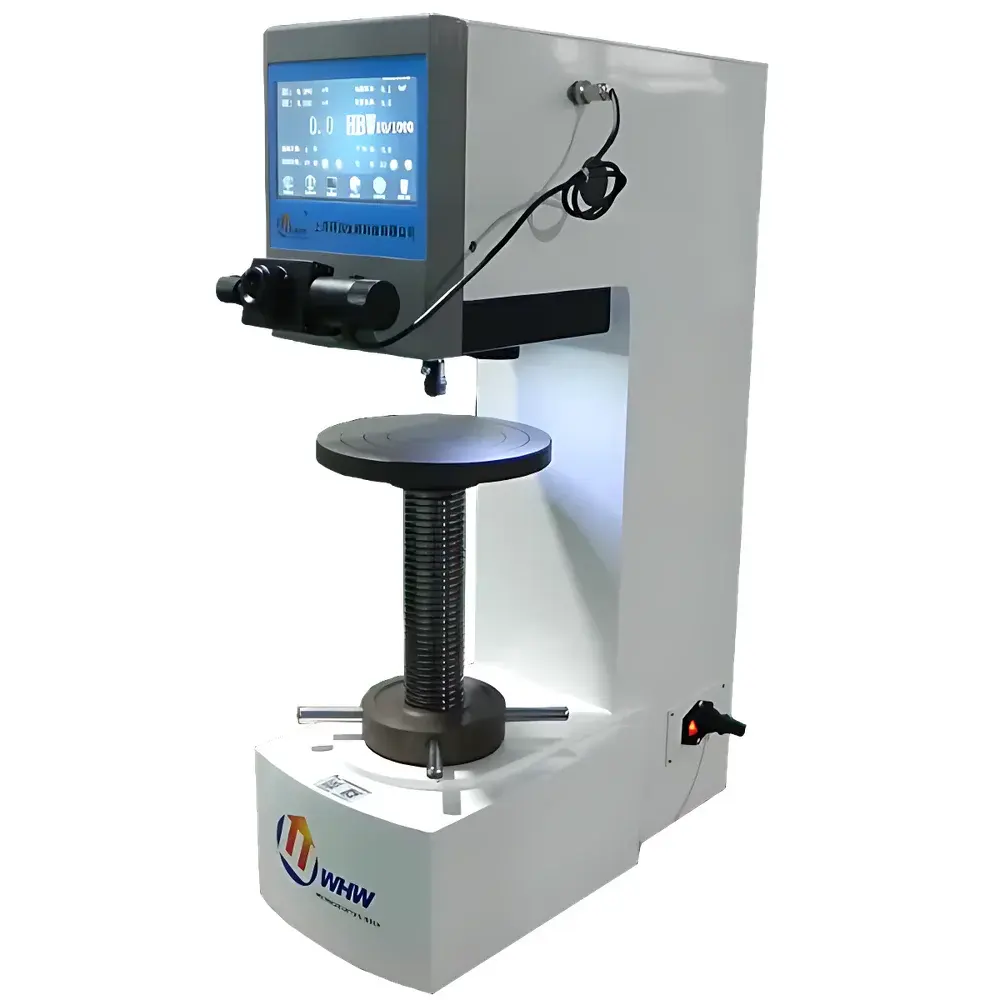
YANRUN HBS-3000LZ Touchscreen Automatic Turret Brinell Hardness Tester
| Brand | YANRUN |
|---|---|
| Origin | Shanghai, China |
| Manufacturer Type | Direct Manufacturer |
| Instrument Type | Brinell Hardness Tester |
| Model | HBS-3000LZ |
| Measurement Range | 8–650 HBW |
| Test Forces | 62.5 kgf, 100 kgf, 125 kgf, 187.5 kgf, 250 kgf, 500 kgf, 750 kgf, 1000 kgf, 1500 kgf, 3000 kgf |
| Maximum Specimen Height | 225 mm |
| Depth of Throat | 135 mm |
| Vertical Clearance | 200 mm |
| Indenter Diameters | 2.5 mm, 5 mm, 10 mm tungsten carbide balls |
| Optical Magnification | 20× |
| Eyepiece Resolution | 0.564 µm |
| Load Application | Motor-driven closed-loop electronic force control |
| Dwell Time | 0–60 s (adjustable in 1-s increments) |
| Hardness Scale Conversion | HRB, HRC, HRA, HRD, HRF, HK, HV, HR15N/30N/45N, HR15T/30T/45T, HBW |
| Data Storage | Up to 30 test records |
| Compliance | GB/T 231.2, JJG 150 |
| Power Supply | AC 220 V |
| Dimensions (W×D×H) | 520 × 230 × 750 mm |
| Weight | ~130 kg |
Overview
The YANRUN HBS-3000LZ is a fully automated, touchscreen-controlled Brinell hardness tester engineered for precision, repeatability, and compliance with international mechanical testing standards. It operates on the fundamental Brinell principle—applying a predetermined spherical indenter load to the specimen surface and measuring the resulting permanent indentation diameter under optical magnification. As the method producing the largest impression among standardized hardness tests, Brinell testing delivers robust macro-scale mechanical property assessment, minimizing sensitivity to microstructural heterogeneity, phase segregation, or local compositional variation. This makes the HBS-3000LZ especially suitable for bulk characterization of as-cast iron, hot-rolled and annealed steels, aluminum alloys, copper-based materials, and other relatively soft-to-medium-hard metallics where representative volume averaging is critical.
Key Features
- Motor-driven, closed-loop electronic loading system eliminates reliance on mechanical deadweights—ensuring consistent force application across all 10 selectable test loads (62.5–3000 kgf) with high linearity and minimal hysteresis.
- Automatic turret indexing synchronizes indenter selection (2.5 mm, 5 mm, or 10 mm tungsten carbide balls) and optical path alignment without manual intervention, reducing operator error and cycle time.
- Integrated 20× digital eyepiece with 0.564 µm resolution enables precise, repeatable indentation measurement; real-time image capture and automatic diameter calculation eliminate subjective visual estimation.
- Onboard touchscreen interface supports intuitive workflow navigation—including load selection, dwell time (0–60 s), test sequence programming, and immediate result display—with multilingual UI support (English default).
- Direct hardness scale conversion per ISO 18265 and ASTM E140: outputs HBW values alongside equivalent HRB, HRC, HV, HK, and superficial Rockwell scales (HR15N/30N/45N, HR15T/30T/45T) based on standardized interpolation algorithms.
- Built-in thermal printer provides traceable, hard-copy documentation of each test—including date/time stamp, load, dwell, indenter size, measured diameters, calculated HBW, and converted values—supporting GLP/GMP documentation requirements.
Sample Compatibility & Compliance
The HBS-3000LZ accommodates specimens up to 225 mm in height and 135 mm in depth from the column axis, supporting standard flat, cylindrical, and irregular geometries via included large flat, medium flat, and V-shaped anvils. Its 200 mm vertical clearance and 155 mm maximum distance from indenter center to column ensure compatibility with industrial forgings, billets, and cast components. The instrument conforms to GB/T 231.2 (Chinese national standard equivalent to ISO 6506-2), and its force calibration and verification protocol aligns with JJG 150 (People’s Republic of China Metrological Verification Regulation for Hardness Testers). While not certified to ISO/IEC 17025, its design supports audit-ready operation in regulated environments when paired with documented calibration certificates and routine verification using certified reference blocks (supplied: high-, medium-, and low-HBW blocks).
Software & Data Management
The embedded firmware implements deterministic data handling: each test record stores raw indentation diameters (d₁, d₂), applied load (kgf), dwell duration (s), indenter diameter (mm), calculated HBW value, and all converted scales. Up to 30 recent tests are retained in non-volatile memory with timestamping. Export functionality is limited to printed output; however, the system architecture permits future integration with external LIMS or QA databases via RS-232 serial interface (standard) or optional USB-to-serial adapter. All stored results adhere to ALCOA+ principles (Attributable, Legible, Contemporaneous, Original, Accurate, Complete, Consistent, Enduring, Available) when used within defined SOPs—particularly relevant for laboratories operating under FDA 21 CFR Part 11–aligned quality systems requiring audit trails and user access control (implemented via password-protected administrator mode).
Applications
- Metallurgical process validation: monitoring homogeneity of annealed or normalized steel billets prior to further heat treatment.
- Foundry QC: verifying Brinell hardness consistency across gray iron, ductile iron, and aluminum-silicon casting batches.
- Supplier qualification: assessing incoming material compliance against purchase specifications referencing HBW values per ASTM E10 or ISO 6506-1.
- Academic research: correlating macro-hardness with tensile strength (via empirical HBW–UTS relationships) in alloy development studies.
- Maintenance engineering: evaluating degradation of structural components subjected to long-term thermal or mechanical loading.
FAQ
What Brinell standards does the HBS-3000LZ comply with?
It meets GB/T 231.2 (equivalent to ISO 6506-2) for verification and JJG 150 for metrological calibration in China. Test execution follows ISO 6506-1 principles.
Can the instrument be calibrated externally?
Yes—certified reference hardness blocks (supplied with unit) enable daily verification; third-party accredited labs can perform full force and optical calibration using traceable standards.
Is the test data exportable to CSV or Excel?
No native file export is provided; results are accessible only via printed reports or manual transcription from the display. RS-232 output allows custom integration with external data acquisition software.
What maintenance is required for long-term accuracy?
Monthly cleaning of optical path and indenter surfaces, annual verification of load cell linearity and eyepiece calibration, and biannual inspection of motorized turret alignment per manufacturer guidelines.
Does the system support multi-user access control?
It features dual-tier access (operator/administrator) with password protection, enabling restricted configuration changes while allowing unrestricted test execution—consistent with basic GLP administrative controls.



