
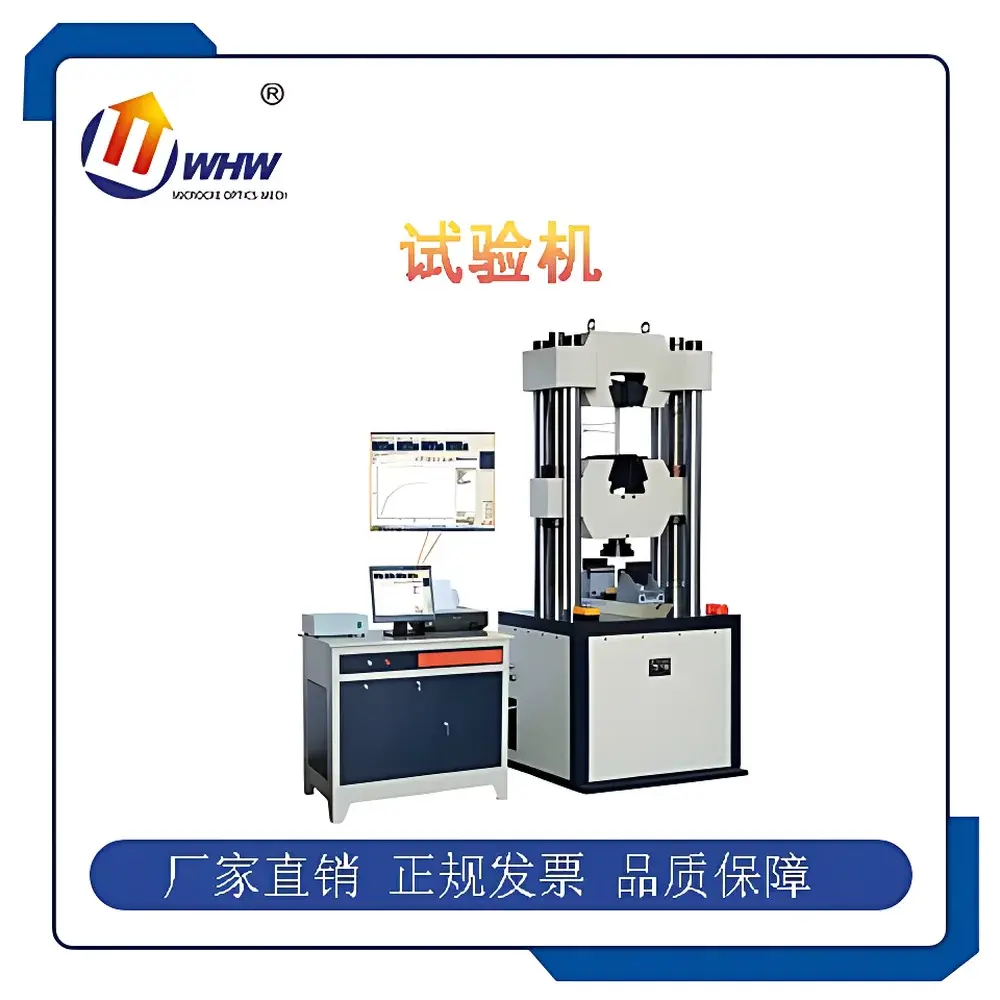
YANRUN MC009 Series Microcomputer-Controlled Electro-Hydraulic Servo Universal Testing Machine WAW-2000C
| Brand | YANRUN |
|---|---|
| Origin | Shanghai, China |
| Manufacturer Type | Direct Manufacturer |
| Model | MC009-WAW-2000C |
| Load Capacity Range | 40–2000 kN |
| Load Accuracy | ±1% or ±0.5% FS |
| Test Classification | Class I or 0.5 |
| Force Resolution | 0.002 kN |
| Displacement Resolution | 0.01 mm |
| Deformation Measurement Accuracy | 0.005 mm |
| Control Modes | Constant Force / Constant Displacement / Constant Strain (0.4–100% FS) |
| Hydraulic System | High-Pressure Servo Valve Controlled with Differential Pressure Valve Group |
| Structural Configuration | Four-Column, Bottom-Loaded Frame with Upper Tensile Zone and Lower Compression/Bending Zone |
| Clamping Method | Integrated Hydraulic Grips |
| Max Piston Speed | 50 mm/min |
| Max Stroke | 250 mm |
| Tensile Space | 800 mm |
| Compression Space | 700 mm |
| Round Specimen Grip Range | Φ35–Φ80 mm |
| Flat Specimen Grip Thickness | 20–60 mm |
| Bending Span | 450 mm |
| Bend Roller Diameter | Φ30 mm |
| Max Deflection | 150 mm |
| Host Dimensions (W×D×H) | 1200×1100×2600 mm |
| Oil Source Dimensions | 1100×700×1100 mm |
| Weight | 6550 kg |
Overview
The YANRUN MC009 Series Microcomputer-Controlled Electro-Hydraulic Servo Universal Testing Machine WAW-2000C is a high-capacity, precision-engineered static mechanical testing system designed for full-range mechanical characterization of metallic and non-metallic materials under tension, compression, bending, and shear loading conditions. Based on the Couette-type hydraulic actuation principle and closed-loop electro-hydraulic servo control architecture, the WAW-2000C delivers stable force generation across its 40–2000 kN operational range, with load accuracy certified to ±1% or ±0.5% of full scale (FS), conforming to ISO 7500-1:2018 and ASTM E4-23 requirements for verification of force-measuring instruments. Its four-column, bottom-mounted hydraulic cylinder configuration provides structural rigidity and thermal stability essential for long-duration creep and relaxation tests, while the upper tensile zone and lower compression/bending zone enable seamless transition between test modes without specimen repositioning. The machine integrates a high-fidelity analog-to-digital acquisition system with 1/500,000 internal resolution—fully unsegmented across the entire force range—ensuring consistent signal fidelity from low-force preloading to ultimate failure.
Key Features
- Four-column, bottom-actuated frame with optimized column spacing and reinforced crosshead design for minimal deflection under peak 2000 kN loads
- Integrated hydraulic grip system with pressure-controlled clamping force, supporting round specimens from Φ35 to Φ80 mm and flat specimens up to 60 mm thick
- Dual-circuit hydraulic power unit featuring a high-efficiency AC motor-driven axial piston pump, servo-controlled directional valve, and differential pressure valve group for precise flow regulation and minimal hysteresis
- Real-time multi-channel closed-loop control of test force, crosshead displacement, and extensometer-derived strain—each operating independently with user-selectable PID tuning parameters
- Overload protection (triggered at >103% FS) and stroke limit detection (mechanical + encoder-based) to safeguard both equipment integrity and operator safety in compliance with EN ISO 12100
- Tensile space of 800 mm and compression space of 700 mm—configurable in three discrete height segments to accommodate high-temperature furnaces, environmental chambers, or digital image correlation (DIC) setups
- Modular software interface supporting customizable test templates, automatic report generation in PDF/Excel, and raw data export in ASCII or binary formats
Sample Compatibility & Compliance
The WAW-2000C accommodates standard and custom geometries per ASTM E8/E8M (tension), ASTM E9 (compression), ASTM E290 (bend), and ISO 6892-1:2019. Its adjustable grip assemblies accept round bars, plates, castings, welded joints, composites, and additively manufactured specimens. For regulatory traceability, the system supports audit-ready calibration records aligned with ISO/IEC 17025:2017 requirements. Force transducers are calibrated using dead-weight standards traceable to NIM (China National Institute of Metrology), and all validation reports include uncertainty budgets per GUM (JCGM 100:2008). Optional configurations meet GLP-compliant data integrity requirements—including electronic signatures, 21 CFR Part 11–compliant audit trails, and role-based access control.
Software & Data Management
The embedded Windows-based control platform implements real-time sampling at ≥1 kHz, with synchronized acquisition of force, displacement, strain, and auxiliary channels (e.g., furnace temperature, acoustic emission). Test sequences are programmable via graphical workflow editor or script-based syntax (VBScript-compatible). All raw data are stored in encrypted SQLite databases with immutable timestamps and user attribution. Export functions support ASTM E1431-compliant .tdms, .csv, and .xml schemas for third-party analysis tools such as MATLAB, Python (NumPy/Pandas), and MTS TestSuite. Historical test archives are searchable by material grade, lot number, operator ID, or date range; automated backup to network drives or NAS devices is configurable.
Applications
This system serves as a primary mechanical testing platform in R&D laboratories and QC departments across aerospace (e.g., Ti-6Al-4V tensile properties per AMS 2300), heavy construction (rebar yield strength per GB/T 1499.2), energy infrastructure (pipeline steel fracture toughness per API RP 5L3), and advanced manufacturing (metal matrix composites per ISO 16232). It supports standardized quasi-static protocols including monotonic loading, cyclic fatigue pre-conditioning (via optional servo-hydraulic controller upgrade), and hold-step tests for stress relaxation analysis. Integration with external systems—such as high-temperature furnaces (up to 1200 °C), extensometers (LVDT or video-based), and acoustic emission sensors—is supported through IEEE 1451.4 TEDS-compliant analog/digital I/O modules.
FAQ
What international standards does the WAW-2000C comply with for force measurement verification?
It meets ISO 7500-1:2018 Class 0.5 and ASTM E4-23 requirements, with factory calibration certificates including expanded uncertainty values.
Can the system be integrated into an existing LIMS or MES environment?
Yes—via OPC UA or RESTful API interfaces; documentation includes sample JSON payloads and authentication protocols.
Is remote diagnostics and firmware update capability available?
Standard Ethernet connectivity enables secure remote access through TLS-encrypted VNC sessions; over-the-air updates require local administrator approval.
What is the typical lead time for delivery and on-site commissioning?
Production lead time is 12–14 weeks from order confirmation; on-site installation, mechanical alignment, and performance validation require two consecutive business days.
Does YANRUN provide accredited calibration services after installation?
Yes—certified field engineers perform annual recalibration with NIM-traceable standards and issue ISO/IEC 17025-compliant reports.



