
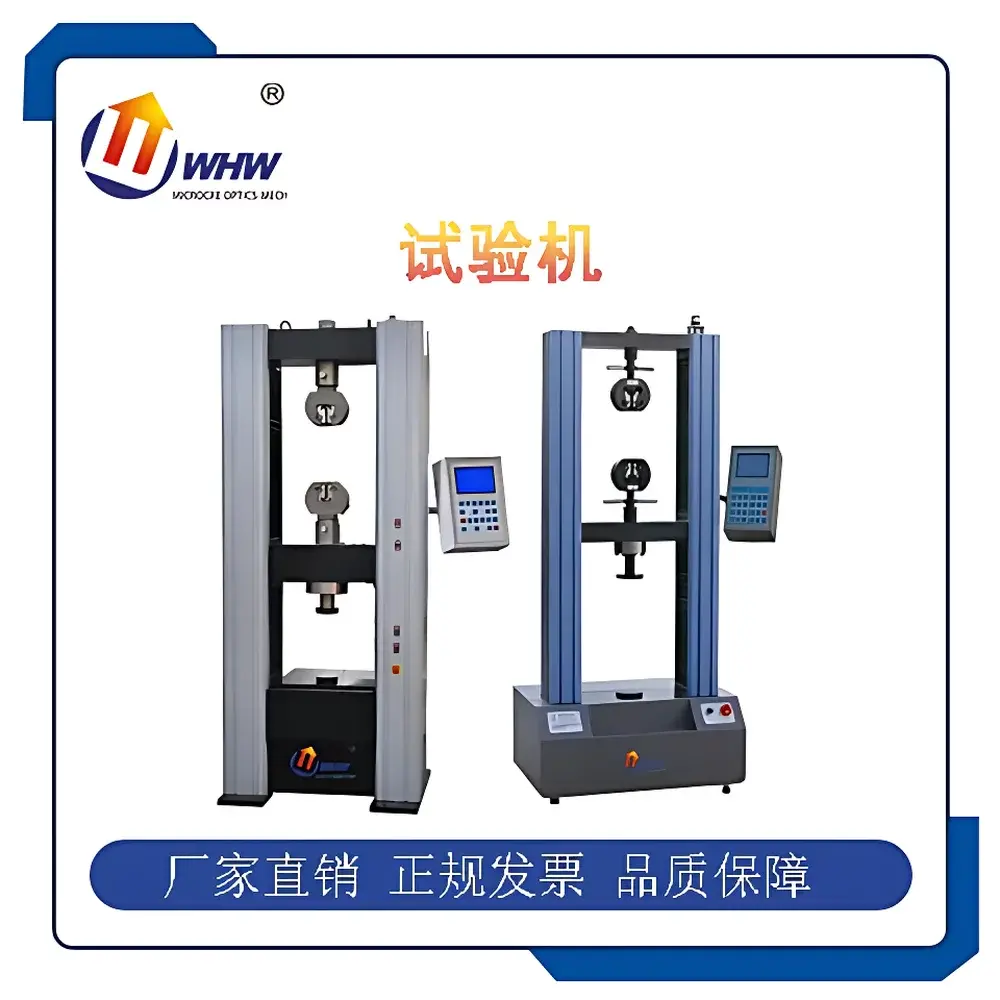
YANRUN MC009-WDS-200GL 0.5-Class High-Precision Floor-Mounted Digital Electronic Universal Testing Machine
| Brand | YANRUN |
|---|---|
| Origin | Shanghai, China |
| Manufacturer Type | Direct Manufacturer |
| Instrument Type | Electronic Universal Testing Machine |
| Model | MC009-WDS-200GL |
| Load Capacity | 0.8–200 kN |
| Load Accuracy | ±0.5% |
| Displacement Resolution | 0.0025 mm |
| Speed Range | 0.001–500 mm/min (infinitely variable) |
| Test Space (Tension/Compression) | 600 mm |
| Effective Width | 570 mm |
| Frame Dimensions (W×D×H) | 800 × 1100 × 2600 mm |
| Weight | 2000 kg |
| Power Supply | Three-phase, 380 V ±10%, 50 Hz |
| Accuracy Class | 0.5 |
Overview
The YANRUN MC009-WDS-200GL is a floor-mounted, microprocessor-controlled electronic universal testing machine engineered for high-fidelity mechanical property characterization of structural and functional materials under uniaxial tensile, compressive, flexural, peel, shear, and bending loading conditions. It operates on the principle of closed-loop servo control, utilizing a precision ball-screw-driven crosshead actuated by a high-torque AC servo motor and calibrated force feedback via a traceable, temperature-compensated load cell. Designed to meet ISO 7500-1:2018 (Class 0.5) and ASTM E4-23 verification requirements, the system delivers metrologically validated force measurement accuracy of ±0.5% of full scale across its 0.8–200 kN operating range. Its rigid welded steel frame—optimized for minimal deflection under peak load—ensures high reproducibility in modulus, yield strength, ultimate tensile strength, elongation at break, and fracture energy determinations.
Key Features
- Structurally reinforced floor-standing frame with high stiffness-to-mass ratio, minimizing parasitic deformation during high-load testing (up to 200 kN)
- Imported high-stability load cell with integrated thermal drift compensation and factory calibration traceable to national standards
- AC servo drive system offering speed resolution down to 0.001 mm/min and maximum traverse speed of 500 mm/min, enabling precise strain-rate control per ISO 6892-1 and ASTM D638
- Displacement measurement via high-resolution optical encoder with 0.0025 mm resolution and ±0.5% linearity over full stroke (600 mm tension/compression)
- Comprehensive hardware safety suite: dual mechanical limit switches, overload cut-off, overcurrent protection, overvoltage suppression, and emergency stop circuit compliant with IEC 60204-1
- Modular design supporting optional accessories including extensometers (contact/non-contact), environmental chambers (-70°C to +300°C), pneumatic wedge grips, and hydraulic side-action clamps
Sample Compatibility & Compliance
The MC009-WDS-200GL accommodates a broad spectrum of specimen geometries and material classes—including metallic rods (up to Ø32 mm), sheet metal (≤3 mm thick), polymer films, composite laminates, ceramic tiles, elastomeric strips, textile fabrics, PCB substrates, medical device components, and adhesive-bonded joints. Its 570 mm effective test width and 600 mm vertical clearance support standardized test configurations per ASTM D882 (thin plastics), ASTM D3039 (composites), ISO 527-2 (tensile testing of plastics), ISO 178 (flexural properties), and EN 13119 (geosynthetic tensile testing). The system’s 0.5-class certification satisfies mandatory requirements for quality control laboratories operating under ISO/IEC 17025, GMP (21 CFR Part 211), and automotive supplier audits (IATF 16949).
Software & Data Management
Control and analysis are executed via YANRUN’s proprietary WinTest Pro software, a Windows-based platform supporting real-time data acquisition at up to 1 kHz sampling rate. The software implements ASTM-compliant test method templates (e.g., tensile, compression, bend, peel), automatic calculation of mechanical parameters (Young’s modulus, Poisson’s ratio, yield offset, n-value, r-value), and export of raw data in CSV, XML, and PDF formats. Audit trail functionality records user actions, parameter changes, and calibration events in accordance with FDA 21 CFR Part 11 requirements. Optional integration with LIMS systems is supported via ODBC and RESTful API interfaces. All test reports include embedded metadata: operator ID, timestamp, environmental conditions (optional sensor input), equipment ID, and calibration certificate reference.
Applications
- Mechanical validation of aerospace-grade aluminum alloys and titanium fasteners per AMS 2300
- Tensile and fatigue life assessment of biomedical stainless steel wires (ASTM F1715) and nitinol stent substrates
- Peel strength quantification of pressure-sensitive adhesives on flexible packaging films (ASTM D903)
- Flexural rigidity testing of printed circuit boards (IPC-TM-650 2.4.4) and ceramic substrates used in power electronics
- Compression testing of structural foams, rubber bushings, and elastomeric vibration isolators (ISO 3386-1)
- Quality conformance testing of extruded polymer profiles, injection-molded housings, and fiber-reinforced thermoplastics in Tier-1 automotive supply chains
FAQ
What international standards does the WDS-200GL comply with for force calibration?
It conforms to ISO 7500-1:2018 Class 0.5 and ASTM E4-23 for static force verification, with calibration certificates issued by CNAS-accredited labs.
Can the system be integrated into an existing laboratory network for centralized data archiving?
Yes—WinTest Pro supports secure network deployment, SQL database logging, and scheduled automated report generation to shared drives or cloud repositories.
Is third-party verification of the 0.5-class rating available upon delivery?
Each unit ships with a factory verification report; on-site verification by accredited metrology providers (e.g., TÜV, SGS, or local NMI) can be arranged pre-commissioning.
What grip options are recommended for testing brittle ceramics or thin-film specimens?
Pneumatic side-action grips with low-profile serrated jaws or vacuum chucks are recommended; non-contact video extensometry is advised for strain measurement to avoid local stress concentration.
Does the controller support custom test sequences with conditional logic (e.g., hold at 80% yield, then ramp to failure)?
Yes—the software allows multi-step programmed tests with real-time conditional triggers based on load, displacement, or time thresholds.



