
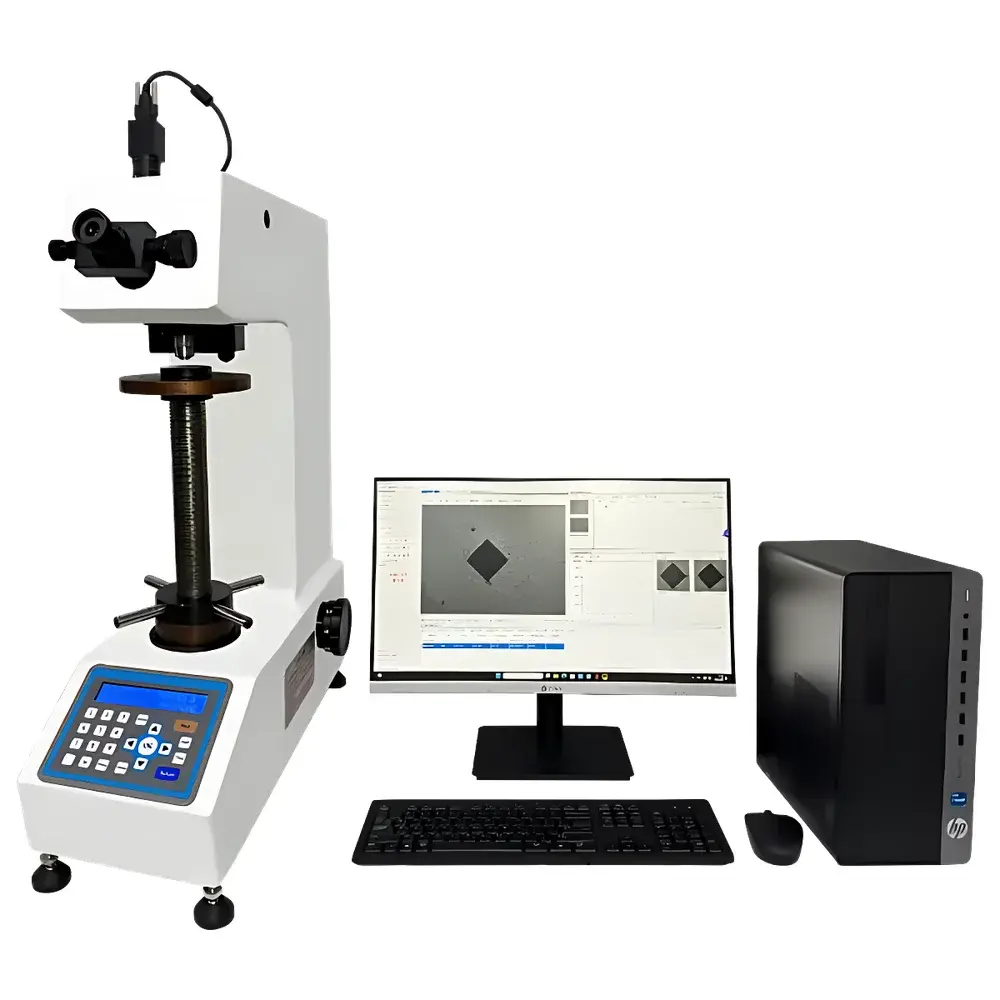
YANRUN HMAS-D5Z/D10Z/D30Z/D50Z Automated Vickers Hardness Testing System
| Brand | YANRUN |
|---|---|
| Origin | Shanghai, China |
| Manufacturer Type | Direct Manufacturer |
| Region of Origin | Domestic (China) |
| Model | HMAS-D5Z / HMAS-D10Z / HMAS-D30Z / HMAS-D50Z |
| Instrument Type | Vickers Hardness Tester |
| Measuring Range | 8–3000 HV |
| Test Force Options | 0.2–50 kgf (6–60 kgf range across models) |
| Standards Compliance | GB/T 4340, ISO 6507 |
| Minimum Detection Unit | 0.06 µm (at 20× objective) |
| Max Specimen Height | 235 mm |
| Depth from Indenter Center to Chamber Wall | 130 mm |
| Power Supply | AC 220 V / 50 Hz |
| Dimensions (L×W×H) | 570 × 220 × 680 mm |
| Net Weight | 54.0 kg |
| Gross Weight | 72.0 kg |
Overview
The YANRUN HMAS-D5Z/D10Z/D30Z/D50Z Automated Vickers Hardness Testing System is an integrated micro- and macro-hardness measurement platform engineered for precision, repeatability, and regulatory readiness in metallurgical laboratories, quality control departments, and R&D facilities. Based on the standardized Vickers indentation principle—where a diamond pyramid indenter (136° apex angle) is applied under controlled load to produce a geometrically defined impression—the system delivers quantitative hardness values expressed in HV (Vickers Hardness Number), calculated from the diagonal length of the residual impression measured optically. Designed to comply fully with ISO 6507-1 and GB/T 4340.1, the system supports both microhardness (down to 0.2 kgf) and macrohardness (up to 50 kgf) testing regimes within a single mechanical architecture. Its closed-loop force actuation, real-time bidirectional communication between controller and software, and millisecond-level response ensure stable loading profiles and minimal thermal drift—critical for high-reproducibility measurements across heterogeneous materials such as case-hardened steels, thin coatings, sintered carbides, and additive-manufactured alloys.
Key Features
- Fully automated turret rotation: Software-commanded, silent switching between Vickers indenter and dual-magnification objectives (10×/20×), eliminating manual intervention and positional error.
- Intelligent load recognition: Automatic detection of selected test force (e.g., 0.3 kgf, 5 kgf, 30 kgf) ensures correct calibration mapping and prevents misapplication of load ranges.
- Triple-phase indentation control: Fully programmable loading, dwell (0–60 s, 1 s increments), and unloading sequence with ≤0.1% repeatability across ≥10 consecutive indentations per test site.
- Modular GUI architecture: Drag-and-drop interface panels, customizable workspaces, and one-click access to frequently used functions—including batch mode initiation and CPK report generation.
- Advanced image processing engine: 13 real-time background enhancement algorithms adapt dynamically to material reflectivity, grain contrast, and surface finish—ensuring consistent edge detection across polished metals, nitrided layers, and ceramic composites.
- Micron-precision positioning: Optical encoder-guided XY stage with grid-based path planning and visual step-distance overlay for case depth profiling; tangent-line placement accuracy of ±0.1 µm.
- Multi-view data synchronization: Simultaneous display of indentation map, hardness distribution curve, and statistical histogram—all linked in real time; individual views exportable as SVG, PNG, or CSV.
Sample Compatibility & Compliance
The HMAS series accommodates specimens up to 235 mm in height and 130 mm from indenter center to chamber interior wall—enabling evaluation of large forged components, heat-treated gears, and welded joints without sectioning. The system supports both bulk metallics and layered structures (e.g., carburized, nitrided, PVD/CVD-coated substrates) via adjustable illumination intensity, polarized lighting options, and multi-threshold segmentation for interfacial hardness gradients. All hardware and firmware conform to ISO/IEC 17025 requirements for testing laboratories. Measurement traceability is maintained through NIST-traceable reference blocks (e.g., HBW 10/3000, HV 10/1000), and audit trails—including operator ID, timestamp, force profile logs, and image metadata—are retained per GLP/GMP principles. While not FDA 21 CFR Part 11–certified out-of-the-box, the software architecture supports electronic signature integration and configurable user-role permissions for regulated environments.
Software & Data Management
YANRUN’s proprietary HMAS Analysis Suite (v5.2+) provides comprehensive data lifecycle management—from acquisition to reporting. Each indentation generates a QR-coded “micro-report” embedding raw image, measurement coordinates, force/dwell parameters, and statistical deviation metrics; scanning the QR code opens a browser-based viewer with full metadata and export controls. The software supports six operational modes: manual point-and-measure, semi-automatic grid scan, full-auto serial mapping, line-scan profiling, multi-site batch analysis, and custom script-driven workflows (via Python API). Reports are template-driven and include embedded CPK/Ppk charts, Gage R&R summaries, and ASTM E384-compliant uncertainty estimates. Export formats include PDF/A-2b (archival), XLSX (with formula-locked cells), and XML (for LIMS integration). Audit logs record all parameter changes, image annotations, and report revisions with immutable timestamps.
Applications
This system serves critical roles in failure analysis labs assessing decarburization depth in bearing steels; aerospace QA teams validating heat treatment uniformity in Ti-6Al-4V turbine blades; and academic researchers quantifying hardness evolution during laser cladding or friction stir welding. It is routinely deployed for evaluating diffusion barrier integrity in nuclear fuel cladding, measuring gradient hardness in functionally graded materials (FGMs), and certifying hardness compliance in automotive powertrain components per ISO 6507-4 Annex A. The D5Z/D10Z variants are optimized for thin-film and small-part metrology (e.g., MEMS devices, dental alloys), while the D30Z/D50Z configurations meet ASTM E92 requirements for heavy-section structural steels and cast irons.
FAQ
What standards does the HMAS system comply with?
It meets ISO 6507-1 (Vickers hardness testing — Part 1: Test method), ISO 6507-4 (Tables of hardness values), and GB/T 4340.1–2012 (Chinese national standard equivalent). Calibration verification follows ISO 6507-3 procedures.
Can the system perform case depth analysis?
Yes—using programmable line-scan mode with configurable step size (1–100 µm), automatic edge-detection thresholding, and built-in Hardeness Gradient Plot (HGP) calculation per ISO 2639.
Is remote operation supported?
The system operates over LAN/WAN via secure RDP or VNC; however, live camera streaming and real-time control require local network latency <50 ms for optimal responsiveness.
How is measurement uncertainty estimated?
Uncertainty budgets incorporate contributions from indenter geometry tolerance (±0.5° apex angle), optical magnification error (±0.8%), diagonal measurement repeatability (≤0.1%), and force calibration uncertainty (±0.5% of reading), per ISO/IEC Guide 98-3 (GUM).
Does the software support multi-user role management?
Yes—administrators can define roles (e.g., Operator, Supervisor, QA Reviewer) with granular permissions for method editing, result approval, report generation, and audit log access.



