
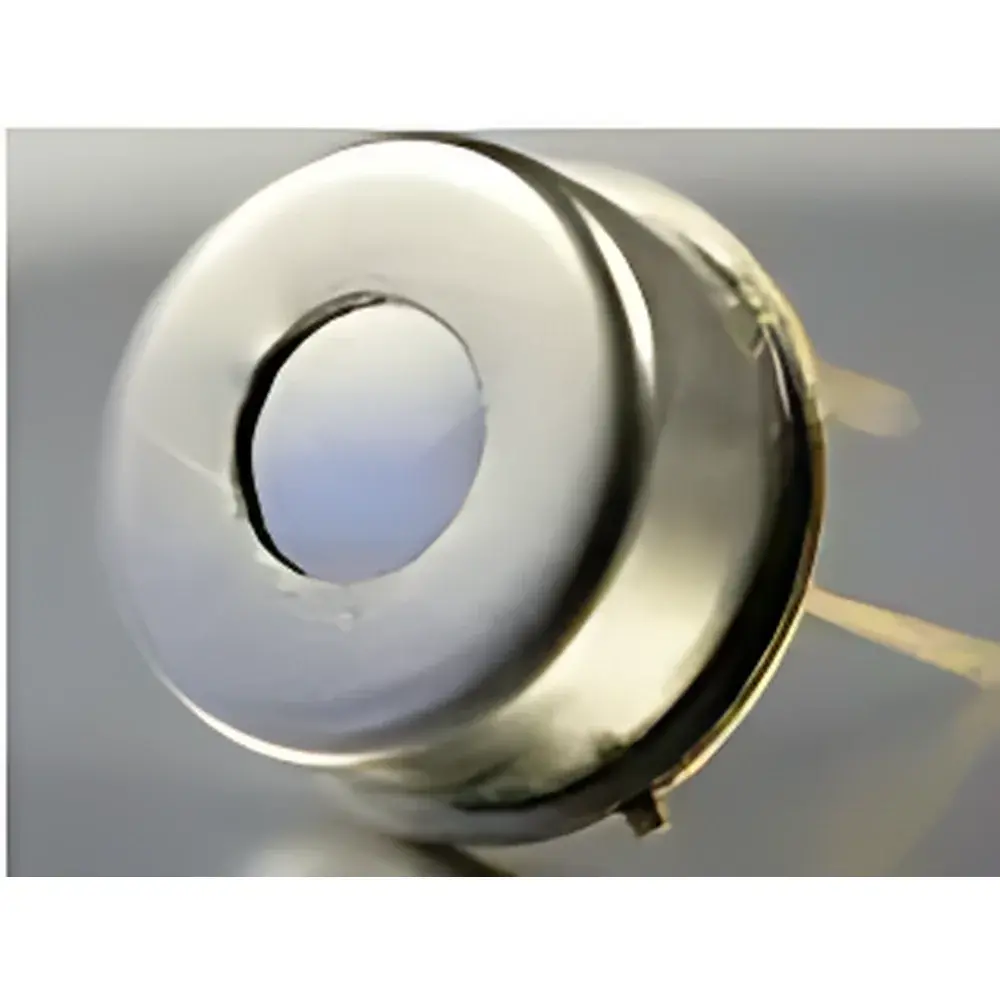
NewOpto RD Series Silicon Radiation Detectors
| Brand | First Sensor |
|---|---|
| Model | newopto |
| Type | Silicon PIN Photodiode-Based Ionizing Radiation Detector |
| Active Area Range | 0.5–100 mm² |
| Dark Current | 0.005–5 nA (typ.) |
| Gamma Energy Threshold | >1 keV (X0.5–γ to X10–γ) |
| Package Options | TO-8S, TO-39, LCC10, CerPin |
| Spectral Response | 0.1–20 keV (Si absorption edge-dependent) |
| Depletion Depth | Fully depleted, 300–500 µm |
| Operating Temperature | –20 °C to +50 °C |
| Bias Voltage | –5 V to –100 V (reverse bias, model-dependent) |
Overview
The NewOpto RD Series comprises a family of silicon-based PIN photodiode radiation detectors engineered for precise detection and quantification of low-energy ionizing radiation—including soft X-rays, gamma photons, and charged particles—in laboratory and industrial measurement environments. These detectors operate on the principle of charge carrier generation via photoelectric absorption and electron-hole pair creation in fully depleted silicon bulk material. Their high atomic number (Z = 14) and optimized depletion depth enable efficient stopping power for photons in the 0.1–20 keV range, while ultra-low dark current (<5 nA, down to 5 pA in selected variants) ensures exceptional signal-to-noise ratio at low count rates and sub-keV energy thresholds. Designed for integration into spectroscopic, dosimetric, and beam-monitoring systems, the RD Series complies with fundamental requirements for radiation detection in physics education labs, nuclear instrumentation calibration setups, and synchrotron beamline diagnostics.
Key Features
- Fully depleted silicon active layer (300–500 µm thickness) enabling high quantum efficiency across soft X-ray and low-energy gamma bands
- Ultra-low dark current (as low as 0.005 nA at –5 V bias), minimizing thermal noise and supporting high-sensitivity pulse-height analysis
- Multiple active area options—from Ø0.8 mm (0.5 mm²) to 10 × 10 mm (100 mm²)—to balance spatial resolution, detection efficiency, and capacitance-limited bandwidth
- Hermetically sealed packages including TO-8S, TO-39, LCC10, and ceramic-pin (CerPin) variants for stable long-term operation under vacuum or controlled-atmosphere conditions
- Standard reverse-bias compatibility (–5 V to –100 V), allowing flexible optimization of charge collection speed and spectral linearity
- No internal amplification—designed for external low-noise charge-sensitive preamplifiers (e.g., ORTEC 142A, Cremat CR-110), preserving pulse shape fidelity for energy-resolved applications
Sample Compatibility & Compliance
The RD Series is compatible with standard radiation sources used in academic and metrology laboratories—including 55Fe (5.9 keV Mn Kα), 241Am (59.5 keV), and 109Cd (22.1 keV)—and supports quantitative measurements traceable to NIST SRM standards when paired with calibrated preamplifier/digitizer chains. All detectors meet RoHS Directive 2011/65/EU and are manufactured in accordance with ISO 9001-certified processes. While not certified for medical or safety-critical use per IEC 61508 or IEC 62304, the devices conform to general-purpose radiation detection guidelines outlined in ASTM E1733-18 (Standard Guide for Use of Detectors in Radiological Measurements) and support GLP-compliant data acquisition workflows when integrated with audit-trail-enabled software platforms.
Software & Data Management
These detectors do not include embedded firmware or onboard processing; they interface exclusively via analog output (current pulse or integrated charge) to external spectroscopy systems. Compatible data acquisition ecosystems include ORTEC’s Maestro-32, Amptek’s DPPMCA, and open-source frameworks such as PyMCA and SpecTcl. When deployed in regulated environments, users may implement 21 CFR Part 11-compliant electronic signatures and audit trails through validated third-party DAQ software—provided hardware-level timestamping and raw waveform logging are preserved. Detector calibration files (energy-channel mapping, gain/offset, FWHM vs. energy) are typically stored in standard .cal or .mca formats and can be imported into MATLAB, Python (NumPy/SciPy), or LabVIEW for advanced spectral deconvolution and background subtraction.
Applications
- X-ray fluorescence (XRF) elemental analysis in benchtop micro-XRF systems
- Low-energy gamma spectroscopy for environmental radionuclide screening (e.g., 210Pb, 241Am)
- Beam intensity monitoring and position sensing in synchrotron and plasma diagnostic setups
- Educational experiments in nuclear physics labs—including Compton scattering verification and half-life determination
- Particle-induced X-ray emission (PIXE) detection in ion beam analysis facilities
- Integration into compact radiation survey meters and handheld spectrometers requiring high-resolution, low-power solid-state detection
FAQ
What radiation types can the RD Series detect?
It detects ionizing photons (X-rays and low-energy gamma rays) and charged particles (e.g., alpha, beta) incident on the silicon surface—provided their energy exceeds the detector’s effective threshold (~1 keV for thin-window variants).
Is cooling required for optimal performance?
Thermoelectric (Peltier) cooling is optional but recommended for extended counting periods (>1 hr) or sub-100 eV energy resolution goals; uncooled operation is suitable for routine qualitative surveys and count-rate applications.
Can these detectors be used in vacuum environments?
Yes—TO-8S, TO-39, and CerPin packages are vacuum-compatible and rated for pressures down to 10−7 mbar; LCC10 requires evaluation of epoxy outgassing in ultra-high vacuum contexts.
Do you provide calibration certificates?
Calibration is system-level and application-specific; NewOpto supplies typified responsivity curves and dark current specifications per batch. Full NIST-traceable calibration must be performed by end-users or accredited metrology labs using reference sources.
What is the maximum count rate before pulse pile-up becomes significant?
Depends on preamplifier shaping time and detector capacitance; typical upper limits range from 5 kcps (for 100 mm² LCC10 with 1 µs shaping) to >100 kcps (for Ø0.8 mm TO-8S with fast CR-RC filtering).






