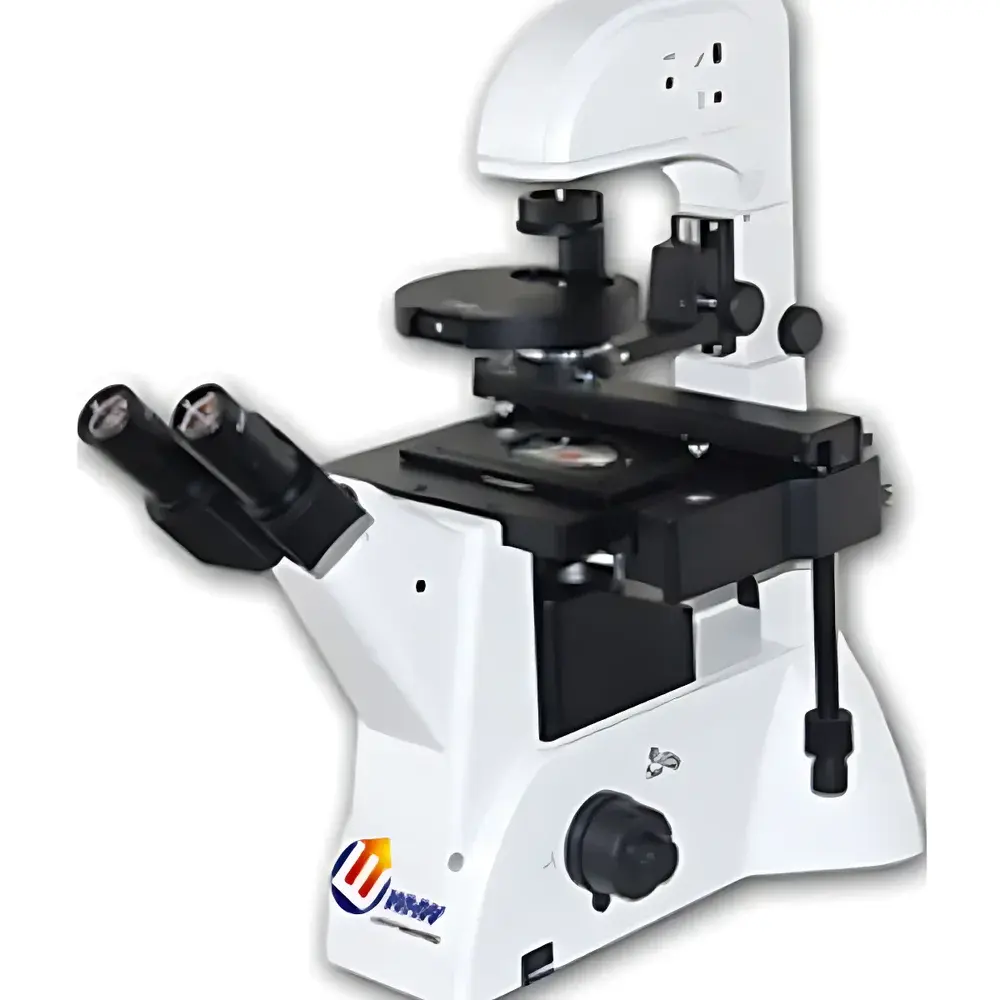
YANRUN BID-400 Inverted Polarized Modulation Contrast Microscope
| Brand | YANRUN |
|---|---|
| Origin | Shanghai, China |
| Manufacturer Type | Direct Manufacturer |
| Product Category | Domestic (China-Made) |
| Model | BID-400 Inverted Polarized Modulation Contrast Microscope |
| Instrument Type | Inverted Microscope |
| Eyepiece Configuration | Binocular |
| Optical Magnification Range | 100×–400× |
| Mechanical Tube Length | Infinity (∞) |
| Object Distance (Infinity-Corrected) | ∞ |
| Eyepieces | Widefield WF10X (Φ22 mm), Centering Eyepiece |
| Interpupillary Distance | 53–75 mm |
| Eyepiece Port Diameter | Φ30 mm |
| Parfocal Distance | 10 mm |
| Objective Types | Infinity-Corrected Long Working Distance Plan Achromatic (PLL), Phase Contrast (PHP), and Modulation Contrast (MC) Objectives (Cover Slip Thickness: 1.2 mm) |
| Objective Specifications | 10X/0.25 (WD 19.4 mm / 4.3 mm), 20X/0.40 (WD 8.0 mm), 40X/0.60 (WD 3.5 mm) |
| Nosepiece | Quintuple Revolving Nosepiece |
| Condenser | Long Working Distance Condenser (WD 55 mm), Rotating or Sliding Modulation Contrast Annulus System |
| Stage | Dual-Layer Mechanical Stage (227 × 208 mm), Travel Range 77 × 134.5 mm, Removable Scale Rule |
| Focusing Mechanism | Coaxial Coarse/Fine Focus, Fine Adjustment Graduation: 2 µm per division |
| Petri Dish Adapters | Three Interchangeable Plates (86×129.5 mm, 34×77.5 mm, 57×82 mm) |
| Illumination | 6 V / 30 W Halogen Lamp with Continuously Adjustable Brightness |
| Optional Upgrades | High-Power LED Illumination, Hexapod Nosepiece, Variable Aperture Iris Diaphragm, Additional Phase & MC Objectives |
Overview
The YANRUN BID-400 Inverted Polarized Modulation Contrast Microscope is an engineered solution for live-cell observation, dynamic tissue culture monitoring, and birefringent material analysis in academic research laboratories, pharmaceutical QC environments, and biotechnology development facilities. Designed around an infinity-corrected optical pathway, the BID-400 integrates three complementary contrast modalities—brightfield, phase contrast, and modulation contrast—within a single inverted platform optimized for bottom-mounted specimen observation. Its polarized illumination capability enables quantitative assessment of anisotropic structures such as collagen fibers, muscle sarcomeres, crystalline proteins, and polymerized cytoskeletal components. The microscope’s long working distance (up to 55 mm condenser WD and ≥3.5 mm objective WD at 40×) ensures unobstructed access to standard and specialized culture vessels—including T-flasks, roller bottles, and multi-well plates—without mechanical interference during imaging or micromanipulation.
Key Features
- Hinged binocular head inclined at 45°, with interpupillary adjustment (53–75 mm) and parfocal widefield eyepieces (WF10X, Φ22 mm field number) for ergonomic extended-use operation.
- Robust inverted frame with reinforced coaxial fine-focus mechanism (2 µm graduation) and automatic end-stop protection to prevent objective collision during coarse focusing.
- Dual-layer mechanical stage (227 × 208 mm) with calibrated X–Y travel (77 × 134.5 mm) and removable metric scale rule for precise positional referencing across time-lapse experiments.
- Integrated long working distance condenser (55 mm) featuring interchangeable rotating or sliding modulation contrast annuli—compatible with dedicated MC objectives (10×/0.25, 20×/0.40, 40×/0.60) and calibrated for 1.2 mm cover slip thickness.
- Triple-mode illumination system: adjustable 6 V / 30 W halogen source with heat-absorbing filter; optional high-efficiency LED upgrade available for stable color temperature and reduced thermal load on live specimens.
- Rear-mounted C-mount (Φ30 mm) imaging port enabling simultaneous photomicrography or videomicroscopy without occluding the visual path—optimized for low-light CCD/CMOS sensor coupling with 100% light transmission efficiency.
Sample Compatibility & Compliance
The BID-400 accommodates standard and custom culture formats via three interchangeable petri dish adapters—supporting Ø87.5 mm, Ø68.5 mm, and rectangular dishes up to 86 × 129.5 mm. Its modular condenser design permits rapid switching between brightfield, phase contrast, and modulation contrast modes without realignment. The system complies with ISO 10934-1:2003 (microscope nomenclature and performance standards) and adheres to fundamental optical safety requirements per IEC 61010-1 for laboratory equipment. While not pre-certified for GMP-regulated production environments, its mechanical stability, reproducible focus repeatability, and traceable calibration pathways support GLP-aligned documentation protocols when integrated into validated workflows.
Software & Data Management
The BID-400 operates as a hardware platform compatible with third-party imaging software suites including NIS-Elements (Nikon), ZEN Blue (Zeiss), and open-source solutions such as FIJI/ImageJ. Its standardized C-mount interface and analog video output (optional USB 3.0 camera integration) ensure seamless data acquisition across Windows and Linux-based acquisition stations. For regulated environments, users may implement FDA 21 CFR Part 11-compliant audit trail modules via external image management systems—provided instrument metadata (objective ID, magnification, contrast mode, exposure settings) is logged alongside captured frames.
Applications
- Long-term time-lapse imaging of adherent mammalian cell lines (e.g., HeLa, NIH/3T3) under physiological conditions using modulation contrast for enhanced edge definition without staining.
- Real-time monitoring of mitotic progression, cytokinesis, and organelle trafficking in primary neurons or stem cell-derived organoids.
- Qualitative and semi-quantitative birefringence analysis of extracellular matrix remodeling in 3D collagen gels or decellularized scaffolds.
- Quality control inspection of microcarrier-based suspension cultures in bioreactors, leveraging phase contrast for viability assessment without trypan blue.
- Teaching laboratory deployment for comparative instruction in optical contrast mechanisms—particularly the differentiation between phase shift (phase contrast) and amplitude gradient (modulation contrast) visualization principles.
FAQ
Is the BID-400 suitable for fluorescence imaging?
No—the base configuration lacks epi-illumination, excitation filters, dichroic mirrors, or emission filter sets required for fluorescence microscopy. Fluorescence-capable variants are not offered.
Can the microscope be upgraded to accommodate DIC (Differential Interference Contrast)?
Not natively—the optical train does not include prism slots or strain-free objectives necessary for DIC. Modulation contrast remains the highest-resolution label-free alternative supported.
What is the maximum recommended working distance for objective immersion in culture medium?
All MC and phase objectives are corrected for 1.2 mm cover slip thickness and air immersion; direct immersion in aqueous media is not advised without dedicated water-dipping or silicone-oil objectives.
Does the system include calibration certificates or traceable metrology documentation?
Factory calibration data for magnification accuracy and parfocality is provided; NIST-traceable certification requires third-party metrology service engagement.
Are replacement parts and service support available outside mainland China?
Yes—YANRUN maintains authorized distribution partners in Southeast Asia, the Middle East, and Eastern Europe; technical documentation and spare optics are distributed under ISO 9001-compliant logistics channels.