
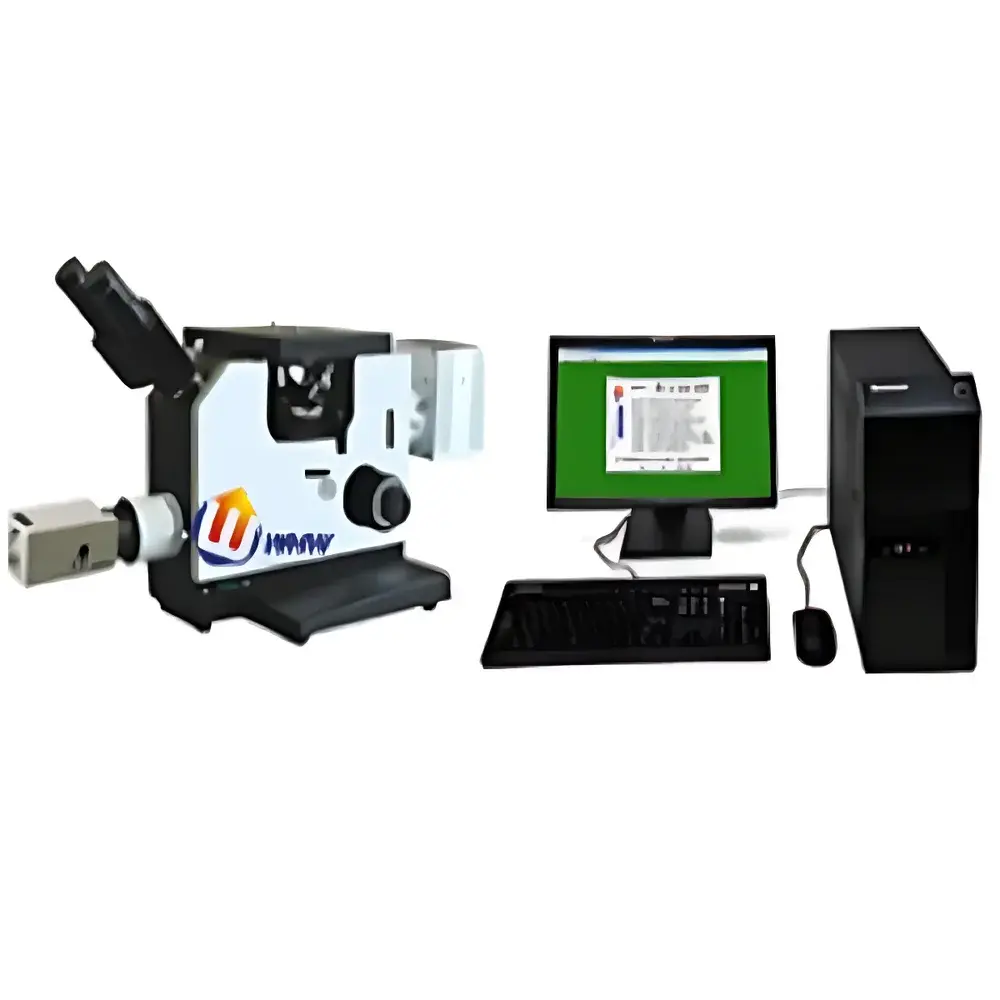
YANRUN AMM-8ST Large-Scale R&D Inverted Horizontal Metallurgical Microscope
| Brand | YANRUN |
|---|---|
| Origin | Shanghai, China |
| Manufacturer Type | Direct Manufacturer |
| Product Type | Inverted |
| Eyepieces | Wide-Field WF10X (Φ18 mm) |
| Objectives | 4X, 10X, 20X, 40X |
| Optical Total Magnification | 40–400× |
| Optional Total Magnification | 25–1000× |
| Coaxial Coarse/Fine Focus (Coarse travel | 15 mm |
| Fine graduation | 0.002 mm / 2 µm) |
| Reflected Illumination | 6 V / 30 W Halogen Lamp with Brightness Control |
| Power Supply | 220 V / 50 Hz |
| System Configurations | Base Unit Only |
Overview
The YANRUN AMM-8ST is a precision-engineered inverted horizontal metallurgical microscope designed for demanding materials science research, metallurgical quality control, and advanced failure analysis in industrial R&D laboratories. Its inverted configuration places the objective lenses beneath the specimen stage—enabling stable observation of large, heavy, or irregularly shaped metallic samples (e.g., castings, weldments, heat-treated components, or cross-sectioned bulk specimens) without mechanical interference from top-mounted optics. The system operates on standard brightfield reflected-light illumination principles, optimized for high-contrast visualization of polished and etched metallographic surfaces. Engineered for long-term dimensional stability and thermal consistency, the AMM-8ST features a rigid cast-aluminum base and horizontally oriented optical path—minimizing vibration coupling and facilitating seamless integration with auxiliary measurement hardware such as microhardness testers or in-situ thermal stages.
Key Features
- Inverted horizontal optical architecture supporting oversized specimens up to 180 × 155 mm on a dual-layer mechanical stage with 75 × 50 mm travel range and calibrated vernier scales.
- Trinocular viewing head with 45° inclined eyepiece tubes, adjustable interpupillary distance (55–75 mm), and beam-splitter capability for simultaneous visual observation and digital imaging.
- Standard wide-field WF10X (Φ18 mm) eyepieces; optional upgrades include Huygens 5X, wide-angle 10X (Φ20 mm), and 12.5X oculars for extended field-of-view and ergonomic viewing.
- Parfocal, achromatic objective set (4X, 10X, 20X, 40X) with optional plan achromat additions (2.5X, 100X) for improved flatness and chromatic correction across the field.
- Coaxial coarse/fine focusing mechanism with 15 mm vertical travel and 0.002 mm (2 µm) fine-focus graduation—designed for repeatable, high-resolution depth profiling of layered microstructures.
- Reflected illumination system featuring a 6 V / 30 W halogen lamp with continuous brightness control and integrated heat-absorbing filter to prevent thermal distortion during prolonged observation.
Sample Compatibility & Compliance
The AMM-8ST accommodates standard metallographic specimens prepared per ASTM E3, ISO 643, and GB/T 13298. Its inverted design permits direct mounting of unmounted bulk sections, large-diameter rods, or finished components without sectioning—reducing preparation artifacts and enabling correlation between macro- and microstructural features. The stage’s load capacity exceeds 5 kg, supporting specimens requiring mechanical clamping or thermomechanical fixtures. All optical components comply with ISO 10110 surface quality standards; illumination uniformity meets ANSI Z80.10 specifications for photometric consistency. The instrument supports GLP-compliant documentation workflows when paired with validated image acquisition software and audit-trail-enabled data processing modules.
Software & Data Management
While the base AMM-8ST configuration does not include embedded image analysis, it is fully compatible with third-party metrology and quantitative metallography platforms—including those compliant with ASTM E112 (grain size), E1245 (inclusion rating), and ISO 9042 (phase fraction analysis). Optional configurations integrate USB 3.0 digital cameras, real-time video capture systems, and dedicated image processing suites offering calibration traceability, multi-point measurement logging, and CSV/PDF report generation. All software interfaces support FDA 21 CFR Part 11–compliant user authentication, electronic signatures, and immutable audit trails for regulated environments.
Applications
- Microstructural characterization of ferrous and non-ferrous alloys, including grain boundary delineation, phase identification, and precipitate morphology analysis.
- Weld quality assessment—heat-affected zone (HAZ) evaluation, fusion line mapping, and porosity quantification in aerospace and power-generation components.
- Failure analysis of fatigue cracks, intergranular corrosion, and stress corrosion cracking in service-exposed parts.
- R&D validation of heat treatment parameters (annealing, quenching, tempering) through comparative microstructure evolution studies.
- Quality assurance of additive manufacturing (AM) metal parts—layer bonding integrity, pore distribution, and residual stress-induced microcracking.
FAQ
Is the AMM-8ST suitable for automated image acquisition and analysis?
Yes—when configured with the optional digital imaging or video image processing system, the microscope supports programmable stage control, focus stacking, and batch image capture via industry-standard SDKs.
Can the system be upgraded with high-magnification oil-immersion objectives?
The standard optical path accommodates dry objectives up to 40X; optional 100X plan achromat objectives are available but require dry operation—oil immersion is not supported due to the inverted illumination geometry.
What electrical safety and EMC standards does the unit meet?
The AMM-8ST complies with IEC 61010-1 for laboratory equipment safety and meets EN 61326-1 for electromagnetic compatibility in industrial environments.
Is stage movement motorized in any configuration?
Motorized XY stage and Z-axis focus drives are available as factory-installed options under the “Data Processing System” configuration package.
Does the microscope support DIC or polarized light contrast methods?
The base model includes only brightfield reflected illumination; DIC and polarization modules can be retrofitted upon request, subject to optical path compatibility verification.



