
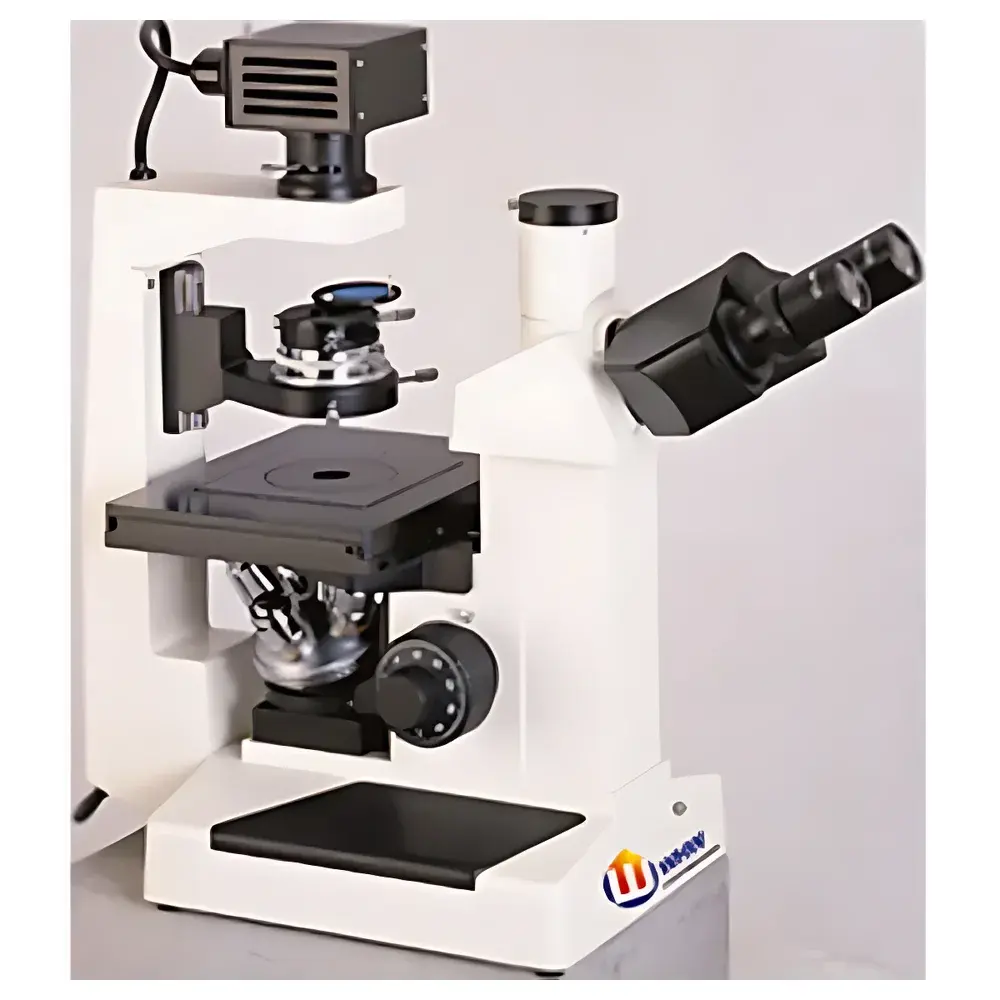
YANRUN BID-100 Inverted Phase Contrast Biological Microscope
| Brand | YANRUN |
|---|---|
| Origin | Shanghai, China |
| Manufacturer Type | Original Equipment Manufacturer (OEM) |
| Product Category | Domestic |
| Model | BID-100 Inverted Phase Contrast Biological Microscope |
| Instrument Type | Inverted Microscope |
| Eyepiece Configuration | Binocular |
| Optical Magnification Range | 100×–400× |
| Mechanical Tube Length | 160 mm |
| Object Conjugate Distance | 195 mm |
| Eyepiece Port Diameter | 23.2 mm |
| Parfocal Distance | 10 mm |
| Eyepieces | Wide-Field WF10× (Φ20 mm), Centering Telescope |
| Long Working Distance Plan Achromatic Objective PLL (Cover Glass Thickness | 1.2 mm): 10×/0.25 (WD 8.8 mm), 25×/0.40 (WD 4.8 mm), 40×/0.60 (WD 3.3 mm) |
| Long Working Distance Plan Achromatic Phase Contrast Objective PHP (Cover Glass Thickness | 1.2 mm): 10×/0.25 (WD 8.8 mm) |
| Trinocular Head | 30° Inclination, Interpupillary Adjustment Range: 53–75 mm |
| Focus Mechanism | Coaxial Coarse/Fine Focus with Locking & Upper/Lower Limit Stops |
| Fine Focus Graduation | 2 µm |
| Nosepiece | Four-Position Internal Ball-Bearing Centered Revolving Turret |
| Stage | Dual-Layer Mechanical Stage, Travel Range: 30 mm × 75 mm |
| Culture Dish Holder Plate I | 99 mm × 105 mm, Inner Groove Ø68 mm (Compatible with Ø68.5 mm Round Petri Dishes) |
| Culture Dish Holder Plate II | 99 mm × 105 mm, Compatible with Rectangular Dishes (34 mm W × 77.5 mm L) |
| Culture Dish Holder Plate III | Outer Diameter 67.5 mm, Inner Aperture 20 mm |
| Condenser | Plug-in Phase Contrast Condenser, Working Distance 30 mm, Integrated Phase Annuli |
| Illumination | 6 V / 20 W Halogen Lamp with Continuously Adjustable Brightness |
| Filters | Blue Filter, Green Filter, Ground Glass Diffuser |
Overview
The YANRUN BID-100 Inverted Phase Contrast Biological Microscope is engineered for high-fidelity observation of unstained, living cells and monolayer cultures in standard tissue culture vessels. Its inverted optical architecture positions the objective lenses beneath the specimen stage—enabling direct access to the sample surface from above—while maintaining optimal working distance for micromanipulation, incubation integration, or long-term time-lapse imaging. The system employs classical Zernike phase contrast optics, converting subtle differences in refractive index and thickness into high-contrast, edge-enhanced monochrome images without chemical fixation or staining. Designed around a 160 mm mechanical tube length and 195 mm object conjugate distance, the BID-100 adheres to legacy optical standards while incorporating modern ergonomic and mechanical enhancements—including parfocalized long-working-distance plan achromatic objectives and precision coaxial focusing with 2 µm fine-adjustment resolution.
Key Features
- Inverted configuration optimized for live-cell imaging in Petri dishes, multi-well plates, and flasks—eliminating interference from vessel bottoms during objective approach
- Dual-mode optical path: standard brightfield and phase contrast imaging via plug-in annular condenser with matched phase rings for 10×, 25×, and 40× objectives
- Long working distance (LWD) plan achromatic phase contrast objectives (PHP series) and standard plan achromats (PLL series), all corrected for 1.2 mm cover glass thickness—ensuring compatibility with common TC-treated plasticware
- Trinocular head (30° inclination) supports simultaneous visual observation, photomicrography, and video capture via C-mount or dedicated DSLR interfaces (Canon EF, Nikon F)
- Robust dual-layer mechanical stage with 30 mm × 75 mm travel range and three interchangeable culture dish holders—including configurations for Ø68.5 mm round dishes, 34 mm × 77.5 mm rectangular dishes, and specialized adapters for 88 mm standard Petri dishes
- Stable 6 V / 20 W halogen illumination with continuous intensity control and integrated blue/green filters and ground glass diffuser for contrast optimization and glare reduction
Sample Compatibility & Compliance
The BID-100 accommodates a broad range of in vitro biological specimens, including adherent mammalian cell lines (e.g., HeLa, NIH/3T3), primary neurons, fibroblasts, and suspension cultures immobilized on coated surfaces. Its 8.8–3.3 mm working distance range allows unobstructed imaging through standard polystyrene and treated plastic substrates. The microscope meets general laboratory safety requirements per IEC 61010-1 and conforms to ISO 10934-1 (optical microscopy—nomenclature and terminology). While not certified for GLP or GMP-regulated environments out-of-the-box, its mechanical reproducibility, parfocal stability, and traceable calibration paths support audit-ready documentation when integrated into validated workflows. Optional USB/VIDEO output modules enable alignment with FDA 21 CFR Part 11-compliant image acquisition systems when paired with appropriate software validation protocols.
Software & Data Management
The BID-100 functions as a hardware platform compatible with third-party imaging software suites such as NIS-Elements (Nikon), ZEN (Zeiss), or open-source alternatives like Fiji/ImageJ. When equipped with optional USB or HDMI video output, it delivers real-time analog/digital streams suitable for frame-grabbing, time-lapse recording, and quantitative morphometric analysis. All digital interfaces maintain native resolution fidelity at the sensor level—no internal interpolation or compression is applied. Metadata tagging (objective magnification, illumination mode, filter selection) can be embedded via external capture software, supporting FAIR (Findable, Accessible, Interoperable, Reusable) data principles in academic and industrial research settings.
Applications
- Real-time monitoring of cell proliferation, migration, and confluence in routine quality control of bioproduction cell banks
- Phase contrast-based assessment of embryoid body formation and stem cell differentiation dynamics
- Pre-screening of transfection efficiency and cytotoxicity prior to endpoint assays
- Observation of microbial biofilm architecture on solid-phase substrates
- Educational demonstration of mitotic stages, organelle motility, and cytoskeletal reorganization in undergraduate and graduate laboratories
- Integration with micropipette-based patch-clamp rigs where vertical access to the specimen is required
FAQ
What types of culture vessels are supported by the BID-100 stage?
The microscope includes three interchangeable holder plates: one for Ø68.5 mm round Petri dishes, one for 34 mm × 77.5 mm rectangular dishes, and a third with 67.5 mm outer diameter and 20 mm inner aperture for specialized inserts. An optional adapter supports 88 mm standard Petri dishes.
Can the BID-100 be used for fluorescence imaging?
No—the base configuration lacks excitation/emission filter sets, dichroic mirrors, or high-intensity LED/laser sources required for fluorescence. It is strictly optimized for transmitted-light contrast techniques (phase contrast and brightfield).
Is the fine focus mechanism calibrated to industry-standard resolution?
Yes—the coaxial fine focus has a graduation value of 2 µm per division, enabling precise z-axis positioning consistent with ISO 8578 recommendations for microscopical measurement repeatability.
Are replacement objectives and phase annuli available as spare parts?
All PLL and PHP series objectives, along with matching phase contrast condenser annuli, are stocked as service parts with documented MTF and wavefront error specifications for recalibration traceability.
Does the BID-100 comply with CE or UL safety directives?
As supplied for the domestic Chinese market, the instrument complies with GB/T 19001 (equivalent to ISO 9001) and CCC certification requirements. CE marking requires additional conformity assessment under EU Machinery Directive 2006/42/EC and Low Voltage Directive 2014/35/EU, which may be arranged upon export order.



