
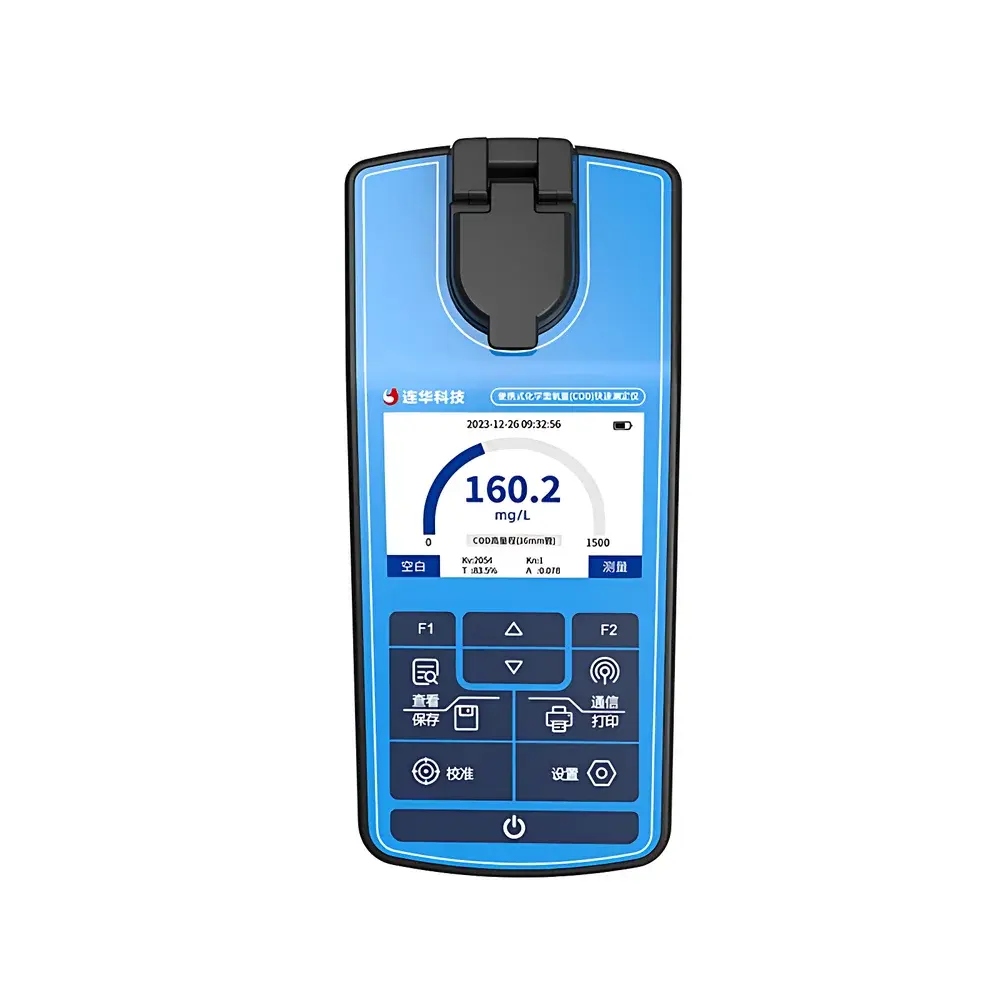
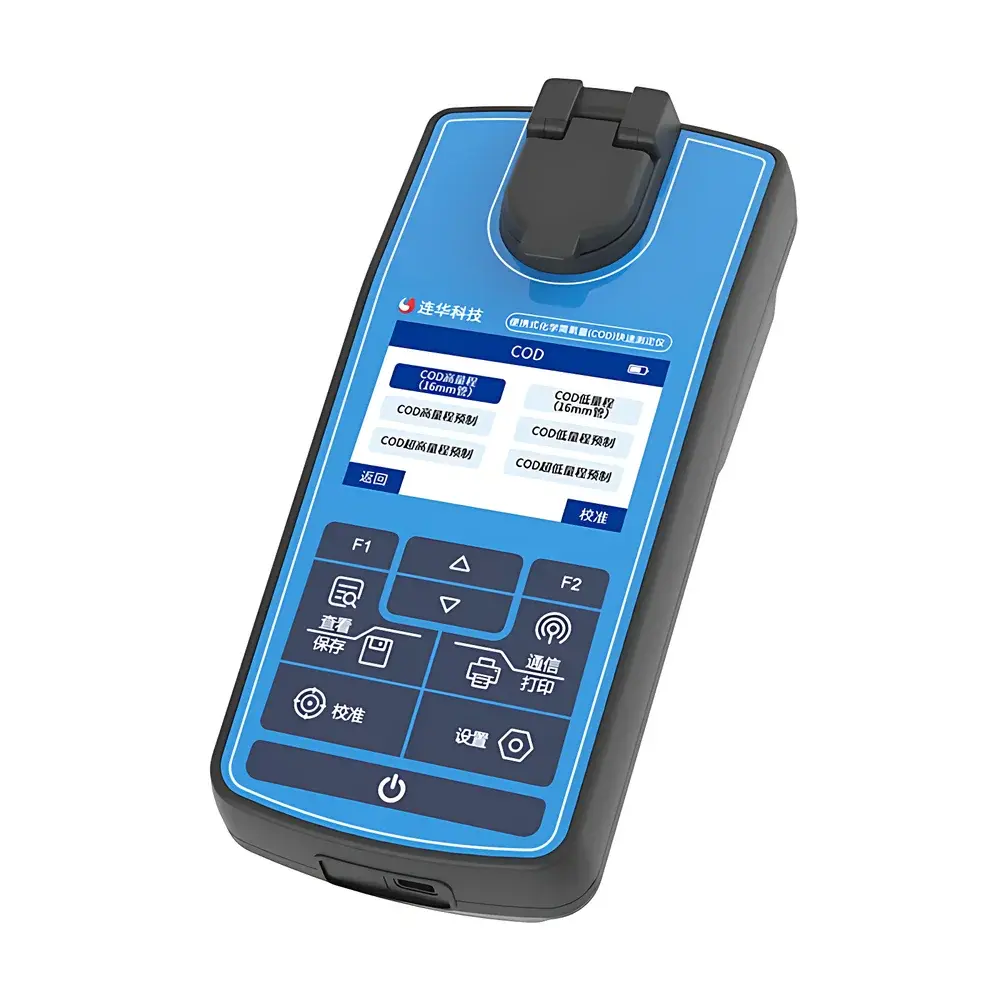
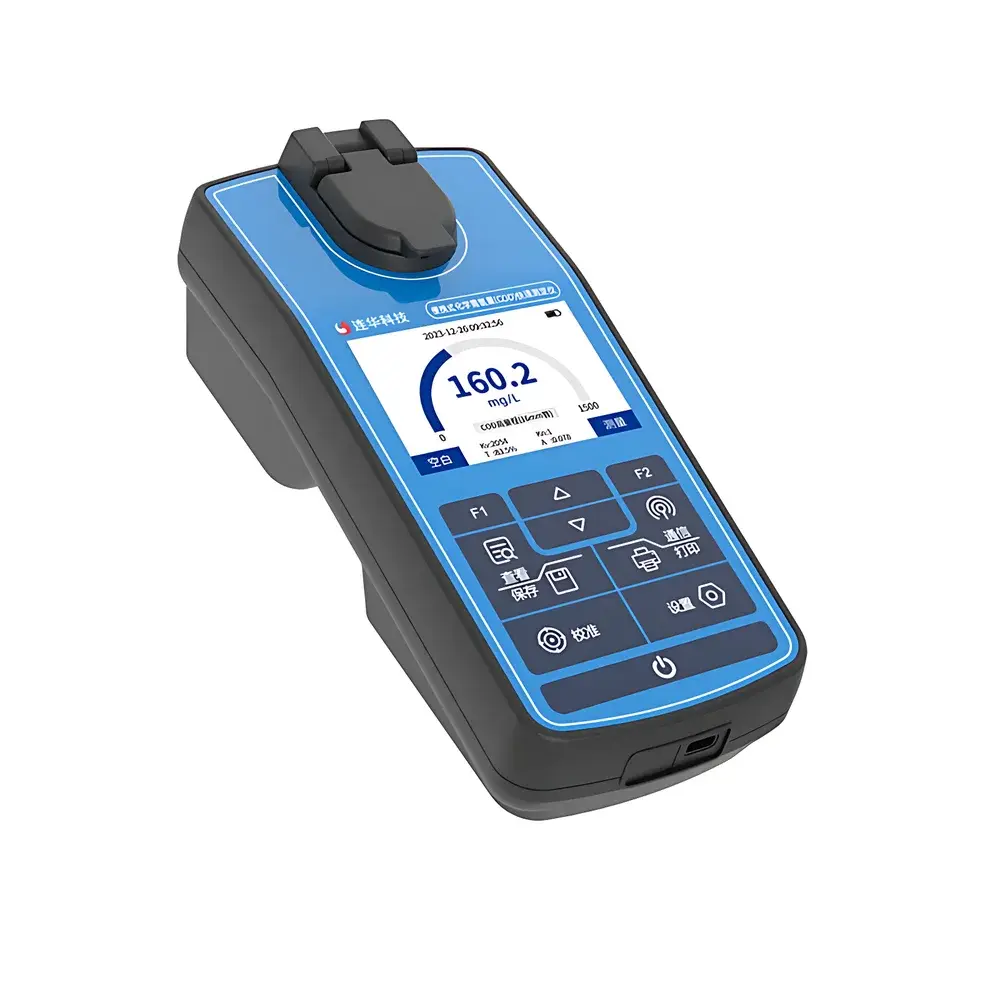
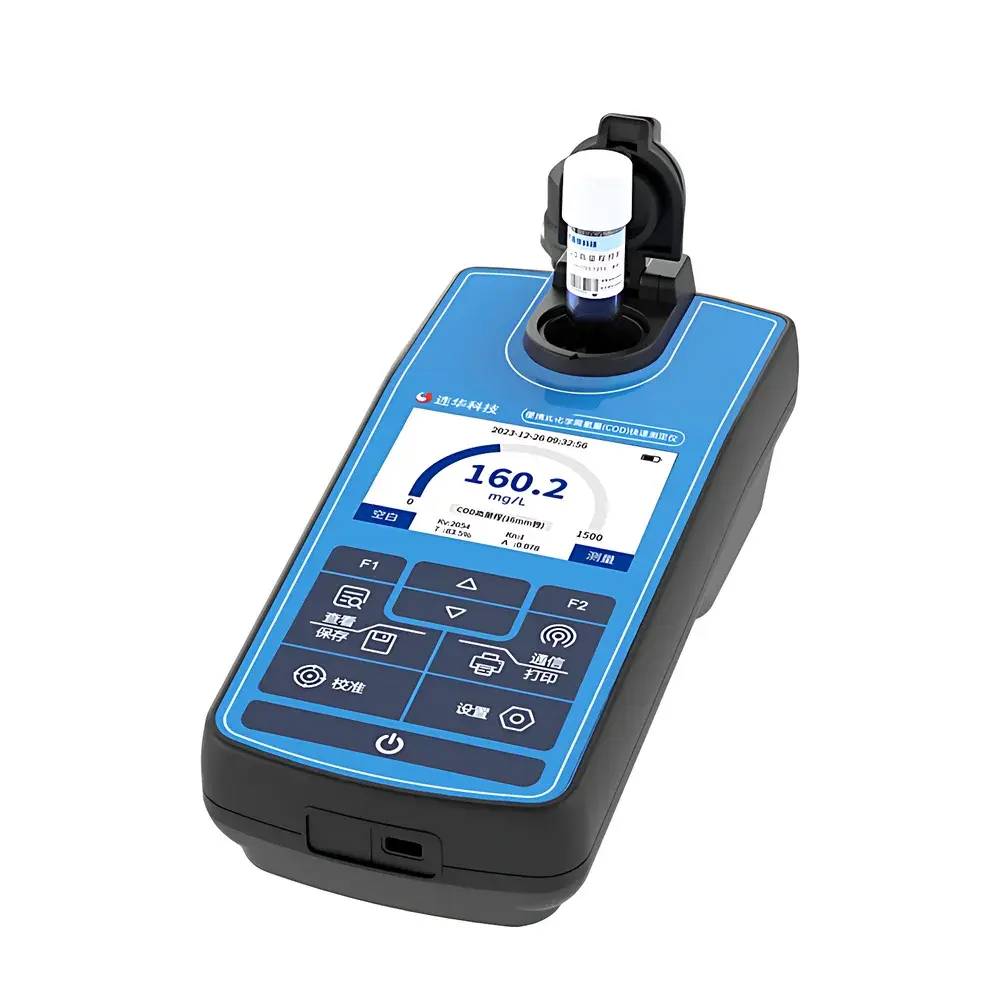
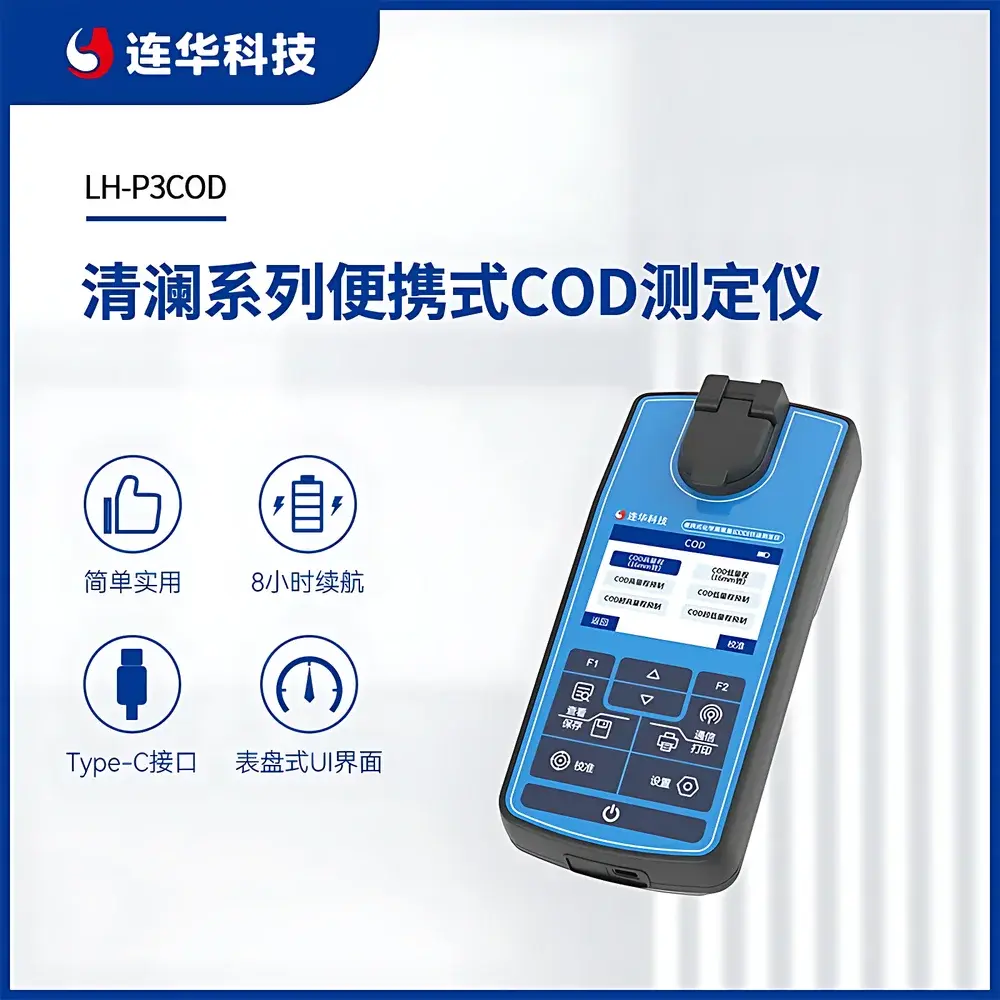
Lianhua LH-P3COD Portable COD Analyzer
| Brand | Lianhua |
|---|---|
| Origin | Beijing, China |
| Manufacturer Type | Direct Manufacturer |
| Regional Classification | Domestic (China) |
| Model | LH-P3COD |
| Instrument Type | Portable |
| Measurement Principle | Potassium Dichromate Digestion Method (Portable) |
| Wavelengths | 420 nm and 610 nm |
| Measurement Range | 0–15,000 mg/L COD |
| Accuracy | ≤ ±8% for values ≤ 50 mg/L |
| Repeatability | ≤ ±3% |
| Batch Processing Capacity | 6 / 9 / 16 / 25 samples (user-selectable) |
Overview
The Lianhua LH-P3COD Portable COD Analyzer is a field-deployable spectrophotometric instrument engineered for rapid, on-site determination of Chemical Oxygen Demand (COD) in water and wastewater samples. It implements the standardized open-reflux potassium dichromate digestion method—aligned with HJ/T 399–2007, the People’s Republic of China Environmental Protection Industry Standard—followed by colorimetric quantification at dual fixed wavelengths (420 nm and 610 nm). This two-wavelength approach enables effective compensation for turbidity and interferences from colored matrices, improving measurement robustness in real-world environmental samples. Designed for operational continuity in resource-constrained settings—including municipal water utilities, industrial effluent monitoring stations, emergency response teams, and field research units—the LH-P3COD integrates digestion heating, optical detection, and data processing into a single handheld platform. Its architecture prioritizes thermal stability during digestion, optical path consistency, and minimal operator dependency—critical attributes for regulatory-compliant field analysis where laboratory infrastructure is unavailable.
Key Features
- Integrated digestion-heating module with precise temperature control (165 °C ± 1 °C), ensuring full oxidation of organic matter per HJ/T 399–2007 protocol.
- 3.5-inch high-resolution color TFT display with dial-style UI interface—enabling direct concentration readout without manual calculation or external software.
- Pre-loaded calibration curves (n = 30), covering both low-range (0–150 mg/L) and high-range (150–15,000 mg/L) COD applications; supports user-defined curve validation and offset correction.
- Optical calibration function using certified neutral-density filters to verify and adjust photometric gain—maintaining long-term absorbance linearity and minimizing drift across extended deployment cycles.
- Configurable batch capacity: interchangeable sample racks support 6, 9, 16, or 25 vials (16 mm OD), accommodating diverse workflow volumes while preserving uniform digestion geometry and thermal homogeneity.
- Over-range alert system: real-time visual indication (red highlight on dial interface) when measured absorbance exceeds calibrated upper limit—preventing misinterpretation of saturated signals.
Sample Compatibility & Compliance
The LH-P3COD accepts standard 16-mm borosilicate glass or quartz digestion vials compatible with Cr(VI)-based reagents. It accommodates raw influent, treated effluent, surface water, groundwater, and industrial process streams—with appropriate dilution and chloride interference mitigation (e.g., HgSO₄ masking) applied per HJ/T 399–2007 guidelines. While not certified to ISO/IEC 17025 under third-party accreditation, the instrument’s methodology conforms to the technical requirements of HJ/T 399–2007 and is routinely validated against reference materials traceable to NIM (National Institute of Metrology, China). Data output meets basic GLP documentation requirements, including timestamped results, batch ID tagging, and operator ID logging (when enabled via optional USB export).
Software & Data Management
Internal firmware stores up to 1,000 test records with metadata (date/time, wavelength used, curve ID, sample ID, operator code). Data export is supported via USB 2.0 to FAT32-formatted drives in CSV format—enabling direct import into LIMS or spreadsheet environments. No proprietary software installation is required. The device supports audit-ready reporting: each exported file includes instrument serial number, firmware version, calibration date, and digest temperature log summary. While not 21 CFR Part 11 compliant out-of-the-box, the immutable CSV structure and timestamp integrity provide foundational traceability suitable for internal QA/QC and regulatory pre-audit preparation.
Applications
- Routine monitoring of municipal wastewater treatment plant influent and effluent compliance points.
- Field verification of industrial discharge permits under local environmental protection bureau oversight.
- Emergency spill response—rapid assessment of organic loading in stormwater runoff or accidental releases.
- Educational laboratories requiring portable, standards-aligned COD training platforms with minimal infrastructure dependency.
- Research expeditions conducting longitudinal water quality surveys across remote watersheds or distributed sampling networks.
FAQ
Does the LH-P3COD require external lab equipment for digestion?
No—the integrated heating block performs complete reflux digestion in situ, eliminating the need for separate hot plates or fume hoods.
Can it measure samples with high chloride content?
Yes—when used with mercury sulfate (HgSO₄) pretreatment per HJ/T 399–2007, it mitigates chloride interference up to 2,000 mg/L Cl⁻.
Is spectral calibration traceable to NIST standards?
The optical calibration routine verifies photometric performance but does not constitute NIST-traceable calibration; users requiring metrological traceability must perform periodic verification with NIST SRM 930e filters.
What power sources are supported in field operation?
Operates on rechargeable Li-ion battery (≥8 hours continuous use) or 12 V DC input—compatible with vehicle power outlets and solar-charged portable power stations.
How frequently should optical calibration be performed?
Recommended before each daily shift or after transport-induced vibration; also advised following exposure to extreme ambient temperature gradients (>15 °C change).
Related Products







