
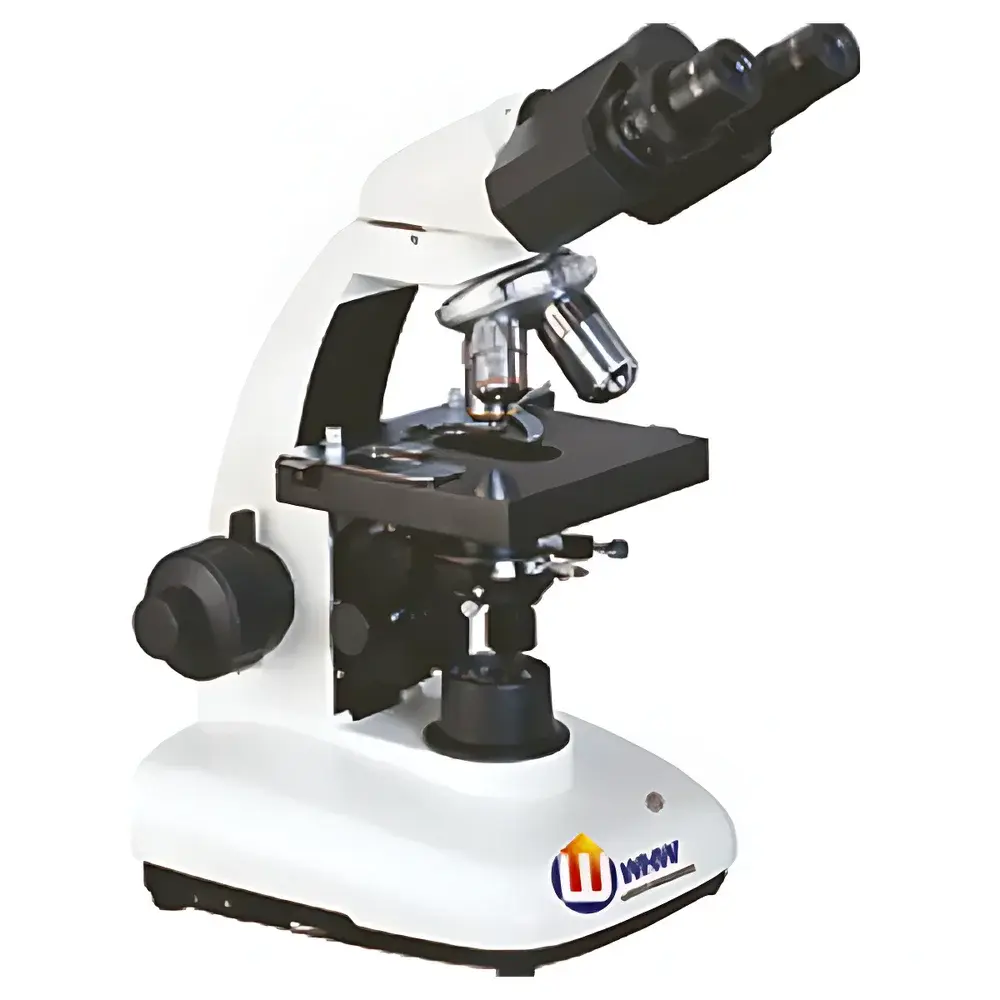
YANRUN BI-19 Biological Inverted Microscope
| Brand | YANRUN |
|---|---|
| Origin | Shanghai, China |
| Manufacturer Type | Direct Manufacturer |
| Product Category | Domestic (China-Made) |
| Model | BI-19 Biological Inverted Microscope |
| Instrument Type | Inverted Microscope |
| Eyepiece Configuration | Binocular |
| Magnification Range | 40×–1000× |
| Eyepieces | Wide-Field WF10× (Φ18 mm) |
| Objectives | Achromatic BI-19A or Semi-Plan Achromatic BI-19B (4×/0.10, 10×/0.25, 40×/0.65 spring-loaded, 100×/1.25 spring-loaded oil-immersion) |
| Interpupillary Adjustment | 55–75 mm |
| Inclined Binocular Tube | 30° tilt |
| Focusing Mechanism | Coaxial coarse/fine focus with adjustable coarse tension, locking knob, and limit stop |
| fine focus graduation | 2 µm |
| Nosepiece | Four-position outward-rolling ball bearing turret with centering mechanism |
| Stage | Dual-layer mechanical stage (135 mm × 125 mm), travel range 75 mm × 35 mm |
| Condenser | Abbe condenser, N.A. 1.25, vertically adjustable |
| Filters | Blue filter, ground glass |
| Illuminator | 6 V / 20 W halogen lamp with brightness control |
| Optional Configurations | Phase contrast (PH-I/PH-II turret, PHP objectives), LED illumination upgrade, polarizing accessories, USB/VIDEO camera adapters, infinite-corrected optical path components, darkfield condensers (dry/wet), extended objective sets (5×, 20×, 60×), reticle eyepieces, teaching twin-head tube |
Overview
The YANRUN BI-19 Biological Inverted Microscope is an engineered platform for routine and advanced live-cell observation, tissue culture monitoring, and in vitro biological assessment. Designed with inverted optical geometry—where the objective lenses are positioned beneath the specimen stage and the condenser above—the BI-19 enables direct, high-stability imaging of cells grown in standard Petri dishes, flasks, and multi-well plates without specimen inversion or mounting. Its optical architecture conforms to classical Köhler illumination principles, supporting both brightfield and optional contrast enhancement modes including phase contrast and polarized light. The microscope employs a finite-conjugate achromatic optical system optimized for consistent color fidelity and minimal spherical/chromatic aberration across its 40×–1000× magnification range. All mechanical subsystems—including coaxial focusing, precision stage translation, and turret indexing—are calibrated for long-term repeatability and operator ergonomics in multi-hour laboratory workflows.
Key Features
- Binocular inclined viewing tube (30° tilt) with interpupillary adjustment (55–75 mm) and diopter compensation for sustained visual comfort during extended observation sessions.
- Coaxial coarse/fine focusing mechanism featuring independently adjustable coarse-focus tension, mechanical lock, upper/lower travel limit stops, and a calibrated fine-focus scale (2 µm per division) for precise Z-axis positioning.
- Four-position nosepiece with outward-rolling ball-bearing indexing for smooth, repeatable objective alignment and reduced mechanical drift during high-magnification work.
- Dual-layer mechanical stage (135 mm × 125 mm) offering 75 mm × 35 mm travel range with vernier-scaled X/Y controls—engineered for stable positioning of culture vessels under varying load conditions.
- Abbe condenser (N.A. 1.25) with full vertical adjustability and centering screws, compatible with standard filter holders and auxiliary modules such as phase contrast annuli or darkfield stops.
- 6 V / 20 W halogen illuminator with continuous dimming control, integrated heat-absorbing glass, and field diaphragm for optimal illumination uniformity and thermal management.
Sample Compatibility & Compliance
The BI-19 accommodates standard ANSI/TIA-1083 compliant cultureware, including 35 mm–150 mm Petri dishes, T-25 to T-225 flasks, and 6–96-well plates. Its low-profile stage clearance and centered optical axis allow unobstructed access for micromanipulation tools, perfusion systems, and environmental chambers. While not certified to ISO 13485 or FDA 21 CFR Part 11 out-of-the-box, the instrument’s mechanical and optical design supports GLP-compliant documentation when paired with validated digital imaging modules (e.g., USB/VIDEO output with timestamped metadata). Optional phase contrast and polarizing configurations comply with ASTM E2877-22 guidelines for qualitative contrast evaluation in unstained biological specimens.
Software & Data Management
The BI-19 itself is an analog optical platform; however, its standardized trinocular port (C-mount or 23.2 mm thread) and USB/VIDEO output options enable integration with third-party imaging software suites—including NIS-Elements (Nikon), ZEN (Zeiss), and open-source platforms like Fiji/ImageJ. When equipped with a compliant CMOS camera module, the system supports acquisition of time-lapse sequences, multi-channel overlays, and measurement annotation with pixel calibration traceability. Audit trails, user permissions, and electronic signatures require external software validation per 21 CFR Part 11—a process managed independently by the end-user’s IT and QA departments.
Applications
- Real-time monitoring of adherent mammalian cell lines (e.g., HeLa, CHO, HEK293) during passage, transfection, or drug treatment assays.
- Qualitative assessment of primary neuron morphology, glial migration, and organoid structural integrity in developmental biology studies.
- Routine quality control of hybridoma cultures and monoclonal antibody production batches.
- Phase contrast imaging of unstained live bacteria, protozoa, and algae without fixation or staining artifacts.
- Teaching laboratories requiring robust, serviceable hardware for undergraduate microscopy training and collaborative observation via dual-head or teaching tube configurations.
- Preliminary screening in regenerative medicine workflows involving mesenchymal stem cell differentiation and scaffold colonization.
FAQ
Is the BI-19 compatible with oil immersion at 100× magnification?
Yes—the BI-19 includes a spring-loaded 100×/1.25 NA oil-immersion objective (BI-19A or BI-19B series) with integrated correction collar and working distance optimization for standard #1.5 coverslips.
Can I upgrade the halogen illumination to LED?
Yes—YANRUN offers interchangeable LED illuminators (9 V DC input, white light, CRI > 80) with identical mechanical footprint and power interface compatibility.
Does the microscope support phase contrast without modification?
No—phase contrast requires optional PH-I or PH-II turret-mounted condensers and matched PHP-series objectives; these are factory-installed or retrofitted as accessory kits.
What is the maximum specimen height clearance beneath the objectives?
Approximately 45 mm from stage surface to lowest objective front lens (with 4× objective engaged); clearance reduces progressively with higher-magnification objectives.
Are calibration certificates available for the fine-focus scale?
The 2 µm fine-focus graduation is factory-verified using interferometric reference standards; formal ISO/IEC 17025 calibration reports are available upon request through YANRUN’s Shanghai quality assurance department.



