
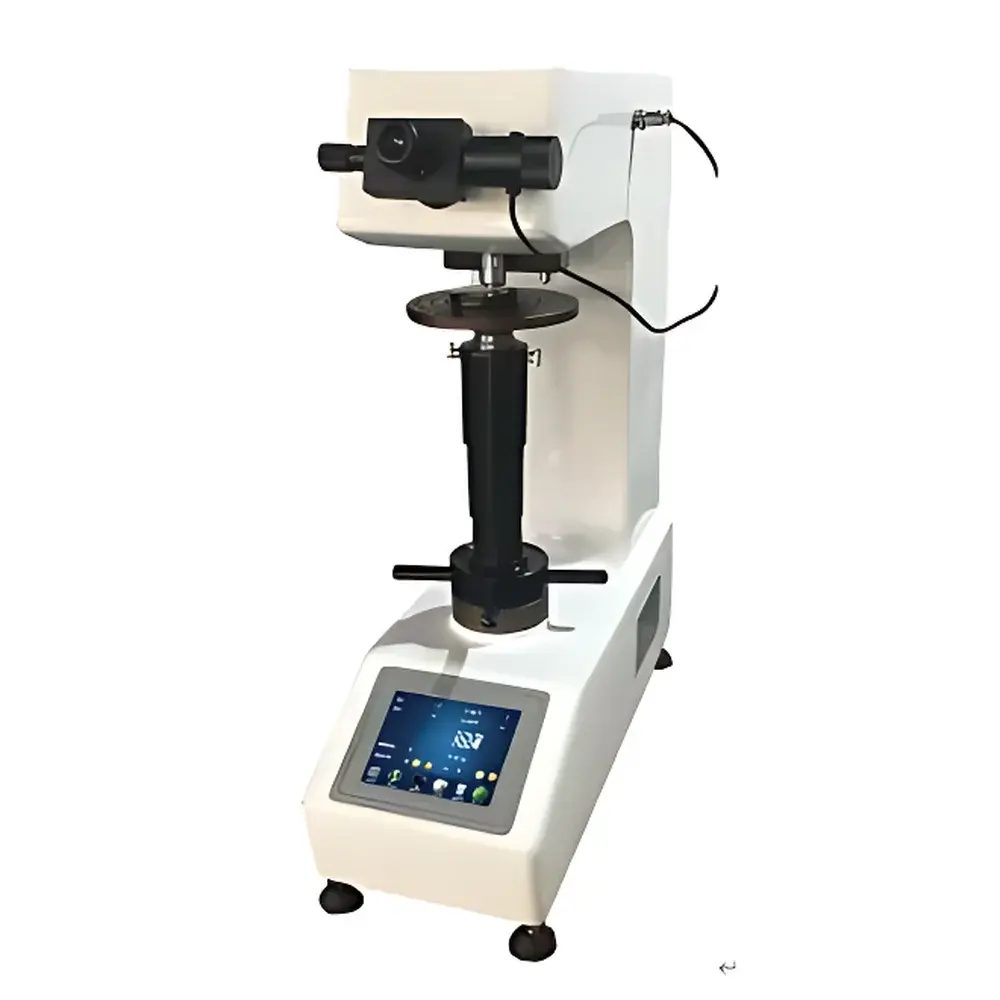
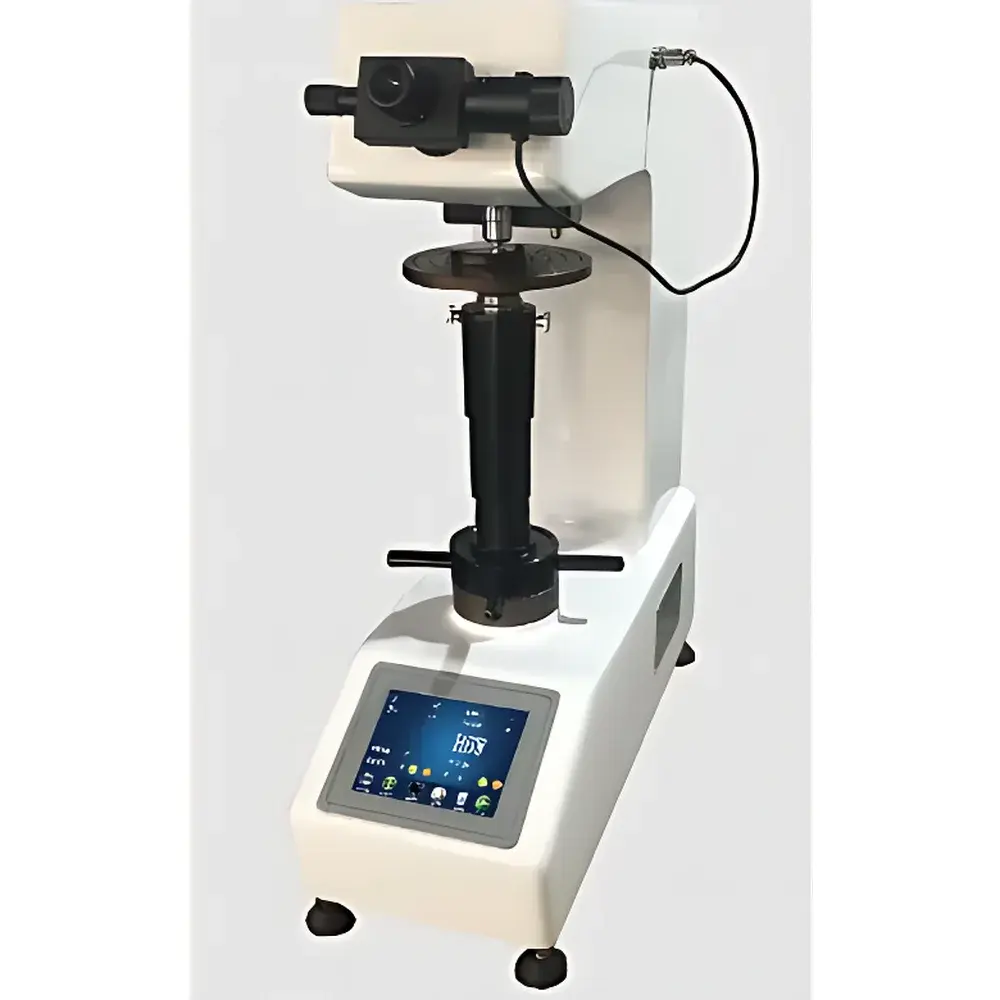
YANRUN HBS-62.5MZ Touchscreen Digital Low-Load Brinell Hardness Tester
| Brand | YANRUN |
|---|---|
| Origin | Shanghai, China |
| Manufacturer Type | Manufacturer |
| Product Category | Domestic |
| Model | HBS-62.5MZ |
| Instrument Type | Brinell Hardness Tester |
| Measurement Range | 4–650 HBW |
| Total Test Forces | 1 kgf, 2.5 kgf, 5 kgf, 10 kgf, 15.625 kgf, 25 kgf, 30 kgf, 31.25 kgf, 62.5 kgf |
| Test Space | 220 mm (H) × 130 mm (D) |
| Indentation Measurement Magnification | 50×, 100× |
| Dwell Time | 0–60 s (adjustable in 1 s increments) |
| Hardness Scale Conversions | 14 scales (HRA, HRB, HRC, HRD, HEF, HV, HK, HBW, HR15N, HR30N, HR45N, HR15T, HR30T, HR45T) |
| Compliance | GB/T 230.2, JJG 112 |
| Built-in Thermal Printer | Yes |
| Net Weight | ~40 kg |
| Dimensions (L×W×H) | 520 × 190 × 650 mm |
| Power Supply | AC 220 V / 50 Hz |
Overview
The YANRUN HBS-62.5MZ is a fully automated, touchscreen-operated low-load Brinell hardness tester engineered for precision, repeatability, and compliance in quality control laboratories and R&D environments. It implements the standardized Brinell indentation principle—applying a precisely controlled spherical indenter (1 mm, 2.5 mm, or 5 mm tungsten carbide ball) under defined test forces to produce a permanent impression on metallic or hardened polymer surfaces. The resulting indentation diameter is optically measured at 50× or 100× magnification, and hardness values are calculated per ISO 6506-1 and ASTM E10, expressed in HBW (Hardness Brinell with tungsten carbide ball). Unlike traditional dead-weight Brinell systems, the HBS-62.5MZ employs a high-resolution load cell-based closed-loop force control system, eliminating mechanical weights and enabling real-time force monitoring with gram-level resolution. This architecture ensures traceable, stable, and programmable force application—critical for testing thin sections, case-hardened layers, small components, and soft alloys where conventional high-load Brinell methods are unsuitable.
Key Features
- Load cell–based closed-loop force control system with automatic loading, dwell, and unloading—no manual weight handling or calibration drift from mechanical levers.
- 10 standardized Brinell test scales (e.g., HBW 1/1, HBW 2.5/31.25, HBW 5/62.5), covering applications from annealed aluminum to tempered tool steels.
- Capacitive 7-inch full-color touchscreen interface with intuitive icon-driven navigation; all parameters—including test method, applied force, dwell time, and result summary—are displayed in real time.
- Motorized auto-turret with three pre-installed indenters (1 mm, 2.5 mm, 5 mm WC balls), enabling rapid scale switching without manual intervention or re-alignment.
- Integrated digital optical measurement system with dual magnifications (50× and 100×) and on-screen crosshair positioning for repeatable indentation diameter assessment.
- Onboard data processing engine automatically computes mean, max, min, and range for up to 20 sequential readings per test sequence—aligned with ISO 6506-2 statistical reporting requirements.
- Built-in thermal printer provides immediate hard-copy output of test reports, including date/time stamp, operator ID (if configured), test parameters, raw measurements, and calculated HBW values.
Sample Compatibility & Compliance
The HBS-62.5MZ accommodates specimens up to 220 mm in height and 130 mm from indenter center to machine column—supporting standard coupons, machined bars, heat-treated gears, bearing races, and stamped sheet metal parts. Its low-force capability (1–62.5 kgf) makes it suitable for materials with yield strengths below 800 MPa, including non-ferrous metals (copper, brass, zinc alloys), aluminum extrusions, sintered metals, and case-hardened surfaces with effective case depths ≥ 0.3 mm. The instrument conforms to national verification regulations JJG 112 and performance standards GB/T 230.2 for Rockwell/Brinell testers. While not inherently 21 CFR Part 11 compliant out-of-the-box, its deterministic force control, timestamped internal storage, and audit-ready printed reports support GLP/GMP-aligned workflows when deployed with documented SOPs and periodic third-party verification.
Software & Data Management
All hardness measurements are stored internally with metadata (test date, time, operator code, force, dwell duration, scale, indenter size, and raw indentation diameters). Data export is supported via USB flash drive in CSV format for post-processing in Excel or LIMS integration. The embedded firmware supports user-defined test templates—ideal for recurring QC checks across production lots. No external PC is required for operation; however, optional PC software (available upon request) enables advanced statistical process control (SPC) charting, histogram generation, and report customization compliant with ISO/IEC 17025 documentation requirements.
Applications
- Quality assurance of incoming raw materials (e.g., aluminum billets, copper rods) per ASTM B164 or EN 10204 3.1 certificates.
- Verification of heat treatment uniformity across batch-furnace loads—particularly for carburized or nitrided components where surface hardness gradients must be validated.
- Hardness profiling of thin-walled tubing and micro-machined parts where Vickers or Knoop may induce cracking or substrate deformation.
- Routine inspection in automotive Tier-1 suppliers for suspension bushings, brake caliper housings, and transmission synchronizer rings.
- Educational use in metallurgy labs for comparative study of work hardening, annealing effects, and alloy composition–hardness relationships.
FAQ
What Brinell standards does the HBS-62.5MZ comply with?
It adheres to ISO 6506-1 (test method), ISO 6506-2 (verification), GB/T 230.2 (Chinese national verification regulation), and JJG 112 (metrological verification procedure for hardness testers).
Can the instrument perform hardness conversions?
Yes—it supports automatic conversion across 14 scales (HRA, HRB, HRC, HV, HK, HRN, HRT series, etc.) based on ASTM E140 empirical correlations, with user-selectable reference tables.
Is calibration traceability provided?
The unit ships with two certified Brinell reference blocks (HBW 10/3000 and HBW 5/750), each accompanied by a traceable calibration certificate issued by an accredited Chinese metrology institute (CNAS-recognized).
How is force accuracy maintained over time?
The load cell undergoes automatic zero-point compensation at startup and supports periodic user-initiated recalibration using certified deadweight standards—procedures documented in the operator manual per ISO/IEC 17025 clause 6.5.
Does the system support network connectivity or remote diagnostics?
No Ethernet or Wi-Fi interface is built-in; however, USB host functionality enables firmware updates and data offload. Remote support is available via secure screen-sharing during scheduled maintenance windows.



