
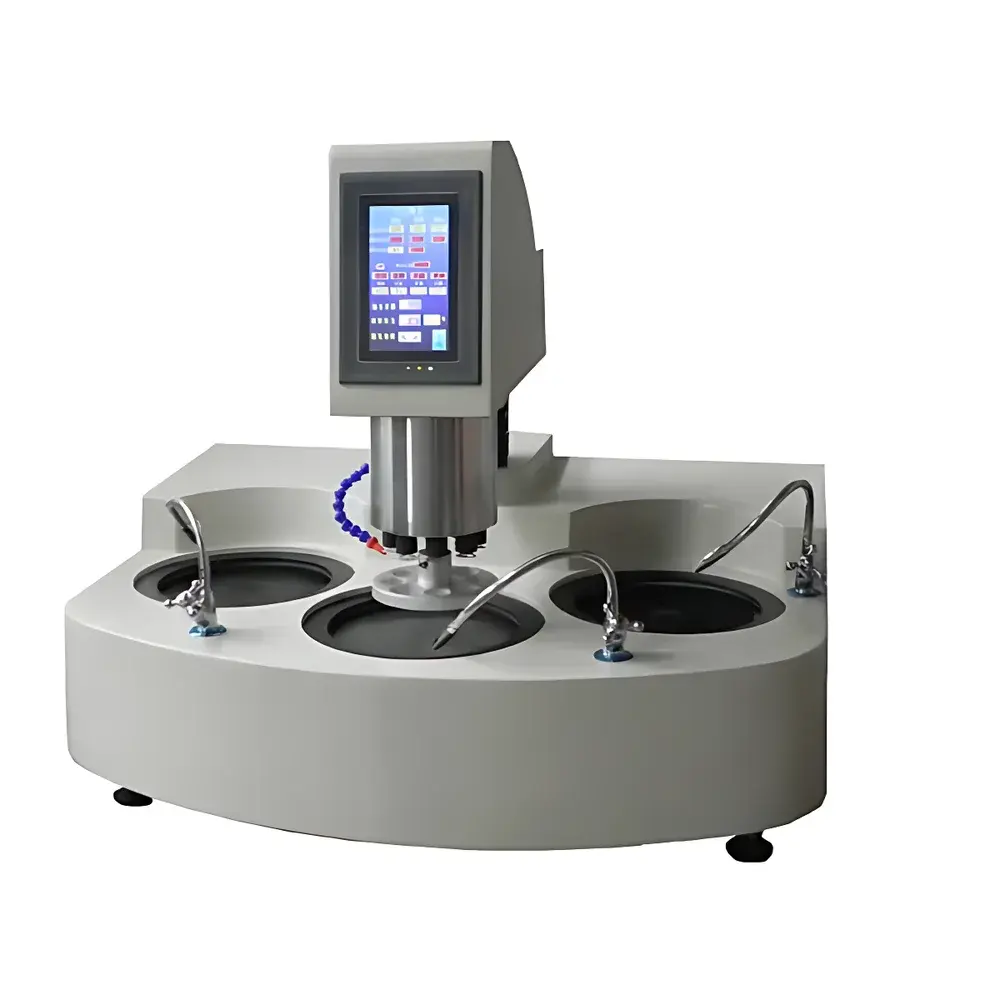
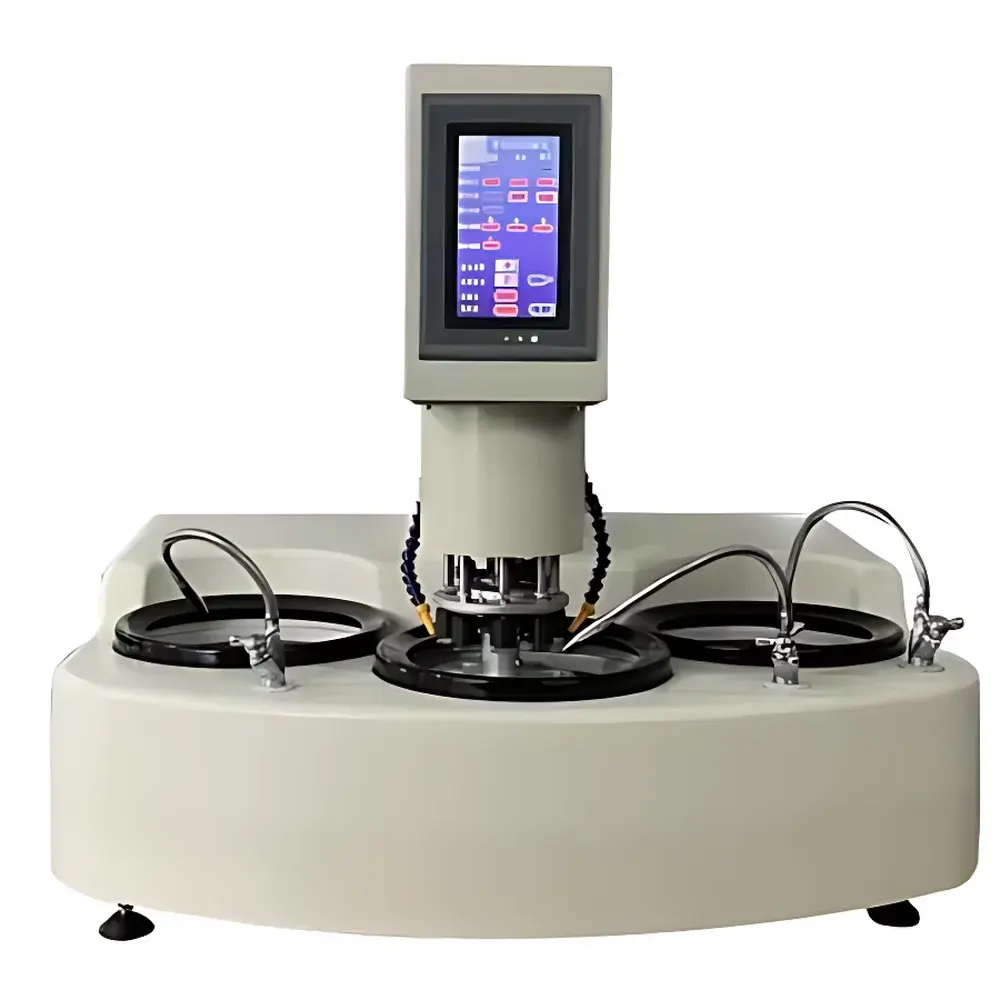
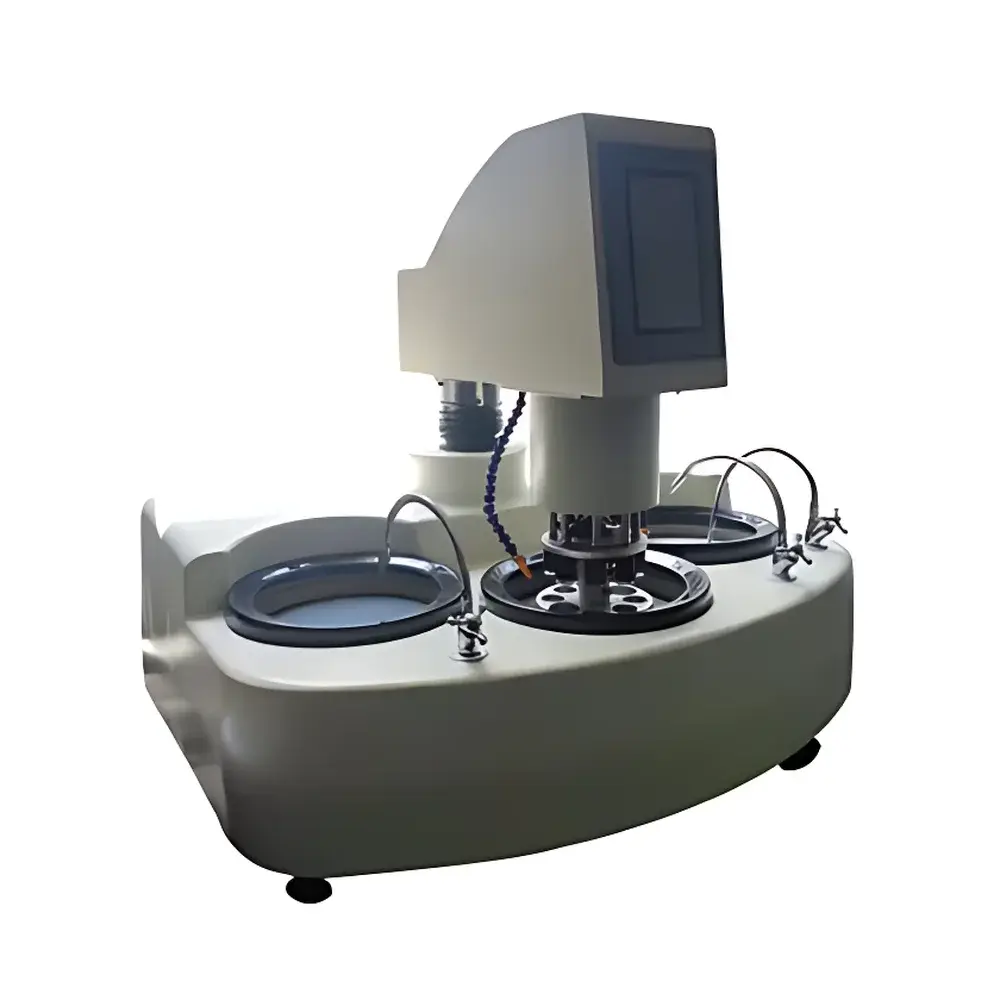
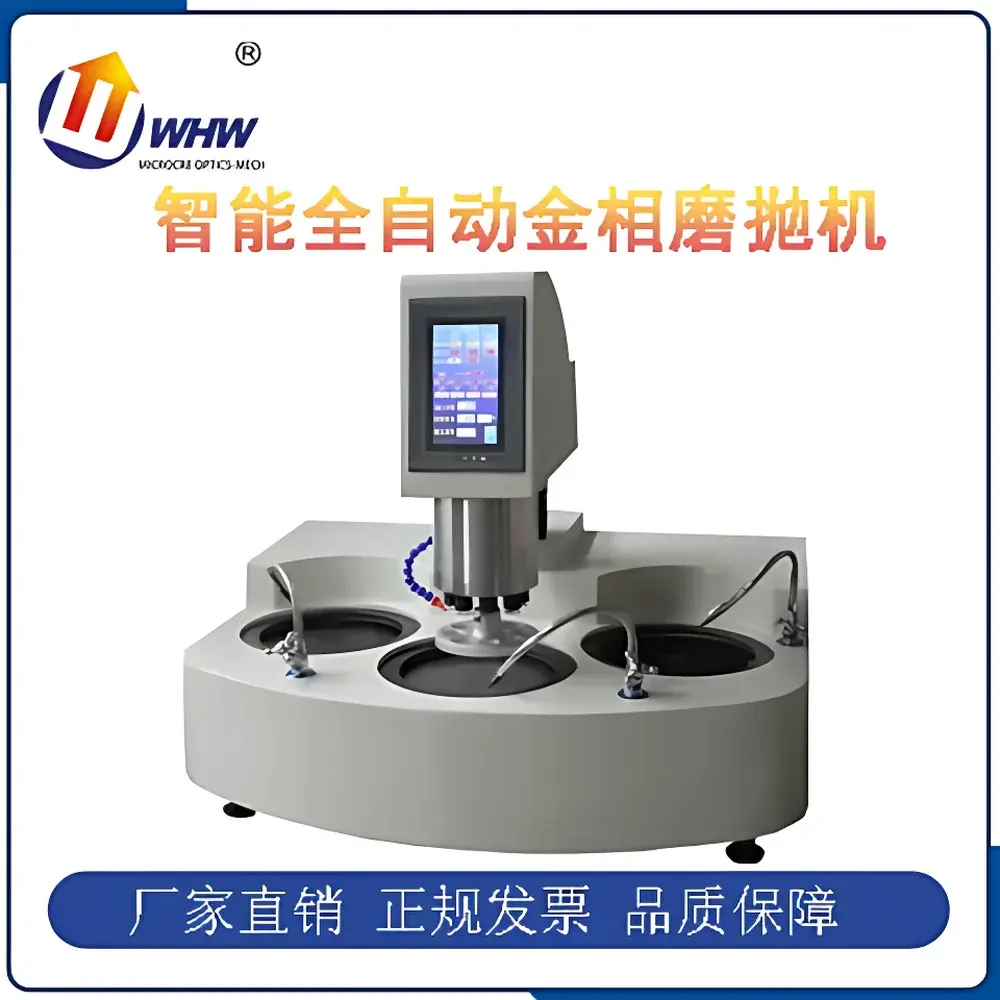
YANRUN ZMP-3000 Fully Automated Metallographic Grinding and Polishing System
| Brand | YANRUN |
|---|---|
| Origin | Shanghai, China |
| Manufacturer Type | Direct Manufacturer |
| Model | ZMP-3000 |
| Price | USD 17,800 (approx.) |
| Speed Range | 20–160 rpm (infinitely variable) |
| Grinding/Polishing Disc Diameter | 230 mm |
| Number of Discs | 3 (2 polishing + 1 grinding) |
| Sample Capacity | 8 specimens (6 × 30 mm + 2 × 40 mm mounting holes) |
| Dimensions (L×W×H) | 950 mm × 720 mm × 800 mm |
| Power Supply | 220 V / 50 Hz |
| Total Motor Power | 3 × 550 W |
| Pressure Control | Pneumatic (single-point: 1–40 N × 8 |
| center load | 300 N) |
| Cooling | Integrated water-cooling system with programmable spray timing (0.1 s resolution) |
| Lubricant Dispensing | Programmable dual-channel auto-dosing (interval & duration adjustable from 0.1 s) |
| Control Interface | 8-inch color touchscreen PLC controller |
| Predefined Protocols | 100 user-storable grinding-polishing programs |
| Operating Modes | Fully automatic, semi-automatic, manual |
| Sample Processing Time | 0–9999 s per stage (×3 stages) |
Overview
The YANRUN ZMP-3000 Fully Automated Metallographic Grinding and Polishing System is an industrial-grade, benchtop tri-disc instrument engineered for high-reproducibility specimen preparation in metallurgical, materials science, and failure analysis laboratories. It implements a closed-loop pneumatic pressure control architecture combined with synchronized rotational motion and precision fluid delivery to execute standardized metallographic sample preparation—compliant with ASTM E3, ISO 16350, and EN 10365—without operator intervention. The system performs sequential material removal (grinding), intermediate smoothing (fine grinding), and surface finish optimization (polishing) in a single automated cycle. Each stage is governed by independently programmable parameters—including rotational speed, applied load, dwell time, coolant flow rate, and abrasive suspension dosing—ensuring strict adherence to GLP/GMP-aligned documentation requirements. Its modular disc configuration supports interchangeable consumables (SiC papers, diamond-impregnated discs, woven cloths, colloidal silica suspensions), enabling adaptation across ferrous alloys, non-ferrous metals, ceramics, composites, and geological specimens.
Key Features
- Fully automated three-stage workflow: grinding → fine grinding → polishing—with seamless, tool-free disc mode switching via motorized head translation.
- Pneumatic dual-pressure system delivering precise, repeatable loads: 1–40 N per specimen (8-position holder) plus 300 N centralized force for uniform planar contact.
- 8-inch industrial-grade touchscreen HMI with PLC-based logic control, supporting real-time parameter monitoring, alarm logging, and audit-trail-capable operation history export (CSV).
- Programmable dual-channel dispensing module for abrasives and lubricants—adjustable dosing interval and duration down to 0.1-second resolution.
- Integrated water-cooling circuit with pressure-regulated spray nozzles, synchronized to rotation phase to prevent thermal distortion and edge rounding.
- 100-user-programmable protocols stored in non-volatile memory, each defining speed profiles, pressure ramps, stage durations, and fluid delivery sequences.
- Modular specimen holder accommodating up to eight 30 mm or 40 mm mounted samples simultaneously—compatible with standard hot-mounting resins (epoxy, phenolic, acrylic).
Sample Compatibility & Compliance
The ZMP-3000 accommodates a broad spectrum of conductive and non-conductive solid specimens, including but not limited to carbon steels, stainless alloys, aluminum and titanium grades, tungsten carbide, silicon nitride, alumina ceramics, graphite composites, and mineral thin sections. Its pressure-controlled, low-shear polishing architecture minimizes relief artifacts and subsurface deformation—critical for quantitative microstructural analysis per ASTM E112 (grain size), ASTM E1245 (inclusion rating), and ISO 643 (steel cleanliness). All operational parameters are traceable and exportable, satisfying documentation prerequisites for ISO/IEC 17025-accredited testing labs and FDA 21 CFR Part 11–aligned quality systems. The unit complies with CE machinery directive 2006/42/EC and IEC 61000-6-2/6-4 electromagnetic compatibility standards.
Software & Data Management
The embedded PLC firmware provides deterministic real-time control with millisecond-level timing resolution for all mechanical and fluidic actuators. The HMI interface supports multilingual operation (English, German, Japanese, Chinese) and enables protocol cloning, parameter scaling, and batch-run scheduling. Operational logs—including start/stop timestamps, executed program ID, actual vs. setpoint deviations (speed ±0.5%, pressure ±1.2 N), and fluid dispense counts—are timestamped and retained for ≥12 months. Data export is supported via USB 2.0 port in CSV format, compatible with LIMS integration and statistical process control (SPC) platforms. Optional Ethernet/IP connectivity enables remote diagnostics and centralized fleet management across multi-instrument lab environments.
Applications
- Routine QC/QA metallography in foundries, forging plants, and aerospace component suppliers.
- Research-scale microstructure characterization for alloy development, heat treatment validation, and corrosion resistance assessment.
- Forensic metallurgy and failure analysis requiring artifact-free cross-sections of weld zones, fatigue cracks, or intergranular attack regions.
- Geological petrography where preservation of brittle mineral phases (e.g., quartz, feldspar) demands minimal mechanical stress during polishing.
- Electronics packaging R&D involving copper-tungsten composites, solder joint intermetallic layer analysis, and die-attach interface evaluation.
FAQ
Does the ZMP-3000 support ASTM E3-compliant preparation cycles?
Yes—its programmable stage sequencing, pressure calibration traceability, and coolant synchronization meet all procedural requirements defined in ASTM E3 Annex A1 for plane grinding and polishing.
Can the system be integrated into a laboratory information management system (LIMS)?
Yes—via USB-exported CSV logs containing full parameter sets and execution metadata; optional Modbus TCP gateway available for direct SCADA/LIMS interfacing.
What is the maximum allowable specimen height for clamping?
The standard holder accepts specimens up to 35 mm in height; custom-height adapters are available upon request.
Is validation documentation (IQ/OQ/PQ) provided with the instrument?
Factory-issued IQ/OQ protocols are included; PQ templates aligned with ISO 17025 Clause 6.4.10 are supplied for on-site performance qualification.
How frequently does the pneumatic pressure system require recalibration?
Annual verification using NIST-traceable deadweight tester is recommended; internal self-diagnostic routines flag drift exceeding ±2% full scale.



