
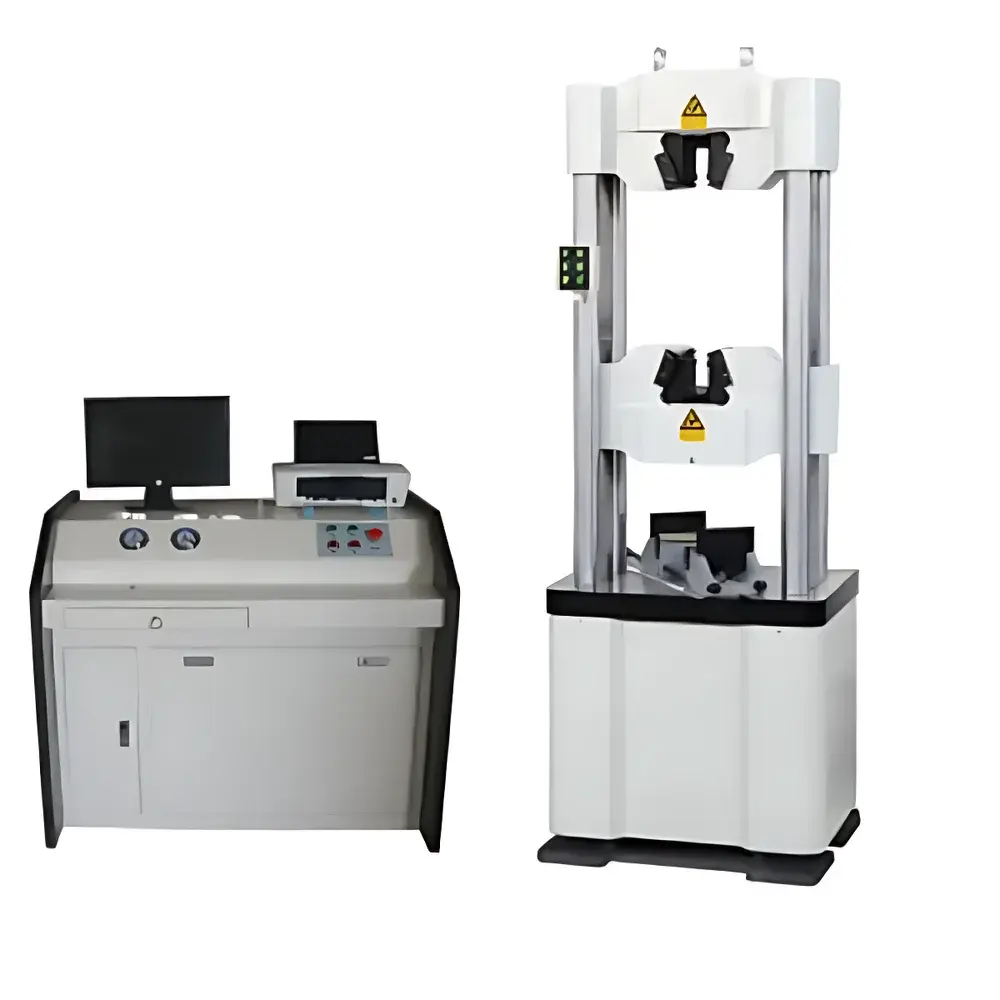
YANRUN WEW-1000D Microcomputer-Controlled Electro-Hydraulic Servo Universal Testing Machine
| Brand | YANRUN |
|---|---|
| Origin | Shanghai, China |
| Manufacturer Type | Direct Manufacturer |
| Country of Origin | China |
| Model | WEW-1000D |
| Instrument Type | Electro-Hydraulic Servo Testing Machine |
| Max. Test Load | 1000 kN |
| Accuracy Class | Class 1 (per GB/T 228.1 & ISO 6892-1) |
| Max. Tensile Space | 620 mm |
| Max. Compression Space | 520 mm |
| Flat Specimen Gripping Range | 0–40 mm |
| Round Specimen Gripping Range | Φ13–Φ60 mm |
| Compression Platen Diameter | Φ204 mm |
| Column Spacing | 510 mm |
| Bend Support Roller Spacing | 40–500 mm |
| Bend Punch Diameter | Φ40 mm |
| Piston Stroke | 250 mm |
| Indicated Value Relative Error | ±1% |
| Gripping Method | Hydraulic Clamping |
| Oil Pump Motor Power | 2.2 kW |
| Crosshead Drive Motor Power | 0.55 kW |
| Mainframe Dimensions (W×D×H) | 890×700×2300 mm |
| Control Cabinet Dimensions (W×D×H) | 1020×620×810 mm |
| Weight | 3800 kg |
Overview
The YANRUN WEW-1000D is a microcomputer-controlled electro-hydraulic servo universal testing machine engineered for high-force static mechanical property evaluation of metallic, composite, and high-strength non-metallic materials. It operates on the principle of closed-loop hydraulic force control, where a precision servo valve modulates high-pressure oil flow to actuate the main piston, enabling precise load application up to 1000 kN. The system complies with international standards including ISO 6892-1 (tensile testing), ISO 7500-1 (calibration of force-proving instruments), ASTM E4 (load verification), and GB/T 228.1 (Chinese national standard for metallic materials tensile testing). Designed for structural integrity validation in R&D labs, quality control departments, and third-party certification centers, the WEW-1000D delivers Class 1 accuracy per ISO 7500-1 and GB/T 228.1, ensuring traceable, repeatable, and auditable test results under GLP and pre-GMP environments.
Key Features
- Electro-hydraulic servo architecture with dual-circuit pressure regulation for stable load control and minimal hysteresis during cyclic or creep testing
- Hydraulically actuated wedge-type grips with self-aligning jaw geometry, ensuring uniform stress distribution across flat (0–40 mm) and round (Φ13–Φ60 mm) specimens
- Adjustable three-point bending fixture with 40–500 mm support span and standardized Φ40 mm punch for ISO 7438 and ASTM E290 compliance
- Dual-sensor force measurement: primary load cell (oil pressure transducer) backed by calibrated reference verification path for redundancy and long-term stability
- Integrated crosshead displacement feedback via high-resolution draw-wire encoder (±0.01 mm resolution), synchronized with load acquisition at ≥1 kHz sampling rate
- Modular accessory system supporting tensile, compression, bending, and shear configurations — all mechanically interlocked for rapid tool-free reconfiguration
- Rigid C-frame construction (3800 kg mass) with 510 mm column spacing and optimized moment resistance, minimizing deflection under full-load eccentric loading
Sample Compatibility & Compliance
The WEW-1000D accommodates standardized specimen geometries per ISO 6892-1 (e.g., gauge lengths of 50 mm or 80 mm), ASTM E8/E21 (tensile bars), and ISO 37 (rubber tensile strips). Its Φ204 mm compression platen meets ISO 3187 requirements for concrete and masonry testing, while the spherical seat assembly ensures automatic alignment per ASTM C39. All gripping systems are validated for yield strength >1200 MPa materials. The machine is fully compatible with ISO/IEC 17025-accredited calibration protocols and supports audit-ready documentation for FDA 21 CFR Part 11-compliant environments when paired with optional electronic signature modules and secure user access controls.
Software & Data Management
The embedded test control software runs on an industrial-grade Windows-based PC and provides real-time force–displacement–time curve visualization, multi-channel data logging (load, displacement, strain via extensometer input), and automated report generation in PDF/Excel formats. It supports ASTM E1823-defined fracture toughness parameters (KIc, J-integral) when configured with clip-on extensometers. Data export conforms to ASTM E1432 (standard practice for digital data recording) and includes full metadata tagging (operator ID, environmental conditions, calibration certificate IDs). Audit trails record all parameter changes, test start/stop events, and user logins—retained for ≥18 months per GLP retention policies.
Applications
- Tensile characterization of structural steels, high-strength alloys, and welded joints per ISO 6892-1 and ASTM A370
- Compression testing of cast iron, concrete cylinders, and ceramic tiles per ISO 13314 and ASTM C39/C109
- Transverse rupture strength evaluation of sintered metal powders and advanced ceramics using three-point bending per ISO 3325
- Proof load verification for anchor bolts, lifting shackles, and fasteners per ISO 898-1 and ASTM F568M
- Creep and stress relaxation studies under constant load with extended dwell capability (up to 999 hours)
- Calibration transfer verification for secondary standards laboratories requiring Class 1 force metrology infrastructure
FAQ
What standards does the WEW-1000D comply with for force calibration?
It conforms to ISO 7500-1:2018 (static calibration of uniaxial testing machines) and GB/T 228.1-2021, with optional NIST-traceable load cell certification available.
Can the system perform closed-loop strain control?
Yes — when equipped with an ASTM E83-compliant clip-on extensometer (included), it enables displacement- and strain-controlled testing modes with PID tuning.
Is remote diagnostics supported?
The control cabinet features Ethernet port and RS-232 interface; OEM-level remote troubleshooting is enabled via secure VPN with prior authorization.
What maintenance intervals are recommended for hydraulic components?
Oil filtration and replacement every 2,000 operating hours; servo valve inspection every 5,000 hours; annual load cell recalibration required per ISO/IEC 17025.
Does the software support multi-language UI and report templates?
English and Chinese UI are standard; customizable report templates (including company logo, QA stamp fields, and bilingual annotations) are configurable within the software editor.
Related Products



